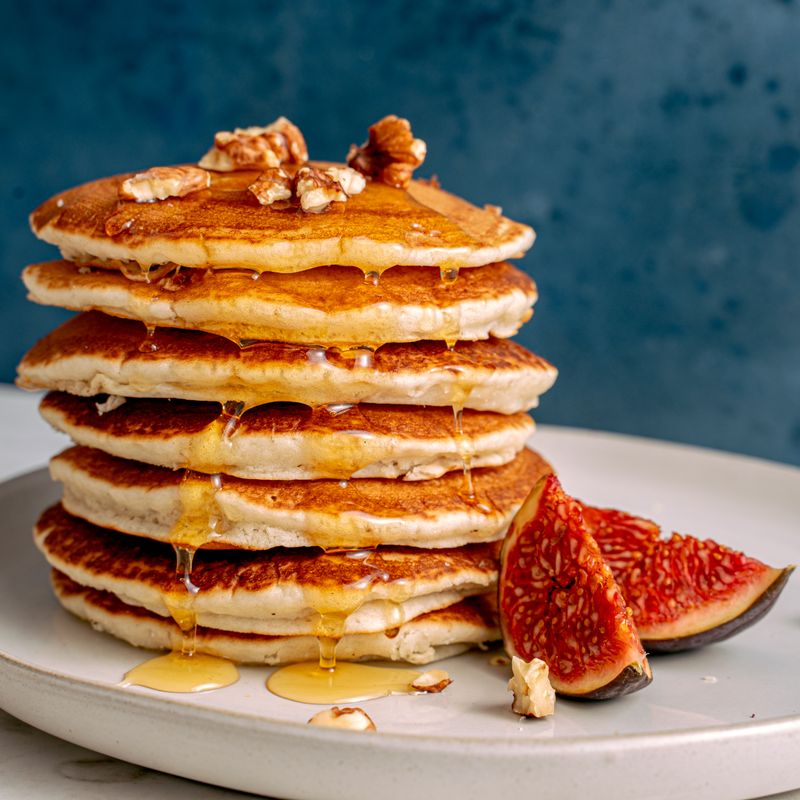
Quick Semolina Pancakes with Honey and Nuts
These tender, naturally sweet semolina pancakes come together in minutes without any leavening agent. Yogurt keeps them moist and slightly tangy while semolina gives them a delicate, slightly gritty texture that's distinctly Middle Eastern. Serve warm with drizzled honey and toasted walnuts for a breakfast or dessert that feels indulgent but comes together faster than you'd expect.
Steps
Before you start
- Have all ingredients measured and ready—the batter comes together very quickly
- Toast the walnuts in a dry skillet over medium-low heat for 2–3 minutes, then chop roughly; set aside
- If your griddle or skillet hasn't been used recently, wipe it with a damp cloth and dry it thoroughly
Mix dry ingredients
- In a large mixing bowl, whisk together the semolina, all-purpose flour, baking powder, salt, and cinnamon if using.
- Make sure there are no lumps of baking powder.
- Set aside.
+ Show details− Hide details
Ready when: No lumps visible in the dry mixture
Tip: Semolina can clump; whisking the dry ingredients well prevents pockets of raw flour in the pancakes.
Combine wet ingredients
- In a medium mixing bowl, whisk together the yogurt, eggs, milk, vanilla extract, and melted butter until smooth and fully combined with no streaks of egg white.
+ Show details− Hide details
Ready when: Mixture is pale, smooth, and completely homogeneous
Tip: Room-temperature eggs and yogurt blend more easily without creating lumps.
Make the batter
- Pour the wet ingredients into the dry ingredients and stir with a whisk or wooden spoon until just combined.
- The batter should be thick and pourable, like a thin pancake batter—slightly thicker than crepe batter but thinner than traditional pancake batter.
- Do not overmix; a few small lumps are fine and will cook out.
+ Show details− Hide details
Ready when: Batter is smooth with no streaks of dry ingredients
Tip: Overmixing the batter will make the pancakes tough; stop as soon as the dry ingredients disappear.
Heat the griddle
- Place a 10–12 inch (25–30 cm) nonstick griddle or large skillet over medium heat.
- Let it warm for 2–3 minutes until a drop of water sizzles gently on the surface.
- Lightly brush with melted butter.
+ Show details− Hide details
Ready when: A droplet of water sizzles gently and evaporates in 2–3 seconds
Tip: Too hot and the outside will brown before the inside cooks; too cool and the pancakes will be rubbery.
Cook first batch of pancakes
- Pour 4 separate ¼-cup (60 ml) portions of batter onto the griddle, spacing them 2 inches (5 cm) apart.
- Cook for 2–3 minutes until the edges look set and the top surface shows tiny bubbles forming.
- The bottom should be light golden.
- Flip carefully with a spatula.
+ Show details− Hide details
Ready when: Edges are opaque, bubbles form on top, bottom is light golden
Tip: Don't flip too early; wait until bubbles form on top and the bottom lifts easily without sticking.
Finish first batch
- Cook the flipped pancakes for 1–2 minutes until the second side is light golden and springs back slightly when gently pressed.
- Transfer to a warm plate and cover loosely with foil to keep warm while you cook the remaining 4 pancakes.
+ Show details− Hide details
Ready when: Second side is light golden; pancake springs back when pressed
Tip: Covering with foil keeps the pancakes warm without trapping steam that makes them soggy.
Cook second batch
- Lightly brush the griddle with melted butter again.
- Pour 4 more ¼-cup (60 ml) portions of batter.
- Cook for 2–3 minutes on the first side until edges are set and the top shows bubbles, then flip and cook for 1–2 minutes on the second side until light golden.
+ Show details− Hide details
Ready when: Pancakes are light golden on both sides and spring back when pressed
Tip: If the griddle seems too hot or the pancakes brown too quickly, lower the heat slightly.
Serve with honey and nuts
- Stack the warm pancakes on serving plates.
- Drizzle generously with honey (use about 2 tablespoons per pancake stack) and scatter the toasted walnuts over the top.
- If using, sprinkle with chopped pistachios for color and extra crunch.
- Serve immediately while the pancakes are still warm.
+ Show details− Hide details
Tip: Warm the honey in a small saucepan for 1 minute over low heat to make it drizzle more smoothly, or thin it with 1 teaspoon of warm water.
Good to know
Tips
- Toast the walnuts yourself for the best flavor—raw walnuts can taste slightly bitter, but toasting brings out their natural sweetness.
- Semolina is finer than cornmeal, so don't substitute without adjusting texture expectations; fine semolina gives these pancakes their characteristic delicate bite.
- If your batter is too thick after mixing, thin it with 1–2 tablespoons of milk; if it's too thin, let it rest for 5 minutes as the semolina will absorb some liquid.
- These pancakes are best served hot. If making ahead, warm them gently in a low oven (300°F / 150°C) for 8 minutes before adding honey and nuts.
Make ahead
You can prepare the dry ingredient mixture up to 2 days ahead and store it in an airtight container. Mix the wet ingredients fresh just before cooking; the batter is best used right away but can sit at room temperature for up to 30 minutes if needed.
Storage & reheating
Store cooled pancakes in an airtight container at room temperature for up to 1 day. Refrigerate for up to 2 days. Freeze in a single layer on a baking sheet, then transfer to a freezer bag for up to 3 months. Reheat frozen pancakes in a 325°F (160°C) oven for 8–10 minutes, or warm gently in a nonstick skillet over medium-low heat for 1–2 minutes per side. Serve with fresh honey and nuts for best texture.
Substitutions
- plain full-fat yogurt → sour cream or Greek yogurt (thin Greek yogurt with 1–2 tablespoons of milk if it's very thick). Both give a tangier flavor and slightly thicker batter; adjust milk quantity as needed to reach the right consistency.
- walnuts → almonds, pecans, or a mix of hazelnuts and walnuts. Toast the same way and chop to similar size; almonds will give a milder flavor.
- honey → date syrup, maple syrup, or agave nectar. Date syrup is traditional in many Middle Eastern cuisines and carries a deeper molasses-like sweetness; maple syrup will give a different but still delicious character.
- fine semolina → cornmeal or polenta (use the same amount). This will give a slightly coarser, grainier texture and a different flavor profile; the pancakes will be less delicate but still tender.
More pancakes & waffles
See all →

Find more like this
- Meal
- Breakfast
- Cuisine
- Middle Eastern
- Diet
- VegetarianHalal
- Method
- Stovetop