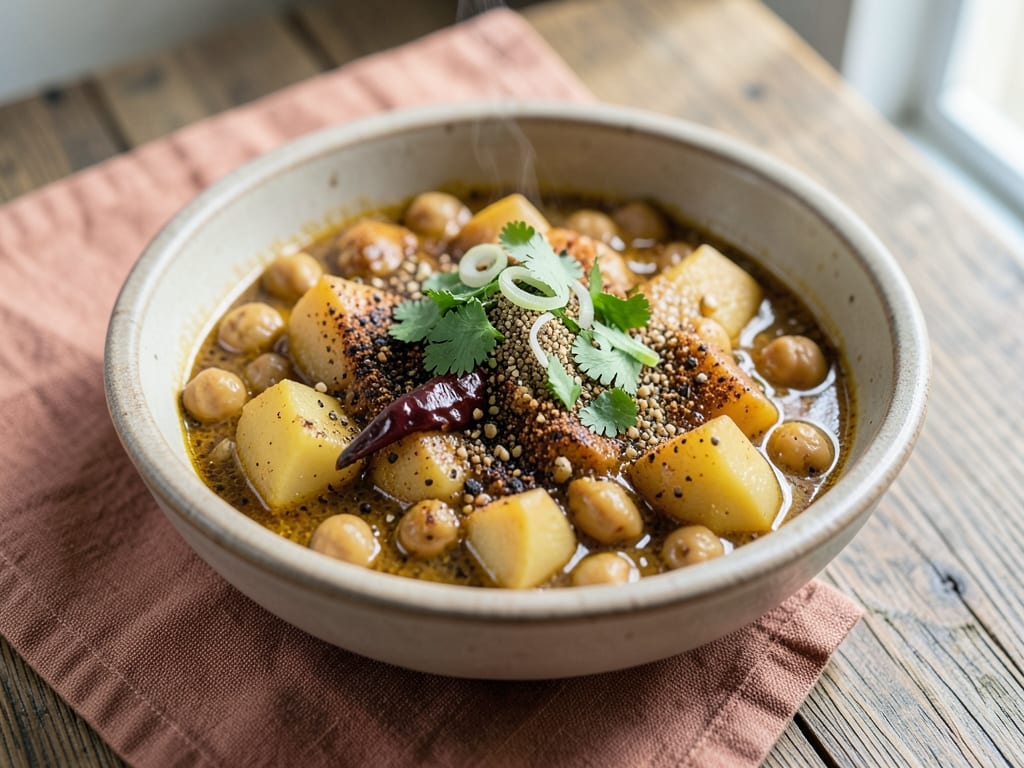
Puerto Rican Mofongo Sandwich
This savory Puerto Rican sandwich features layers of crispy-edged mofongo (garlicky mashed fried plantains) stacked with pan-fried seasoned shrimp, fresh garlic aioli, cilantro, and avocado. A hearty, flavorful main course that combines the comfort of golden-fried plantains with succulent, well-seasoned shrimp. Eaten with a fork and knife, it's an authentic taste of Puerto Rican cuisine.
- Prep
- 20 min
- Cook
- 30 min
- Wait
- 5 min
- Total
- 55 min
- Makes
- 4 mofongo sandwiches
Steps
Before you start
- Peel green plantains under cold running water just before frying to prevent the skin from sticking
- Bring the egg yolk and extra-virgin olive oil to room temperature before making the aioli—this is essential for proper emulsification
- Pat the shrimp dry with paper towels before seasoning to ensure they brown properly instead of steaming
- Have all ingredients measured and ready before you begin frying the plantains, as timing moves quickly
Fry plantain rounds until light goldenOven 350°F / 175°C
- Peel the 2 green plantains (you may need to soak them in water for a minute first to soften the skin).
- Cut each into ½-inch thick rounds; you should have about 16–18 rounds.
- Heat the 2½ cups of vegetable oil in a large heavy-bottomed skillet (12-inch / 30 cm) over medium-high heat to 350°F (175°C), about 3–4 minutes.
- Test the oil temperature using a deep fry thermometer or wooden spoon handle—the oil should sizzle steadily around the handle.
- Working in batches of 4–5 pieces to avoid crowding, carefully lay plantain rounds into the hot oil.
- Fry for 3–4 minutes on the first side until the underside turns light golden and slightly crispy at the edges, then flip with a slotted spoon and fry for 2–3 minutes more until both sides are pale golden (not dark brown or burnt).
- Transfer to a paper towel-lined plate to drain.
- Let cool for 2–3 minutes.
+ Show details− Hide details
Ready when: Both sides are pale golden brown with slightly crispy edges; plantains feel soft to the touch but have structural integrity
Tip: Don't overcrowd the pan—this lowers the oil temperature and results in greasy, oil-soaked plantains. Temperature control is critical; too cool and the plantains absorb oil, too hot and they burn before the interior softens.
Mash plantains with garlic and oil
- Place the cooled fried plantain rounds into a mortar and pestle (or a medium bowl if using a wooden spoon).
- Add the 4 whole garlic cloves, ½ teaspoon salt, and ¼ teaspoon black pepper.
- Using the pestle (or wooden spoon), mash vigorously, crushing the plantains and garlic together until you have a chunky, cohesive paste—similar to rustic mashed potatoes, with some texture remaining.
- The garlic should be fully incorporated and no longer visible as distinct cloves.
- Drizzle in 2–3 tablespoons of the hot frying oil from the pan as you mash, working it in completely.
- The mofongo should be creamy and hold together without being stiff or dry.
- Taste and adjust salt and pepper as needed.
+ Show details− Hide details
Ready when: Plantains and garlic fully mashed together into a creamy, chunky paste with no large pieces remaining; mixture holds together
Tip: Leave some texture in the mofongo—if you mash it too smooth, it will fall apart when you try to form cakes. If the mixture is too stiff to mash easily, add another tablespoon of the hot frying oil; if too wet, mash longer to release starch and bind the mixture.
Pan-fry mofongo cakes until crispyOven 350°F / 175°C
- Divide the mofongo into 8 equal portions (about 3–4 tablespoons each).
- Wet your hands or lightly oil them to prevent sticking.
- Form each portion into a thick disk about ¼ inch thick and 3 inches across—they should resemble hockey pucks or thick patties.
- Heat 2 tablespoons of vegetable oil in the same large skillet over medium-high heat (about 350°F / 175°C).
- Carefully lay 4 mofongo cakes into the hot oil, being gentle not to crowd them.
- Fry for 2–3 minutes on the first side until the bottom is golden brown and crispy, then flip carefully with a wide spatula and fry the other side for 2 minutes until both sides have a crispy, dark golden-brown exterior.
- Transfer to a clean paper towel-lined plate to drain.
- Wipe the pan lightly if needed and repeat with the remaining 4 cakes, adding a bit more oil if the pan looks dry.
- Keep the cooked cakes in a warm place while you prepare the shrimp.
+ Show details− Hide details
Ready when: Bottom and top of each cake are golden brown and crispy; a slight sound of crispness is heard when you press the spatula against the cake
Tip: Don't flip too early—let each side build a crust before turning. Work quickly and confidently when flipping to avoid breaking the cakes. Keep finished cakes warm while the others cook; they firm up as they cool and become harder to assemble later.
Cook seasoned shrimp until pink and opaque
- Pat the 1 lb of shrimp dry with paper towels—this ensures they brown properly and don't steam.
- In a small bowl, mix together ½ teaspoon salt, ¼ teaspoon black pepper, ½ teaspoon garlic powder, and 1 teaspoon adobo seasoning (if using).
- Toss the dry shrimp with this seasoning mixture until evenly coated.
- Heat 2 tablespoons of vegetable oil in a large skillet (or wipe out and reuse the previous one) over medium-high heat.
- Once the oil is shimmering, add the seasoned shrimp in a single layer.
- Don't stir immediately—let them cook undisturbed for 2 minutes to develop a golden-brown crust on the underside.
- Stir and toss the shrimp, cooking for another 2–3 minutes until they are completely pink and opaque throughout (no translucent gray areas).
- Squeeze the 1 tablespoon of fresh lemon juice over the shrimp and toss to coat.
- Taste and adjust seasonings.
- Transfer to a plate and let cool slightly, about 1–2 minutes.
+ Show details− Hide details
Ready when: Shrimp are bright pink and completely opaque throughout with no translucent gray areas; they curl slightly into a C-shape
Tip: Don't skip drying the shrimp—wet shrimp will steam rather than brown. Adobo is traditional but optional; you can use just salt, pepper, and garlic if you prefer. Don't overcook shrimp or they'll become rubbery and tough.
Whisk garlic aioli until thick and creamy
- Bring the egg yolk to room temperature if not already done (this ensures proper emulsification).
- In a small bowl, whisk together the room-temperature egg yolk, 2 minced garlic cloves, ¼ teaspoon salt, and 1 tablespoon fresh lemon juice until combined.
- Begin whisking in the ¾ cup of extra-virgin olive oil very slowly, drop by drop at first, whisking constantly.
- As the mixture begins to thicken and emulsify (after you've incorporated about ¼ of the oil), you can add the oil in a thin, steady stream while continuing to whisk.
- If the mixture becomes too thick or breaks (becomes grainy or separates), whisk in 1 tablespoon of room-temperature water to bring it back together.
- Continue whisking in the remaining oil until fully incorporated.
- You should have a creamy, pale yellow aioli that holds stiff peaks when you lift the whisk.
- Taste and adjust salt and lemon juice to your preference.
- (The aioli can be made 2–3 hours ahead and stored in the refrigerator.)
+ Show details− Hide details
Ready when: Mixture is thick, creamy, pale yellow, and holds peaks when the whisk is lifted; no streaks of oil remain
Tip: Room temperature is critical for emulsification—cold ingredients will cause the aioli to break. If the aioli does break (separates into oily and watery layers), start with a fresh egg yolk and slowly whisk in the broken aioli. Don't rush adding the oil, especially at the beginning, or you'll break the emulsion.
Assemble and serve mofongo sandwiches
- Arrange 1 warm mofongo cake on a serving plate or shallow bowl.
- Spread about 1½ tablespoons of garlic aioli across the top.
- Arrange ¼ of the pan-fried shrimp (about 4 oz / 115 g) over the aioli.
- Scatter about 1 tablespoon of fresh cilantro leaves and 2–3 avocado slices over the shrimp.
- (Add 2 tomato slices if using.) Place a second warm mofongo cake on top, pressing very gently—you want it to sit on top of the filling without squashing the shrimp.
- Repeat for the remaining 3 sandwiches.
- Serve immediately with extra aioli on the side.
- Eat with a fork and knife, cutting through both cakes and filling together.
+ Show details− Hide details
Tip: Warm mofongo is best—if your cakes have cooled significantly, you can briefly warm them in a 350°F (175°C) oven for 2–3 minutes before assembly. Work quickly so the mofongo cakes stay warm throughout assembly.
Good to know
Tips
- Oil temperature is crucial for frying: Use a thermometer to maintain 350°F (175°C). Too cool and the plantains absorb oil, making them greasy; too hot and they burn before the interior softens.
- Mash with texture: Leave some chunks in the mofongo for better structural integrity when forming cakes. Think rustic mashed potatoes, not smooth purée.
- Don't overcrowd the pan: Work in batches when frying plantains, cakes, or shrimp to maintain consistent oil temperature and achieve proper browning and crispiness.
- Room temperature is essential for aioli: Cold ingredients will break the emulsion. If it does happen, start fresh and slowly whisk the broken aioli into a new egg yolk for recovery.
Make ahead
The garlic aioli can be made up to 3 hours ahead and stored in the refrigerator. Bring it to room temperature or let it warm slightly before serving. The mofongo cakes are best served warm and freshly made but can be made up to 2 hours ahead and reheated in a 350°F (175°C) oven for 3–4 minutes just before assembly. The shrimp can be cooked 30 minutes ahead and warmed briefly in the skillet if needed.
Storage & reheating
Leftover mofongo cakes can be stored in an airtight container in the refrigerator for up to 3 days. Reheat in a 350°F (175°C) oven for 4–5 minutes until warm and crispy. Garlic aioli keeps refrigerated for up to 4 days. Shrimp should be consumed the same day or stored separately in the refrigerator for up to 2 days. Do not freeze mofongo or aioli. Frozen shrimp can be thawed and reheated before serving.
Substitutions
- adobo seasoning (optional, traditional Puerto Rican seasoning) → ½ tsp smoked paprika + ¼ tsp dried oregano + ¼ tsp ground cumin. Mix together to replicate the traditional Puerto Rican adobo flavor profile if adobo is unavailable
- large shrimp (16-20 count), peeled and deveined → medium shrimp (21–30 count), peeled and deveined. Reduce cooking time to 3–4 minutes total, as medium shrimp cook slightly faster than large shrimp
- large egg yolk, at room temperature → ½ teaspoon Dijon mustard mixed with a splash of lemon juice, used instead of the egg yolk. Emulsify with the olive oil to make a mustard-based aioli if you prefer to avoid raw eggs. It will be slightly less creamy but still delicious and flavorful
- avocado, ripe → ripe mango, papaya, or sautéed red bell peppers and onions. Adjust toppings based on availability and season; mango and papaya add tropical sweetness, while sautéed peppers and onions add savory depth