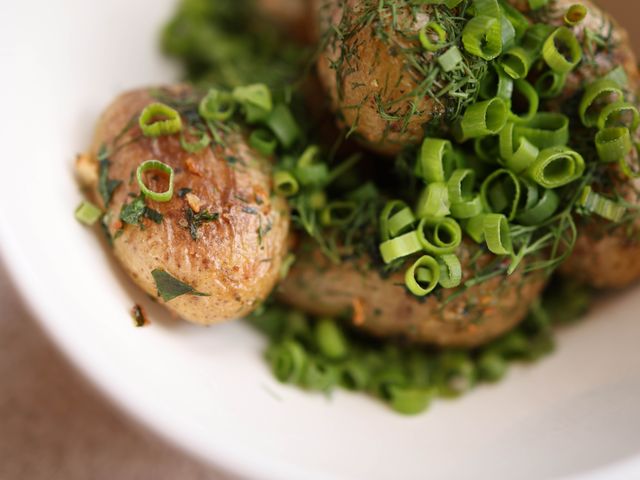
Potatoes with Chermoula and Preserved Lemon
Crispy roasted potatoes tossed with a bright North African herb sauce (chermoula) made from cilantro, parsley, garlic, cumin, and paprika, finished with thinly sliced preserved lemon for a salty, complex tang. A vibrant side dish that works equally well alongside grilled fish, chicken, or as part of a vegetable-forward meal.
Steps
Before you start
- Preheat your oven to 425°F (220°C)
- Have a sharp knife ready for slicing the preserved lemon
- If your cilantro and parsley are damp, dry them thoroughly to make the chermoula
Roast the potatoesOven 425°F / 220°C
- Place the halved potatoes on a large rimmed baking sheet.
- Drizzle with 3 tablespoons of olive oil and sprinkle with ¾ teaspoon kosher salt and ½ teaspoon black pepper.
- Toss well to coat evenly.
- Spread them in a single layer, cut side down.
- Roast in a preheated 425°F (220°C) oven for 30–35 minutes, stirring once halfway through, until the cut sides are deep golden brown and the potatoes are tender when pierced with a fork.
+ Show details− Hide details
Ready when: Cut sides are deep golden brown and flesh is tender when pierced
Tip: Don't stir too early—let the potatoes sit undisturbed for the first 15–18 minutes so they develop a crispy, caramelized exterior.
Make the chermoula
- While the potatoes roast, make the chermoula.
- In a food processor or blender, combine the chopped cilantro, parsley, peeled garlic cloves, ground cumin, sweet paprika, and red pepper flakes if using.
- Pulse until the herbs and garlic break down into a coarse paste, about 1 minute.
- Add 3 tablespoons of olive oil and 1 tablespoon of fresh lemon juice.
- Pulse again just to combine.
- Season with ½ teaspoon kosher salt.
- Transfer to a small bowl.
- The chermoula should be textured and bright green; do not over-blend into a smooth purée.
+ Show details− Hide details
Ready when: Mixture is coarse and textured, not smooth, with visible herb pieces
Tip: Keep the chermoula fresh and vibrant by blending it just before using and not over-processing; you want a chunky herb paste, not a smooth paste.
Prepare the preserved lemon
- While the potatoes finish roasting, prepare the preserved lemon.
- Rinse it under cool water and gently rub to remove any excess salt on the outside.
- Halve it lengthwise and scoop out and discard the seeds inside.
- Using a sharp knife, thinly slice the flesh and rind crosswise into strips about ⅛ inch (3 mm) wide.
- You should have roughly 3–4 tablespoons of sliced preserved lemon.
+ Show details− Hide details
Ready when: Preserved lemon is cut into thin, uniform strips with no seeds visible
Tip: Rinsing the preserved lemon removes excess salt, but these preserves are naturally very salty, so taste as you go when seasoning the final dish.
Combine and finish
- As soon as the potatoes come out of the oven, transfer them to a large bowl.
- While they are still warm, add all of the chermoula and most of the sliced preserved lemon (reserve a few pieces for garnish).
- Using tongs or two spoons, gently toss everything together, being careful not to break up the potatoes.
- The warmth of the potatoes will release the aromatics in the chermoula.
- Taste and adjust the seasoning if needed—you may want a pinch more salt depending on the saltiness of your preserved lemon, or a squeeze more fresh lemon juice for brightness.
+ Show details− Hide details
Ready when: Potatoes are coated in bright green chermoula with visible preserved lemon pieces throughout
Tip: Toss while the potatoes are still hot so they absorb the flavors; if you wait until they cool, the dish will taste more muted.
Serve
- Transfer the potatoes to a serving dish.
- Scatter the reserved sliced preserved lemon and fresh cilantro leaves over the top.
- Serve warm or at room temperature.
+ Show details− Hide details
Tip: This dish is excellent served warm straight from the oven, but it also makes a great room-temperature side dish or component of a grain or vegetable plate.
Good to know
Tips
- Preserved lemons are a staple of North African cooking and are increasingly available in specialty markets and online; if you cannot find them, the lemon-zest substitution works in a pinch, though the flavor will be brighter than salty-funky.
- For best results, use small-to-medium potatoes so they roast evenly and can be coated with the chermoula quickly while still warm.
- The chermoula can also be made with a mortar and pestle if you prefer a more textured, chunky result; blend only until the herbs are broken down but still show some texture.
- Serve these potatoes alongside grilled fish (especially halibut or branzino), roasted chicken, or lamb tagine, or as part of a mixed vegetable platter with hummus and flatbread.
Make ahead
You can make the chermoula up to 4 hours ahead; store it in an airtight container in the refrigerator. Bring it to room temperature and give it a stir before tossing with the potatoes. The potatoes are best roasted and tossed just before serving, but leftovers can be reheated gently.
Storage & reheating
Store leftovers in an airtight container in the refrigerator for up to 3 days. Reheat gently in a 350°F (175°C) oven for 10–12 minutes until warmed through, or serve cold straight from the fridge as part of a salad or grain bowl. Do not freeze.
Substitutions
- 1 preserved lemon → Finely grated zest of 1 regular lemon mixed with ½ teaspoon kosher salt. This won't have the same fermented, complex flavor, but it will add brightness and a salty note. Use sparingly and taste as you go.
- 1 cup (20 g) fresh cilantro leaves and tender stems → An additional ¾ cup fresh mint leaves. Mint creates a lighter, fresher chermoula with a cooling effect; use it if cilantro is unavailable or you prefer a different flavor.
- 1 teaspoon ground cumin → ½ teaspoon ground coriander. Coriander has a citrusy note that complements the preserved lemon, but use half the amount as it's more assertive than cumin.
- ½ teaspoon sweet paprika → ½ teaspoon smoked paprika or a tiny pinch of saffron threads steeped in 1 tablespoon warm water. Smoked paprika adds a deeper flavor; saffron creates a more luxurious, floral dish. Both are optional but lovely.