Persian Kuku Sabzi Herb Frittata
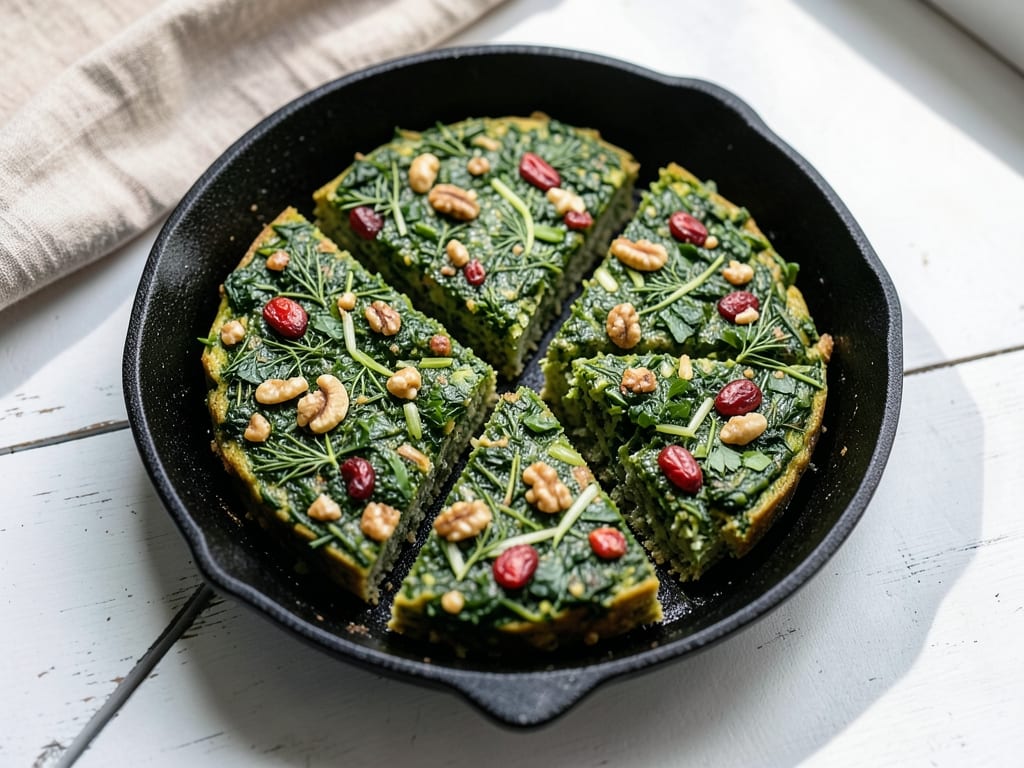
A dense, deep-green Persian frittata packed with parsley, cilantro, dill and scallions, then studded with crunchy walnuts and tart barberries. It's crisp-edged, tender in the middle and just as good warm or at room temperature.
- Prep
- 40 min
- Cook
- 32 min
- Wait
- 10 min
- Total
- 1 hr 22 min
- Makes
- 1 frittata (6 wedges), made in a 10-inch skillet
Steps
Before you start
- Make sure your skillet is 10 inches (25 cm) and oven-safe, with a nonstick or well-seasoned surface. The pan size matters for the thickness and bake time.
- Dry the herbs very thoroughly after washing. Wet herbs make the kuku watery and weepy.
- Dried barberries (zereshk) are sold at Middle Eastern markets and online. See Substitutions if you can't find them.
- Plan about 80 minutes in total. The herbs take most of the hands-on time, and the kuku needs a 10-minute rest before slicing.
Soak barberries, preheat ovenOven 350°F / 175°C
- Position a rack in the center of the oven and heat it to 350°F (175°C).
- Rinse the barberries in a fine-mesh strainer, then put them in a small bowl with the cold water.
- Let them soak while you prep the herbs.
- They'll plump up and lose some of their sharp tartness.
+ Show details− Hide details
Ready when: Oven is fully preheated and barberries are submerged in the water.
Tip: Don't soak longer than about 15 minutes, or they turn soft and lose their tang.
Wash and dry herbs
- Wash the parsley, cilantro, dill and scallions in a large bowl of cold water, lifting them out so any grit stays behind.
- Spin the herbs in a salad spinner in batches until no water drips, then spread them on clean kitchen towels and pat them dry.
- Let them air-dry for a few minutes while you work.
+ Show details− Hide details
Ready when: Herbs feel dry to the touch with no visible droplets, and a towel pressed against them comes away barely damp.
Tip: Wet herbs dilute the egg and make the kuku soggy and pale. Don't skip the drying.
Chop herbs and scallions
- Strip the parsley, cilantro and dill from any thick or woody stems, keeping the tender stems.
- Chop everything finely, about ⅛ inch (3 mm), on a dry cutting board.
- Thinly slice the scallions into ⅛-inch (3 mm) rings.
- Combine all the herbs and scallions in a large mixing bowl and toss with your fingers to fluff and mix them.
+ Show details− Hide details
Ready when: The herbs are finely chopped and evenly mixed, about 6 cups in total.
Tip: Chop with a sharp knife and a rocking motion. A dull knife bruises the herbs and turns them dark and watery.
Prep walnuts and barberries
- Chop the walnuts into pea-sized pieces.
- Drain the soaked barberries well in a strainer and press them gently on a paper towel to remove surface moisture.
- Add the walnuts and barberries to the herbs and toss.
+ Show details− Hide details
Ready when: The barberries are plump and drained, and the walnut pieces are no larger than a pea.
Whisk the egg mixture
- In a separate large bowl, whisk the eggs with the flour, baking powder, turmeric, salt and pepper for about 1 minute, until completely smooth with no flour lumps and no streaks of egg white.
- The mixture should look uniformly yellow and slightly frothy.
+ Show details− Hide details
Ready when: The batter is smooth, even yellow and slightly frothy, with no flour clumps.
Tip: Sprinkle the flour over the eggs as you whisk so it doesn't clump.
Fold herbs into eggs
- Pour the egg mixture over the herb bowl.
- Fold gently with a spatula for about 1 minute, until every bit of herb is coated and the mixture looks like a thick, green, barely pourable batter with only a little loose egg at the bottom.
+ Show details− Hide details
Ready when: Herbs are fully coated and the batter is thick and green, with little loose egg at the bottom of the bowl.
Tip: This is meant to be herbs held together by egg, not an egg dish with herbs in it. Don't add extra eggs.
Heat the pan
- Set the 10-inch oven-safe skillet over medium heat and add the oil.
- Heat for about 2 minutes, tilting the pan to coat the bottom and sides, until the oil shimmers and flows like water.
+ Show details− Hide details
Ready when: Oil shimmers and flows easily across the pan.
Tip: A fully heated, well-oiled pan is what gives the kuku its golden crust and helps it release.
Set the bottom on the stovetop
- Scrape the herb mixture into the hot pan and press it into an even layer with the back of the spatula.
- It should sizzle gently.
- Reduce the heat to medium-low and cook for 5 minutes without stirring, until the edges look set and the bottom is golden when you lift one edge with a spatula.
+ Show details− Hide details
Ready when: The edges are set and pulling away slightly, and the underside is golden brown.
Tip: If the pan is smoking or the bottom darkens fast, lower the heat. The inside will finish in the oven.
Bake until setOven 350°F / 175°C
- Transfer the skillet to the center rack of the 350°F (175°C) oven.
- Bake for 25 minutes, until the top is dry and set, the surface is lightly puffed and golden at the edges, and a knife inserted in the center comes out clean.
- An instant-read thermometer in the center should read 160°F (71°C).
+ Show details− Hide details
Ready when: The center is firm to a light touch, a knife comes out clean, and the center reads 160°F (71°C).
Tip: The skillet handle will be very hot. Use a mitt, and leave a towel or mitt over the handle as a reminder.
Rest and loosen
- Remove the skillet from the oven and let the kuku rest for 10 minutes so it firms up and slices cleanly.
- Run a thin spatula or knife around the edge, then slide it onto a cutting board or serving plate.
- If it sticks, ease the spatula under the bottom first.
+ Show details− Hide details
Ready when: The kuku slides freely when you shake the pan, with a golden-brown bottom.
Tip: Cutting right out of the oven makes the slices crumble and slump.
Slice and serve
- Cut the kuku into 6 wedges with a sharp knife.
- Serve warm or at room temperature with flatbread, plain yogurt, fresh herbs and sliced tomatoes or cucumbers.
+ Show details− Hide details
Ready when: Wedges hold their shape and show a bright green interior flecked with walnuts and red barberries.
Good to know
Tips
- The batter should look mostly like herbs. If it looks like scrambled egg with specks of green, you have too few herbs or too much egg.
- Cut herbs by hand and avoid a food processor. It purees them into a wet paste and the kuku turns dense and gummy.
- For a golden top, broil on low for 1–2 minutes at the end, watching closely so the herbs don't scorch.
- Serve with plain yogurt, flatbread (sangak or lavash), and sliced tomatoes or cucumbers. It's traditional for Nowruz, the Persian new year.
Make ahead
"Kuku is excellent made ahead. Bake and cool it completely, then cover and refrigerate for up to 1 day. Serve cold, at room temperature, or reheated. You can also wash, dry and chop the herbs up to 1 day ahead. Store them in the fridge wrapped in a dry paper towel in a sealed container."
Storage & reheating
"Room temperature: up to 2 hours. Fridge: wrap or cover airtight for up to 4 days. Freezer: wrap wedges individually and freeze for up to 2 months; thaw overnight in the fridge. To reheat, warm wedges on a baking sheet at 325°F (160°C) for 10–12 minutes, or in a nonstick skillet over medium-low heat for 3–4 minutes per side. It's also very good cold."
Substitutions
- dried barberries (zereshk) → Unsweetened dried cranberries, chopped. Use 2 tbsp (15 g), and skip the soaking. They're sweeter and less tart than barberries, so add a squeeze of lemon juice at the table.
- walnut halves → Chopped toasted pecans or pistachios. Use the same amount. Pistachios give a slightly sweeter, greener look.
- fresh cilantro → More flat-leaf parsley, or 1 cup baby spinach plus extra parsley. Use the same total weight of greens. Cilantro lovers will notice the flavor shift, but the texture holds.
- olive oil or neutral oil → Unsalted butter or ghee. Use 3 tbsp (45 g). It browns more readily, so keep the heat at medium-low.