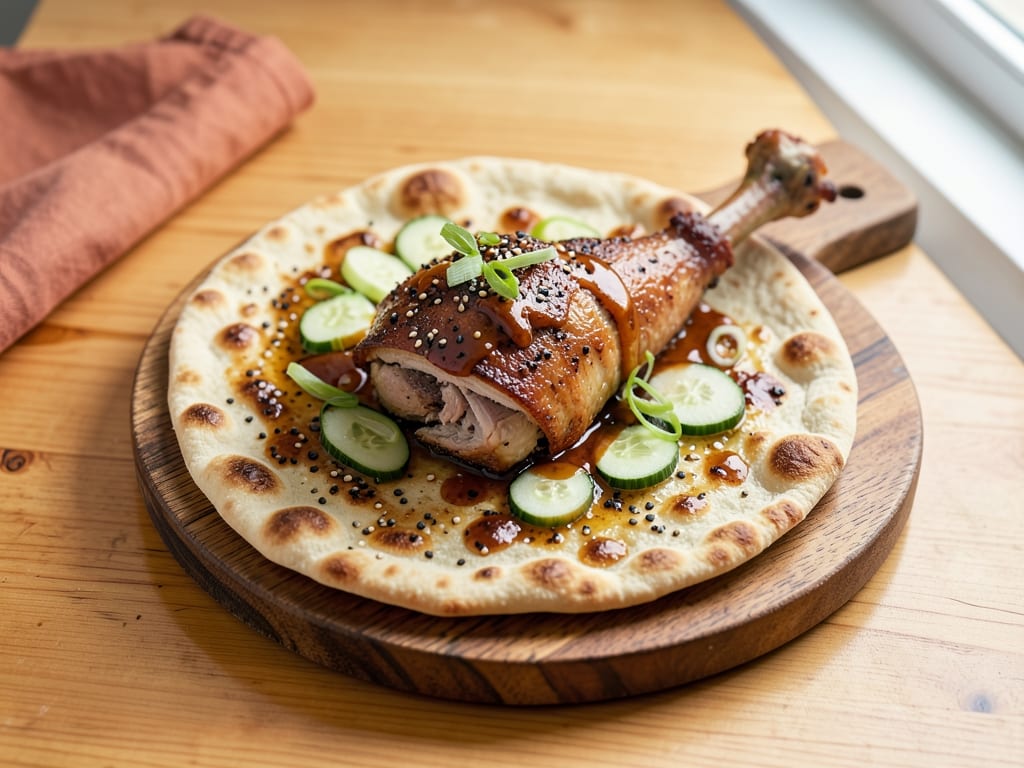
Peking Duck Manakish
Soft, chewy Lebanese-style flatbread brushed with a toasted sesame and olive oil topping, then piled with crisp-skinned five-spice duck, sweet hoisin, cool cucumber and sharp scallions. All the pleasure of Peking duck pancakes on a warm manakish.
- Prep
- 40 min
- Cook
- 1 hr 36 min
- Wait
- 1 hr 25 min
- Total
- 3 hr 41 min
- Makes
- 4 manakish (8-inch / 20 cm rounds)
Steps
Before you start
- Timing is the sum of every step, but you can save about an hour: season and roast the duck while the dough rises (steps 4–6 overlap with step 3).
- Pat the duck legs dry with paper towels and let them sit at room temperature for 20 minutes. Dry skin is what makes it crisp.
- You need a baking steel, pizza stone or a heavy rimless sheet pan for the manakish. It must preheat in the oven with the oven.
- Cut the cucumber and scallions just before serving so they stay crunchy.
Mix the dough
- In a large bowl, whisk the flour, yeast, sugar and dough salt.
- Add the warm water and 2 tbsp (30 ml) olive oil.
- Stir with a wooden spoon or your hand until no dry flour remains and you have a shaggy, sticky dough.
+ Show details− Hide details
Ready when: No dry flour is left and the dough looks shaggy.
Tip: Water hotter than 120°F (49°C) can kill the yeast, so test it on your wrist first.
Knead until smooth
- Turn the dough onto a lightly floured counter.
- Knead for 8 minutes, pushing with the heel of your hand, folding and turning, until it is smooth and stretchy.
- Add flour 1 tsp at a time only if it sticks badly to your hands.
+ Show details− Hide details
Ready when: Dough is smooth, slightly tacky, and springs back slowly when poked.
Tip: A slightly soft dough gives a tender manakish, so resist adding too much flour.
Let dough rise
- Rub a clean large bowl with a little olive oil.
- Add the dough, turn to coat, and cover with a damp towel or plastic wrap.
- Leave in a warm spot for 60 minutes.
- Start the duck while you wait.
+ Show details− Hide details
Ready when: Dough has doubled and a floured finger leaves a dent that fills back in slowly.
Season the duck
- Set the rack in the rimmed baking sheet.
- Mix the duck salt and five-spice powder.
- Prick the duck skin all over with the tip of a knife or a fork, going into the fat but not into the meat.
- Rub the spice mix over both sides of each leg.
- Place skin side up on the rack.
- Stir the honey, soy sauce and rice vinegar together in a small bowl and set aside for the glaze.
+ Show details− Hide details
Ready when: Skin is dry, evenly pricked and evenly coated in spice.
Tip: Do not glaze yet. Sugar would burn during the long roast.
Roast the duckOven 375°F / 190°C
- Heat the oven to 375°F (190°C).
- Roast the legs skin side up on the middle rack for 70 minutes, without turning.
- The fat will render into the pan and the skin will turn golden.
+ Show details− Hide details
Ready when: Skin is golden and the meat at the thickest part registers 185°F (85°C) and pulls easily from the bone.
Tip: Duck legs are safe at 165°F (74°C) but the connective tissue only turns tender around 185°F (85°C), so cook to that.
Glaze and crisp skinOven 425°F / 220°C
- Raise the oven to 425°F (220°C).
- Brush the honey-soy glaze over the skin and roast 8 more minutes until the skin is deep mahogany and crackly.
- Watch closely in the last 3 minutes.
+ Show details− Hide details
Ready when: Skin is deep brown, glossy and crisp, not blackened.
Tip: Honey scorches fast. If one leg darkens first, tent it with foil.
Rest, shred, preheatOven 475°F / 245°C
- Move the legs to a cutting board and rest 15 minutes.
- Meanwhile, put the baking steel, stone or sheet pan on the middle rack and heat the oven to 475°F (245°C) for at least 30 minutes.
- Pull the skin and meat off the bones, discard bones, and chop the crisp skin and shred the meat into bite-size pieces.
- Keep both together in a bowl, loosely covered.
+ Show details− Hide details
Ready when: Meat shreds easily with no pink or resistance.
Tip: Rest the duck uncovered on the board so the skin stays crisp.
Shape and top dough
- Punch down the risen dough and divide into 4 equal pieces (about 120 g each).
- Roll into balls, cover and rest 10 minutes.
- Stir the topping oil, sesame oil and sesame seeds together.
- On a floured counter, stretch or roll each ball into an 8-inch (20 cm) round about ¼ inch (6 mm) thick.
- Place on parchment sheets.
- Dimple all over with your fingertips, then spread a quarter of the sesame mixture over each, leaving a ½-inch (1 cm) border.
+ Show details− Hide details
Ready when: Rounds are even, dimpled and evenly slicked with seeded oil.
Tip: Cover rounds not yet baked with a towel so they do not dry out.
Bake the manakishOven 475°F / 245°C
- Bake in two batches.
- Slide 2 rounds on their parchment onto the hot steel at 475°F (245°C) and bake 8 to 9 minutes.
- Pull them out and repeat with the remaining 2.
+ Show details− Hide details
Ready when: Edges are puffed and golden, the bottom has brown spots, and the sesame seeds are toasted.
Tip: Do not over-bake. Pale golden stays soft and foldable, while dark turns crisp.
Assemble and serve
- Spread 1½ tbsp hoisin over each hot manakish, leaving a thin border.
- Pile on the duck and crisp skin, then top with cucumber, scallion strips and cilantro if using.
- Serve open, or fold in half like a taco.
- Eat right away.
+ Show details− Hide details
Ready when: Hoisin melts into the warm bread and the vegetables stay crunchy.
Tip: Assemble each manakish only when you are ready to eat so the bread does not turn soggy.
Good to know
Tips
- Save the rendered duck fat from the baking sheet. Strain it and use it to roast potatoes or brush on the dough instead of olive oil.
- Soak the cut scallion strips in ice water for 5 minutes so they curl and lose some of their bite. Drain well before using.
- A very hot preheated surface gives the manakish lift and a browned base, so do not skip the 30-minute preheat.
- Pat the duck skin completely dry. Moisture is the main reason skin stays rubbery.
Make ahead
"Roast and shred the duck up to 2 days ahead and refrigerate it. Reheat, spread on a baking sheet, at 400°F (200°C) for 8 to 10 minutes until sizzling and the skin re-crisps. Dough can rise in the refrigerator for 12 to 24 hours; bring to room temperature for 45 minutes before shaping."
Storage & reheating
Room temperature: assembled manakish are best eaten at once. Plain baked bread keeps 1 day covered. Fridge: keep duck, bread and vegetables separate, up to 3 days (cooked duck) in airtight containers. Freezer: plain baked manakish and shredded duck freeze up to 2 months. Reheat bread at 350°F (175°C) for 5 minutes and duck at 400°F (200°C) for 8 to 10 minutes.
Substitutions
- bone-in, skin-on duck legs → Store-bought roast duck (about 1 lb / 450 g meat and skin) or roast chicken thighs. Re-crisp the duck skin in a 425°F (220°C) oven for 5 minutes. Chicken thighs should reach 175°F (80°C) and will not be as rich.
- hoisin sauce → Plum sauce, or 4 tbsp hoisin replaced by 3 tbsp soy sauce plus 3 tbsp honey and 1 tsp sesame oil. Plum sauce is fruitier and thinner, so use slightly less.
- all-purpose flour → Bread flour. Gives a chewier bread. Add 1 to 2 extra tablespoons of water if the dough feels stiff.
- English (seedless) cucumber → Thinly sliced radish or quick-pickled carrot. Keeps the fresh crunch that balances the rich duck.