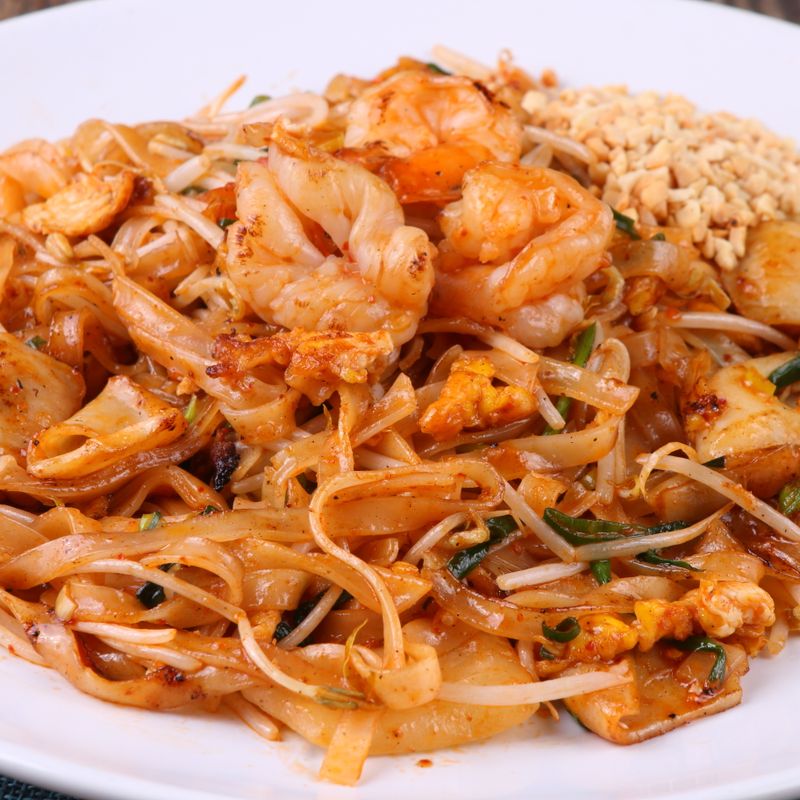
Pad Thai Lasagna
Layers of tender flat rice noodles, garlicky shrimp, scrambled egg, bean sprouts and peanuts, set together with a tamarind-coconut custard instead of cheese. It bakes into sliceable squares with all the sweet, sour and savory flavor of pad thai, finished with lime, cilantro and crunchy peanuts.
- Prep
- 37 min
- Cook
- 48 min
- Wait
- 25 min
- Total
- 1 hr 50 min
- Makes
- 1 (9×13-inch) lasagna, 8 squares
Steps
Before you start
- Buy dried flat rice noodles about ¼ inch (6 mm) wide, sold as 'pad thai' or 'medium' rice sticks. Thin vermicelli won't layer properly.
- Use tamarind concentrate (a thick, dark, seedless paste in a jar), not tamarind pulp blocks or sweetened tamarind candy.
- Peel and devein the shrimp, and measure everything before you start. The stovetop part moves fast.
- Shake the can of coconut milk well before opening so the cream and liquid are blended.
- Leave the oven rack in the center position.
Soak the noodlesOven 375°F / 190°C
- Position a rack in the center and heat the oven to 375°F (190°C).
- Place the rice noodles in a large heatproof bowl and cover with very hot tap water (about 140°F / 60°C).
- Soak for 8–10 minutes, stirring once, then drain well in a colander.
- Brush a 9×13-inch (23×33 cm) baking dish with 1 tablespoon of the neutral oil.
+ Show details− Hide details
Ready when: Noodles bend easily without breaking but still feel firm and slightly chalky in the center.
Tip: Don't soak until fully soft. The noodles keep absorbing custard in the oven and turn mushy if they start too soft.
Prep the filling
- Slice the shallots, mince the garlic, and slice the scallions, keeping the whites and light-green parts separate from the dark-green tops.
- Pat the shrimp very dry with paper towels and cut each into 3 pieces crosswise.
- Lightly beat the 2 filling eggs in a small bowl.
- Divide the bean sprouts into two equal piles and the peanuts into one-third and two-thirds piles.
+ Show details− Hide details
Tip: Dry shrimp sear instead of steam, which keeps the filling from getting watery.
Whisk the custard
- In a large bowl, whisk the coconut milk, 4 custard eggs, tamarind concentrate, fish sauce, brown sugar and sriracha for about 1 minute until the tamarind and sugar dissolve and the mixture is a uniform, pale caramel color.
- Taste a spoonful: it should be assertively sweet, sour and salty, because the noodles will dilute it.
+ Show details− Hide details
Ready when: No streaks of tamarind remain and no sugar granules are visible at the bottom of the bowl.
Tip: If you're using palm sugar, chop it fine so it dissolves.
Sear the shrimp
- Heat 2 tablespoons of oil in a 12-inch (30 cm) skillet over medium-high heat until it shimmers.
- Add the shallots, garlic and scallion whites and stir for 1 minute until fragrant.
- Add the shrimp in a single layer and cook, stirring, for 1½–2 minutes, just until the outsides turn pink but the centers are still slightly translucent.
- Scrape everything into a bowl.
+ Show details− Hide details
Ready when: Shrimp are pink on the outside and still underdone in the very center.
Tip: Undercook the shrimp here. They finish in the oven, and fully cooked shrimp turn rubbery.
Scramble and combine
- Return the empty skillet to medium-high heat.
- Pour in the beaten filling eggs and stir for 30–45 seconds until they form soft, small curds that are just set.
- Turn off the heat.
- Add the shrimp mixture, half of the bean sprouts, one-third of the peanuts and the scallion greens' light-green slices if any remain, and toss for 20 seconds.
- Set aside.
+ Show details− Hide details
Ready when: Eggs form small, moist curds; the sprouts are only barely warmed and still crisp.
Tip: Keep the sprouts raw-crisp here. They'll soften in the oven.
Build the first layer
- Spread one-third of the drained noodles in the oiled dish, laying them in the same direction and trimming with scissors to fit edge to edge.
- Pour one-quarter of the custard evenly over the noodles.
- Spoon half of the shrimp filling over the top and spread to the corners.
+ Show details− Hide details
Ready when: Noodles form an even, snug layer with no bare spots in the dish.
Tip: Whisk the custard again before each pour; the coconut cream settles.
Build the second layer
- Add another third of the noodles, pressing gently with your palm to compact them.
- Pour over another one-quarter of the custard, then spread the remaining shrimp filling on top.
+ Show details− Hide details
Ready when: The filling is spread evenly and reaches the corners.
Finish the top layer
- Cover with the last of the noodles, tucking in any loose ends so they won't dry out and crisp.
- Slowly pour all of the remaining custard over the top, letting it seep down the sides.
- It should come about three-quarters of the way up the top layer.
- Tap the dish firmly on the counter twice to release air bubbles, then cover tightly with foil.
+ Show details− Hide details
Ready when: Custard seeps into the gaps and the top noodles are moistened throughout.
Tip: Any noodle ends sticking up above the custard will turn hard and brittle, so push them down.
Bake coveredOven 375°F / 190°C
- Bake the foil-covered dish at 375°F (190°C) for 25 minutes, so the custard sets gently and the noodles steam through.
+ Show details− Hide details
Ready when: The edges are bubbling and the custard looks mostly set but still jiggles in the center.
Tip: Set the dish on a rimmed baking sheet to catch any drips.
Bake uncoveredOven 375°F / 190°C
- Remove the foil and bake for 15 more minutes at 375°F (190°C) until the top is dry in spots with golden-brown edges.
- Check that the center reaches 160°F (71°C) on an instant-read thermometer.
+ Show details− Hide details
Ready when: Center registers 160°F (71°C), the surface is lightly golden, and a knife inserted in the center comes out with no liquid egg.
Tip: If the top is browning too fast, tent loosely with foil for the last 5 minutes.
Rest before cutting
- Let the lasagna rest on a rack for 15 minutes.
- The custard firms up and the noodle layers hold together when sliced.
+ Show details− Hide details
Ready when: The surface stops jiggling and the edges pull slightly from the dish.
Tip: Cutting sooner will give you loose, sloppy slices.
Garnish and serve
- Scatter the remaining bean sprouts, remaining peanuts, scallion greens and cilantro over the top.
- Cut into 8 squares with a sharp knife and lift out with a wide spatula.
- Serve each with a lime wedge to squeeze over.
+ Show details− Hide details
Tip: Garnish just before serving so the sprouts stay crunchy.
Good to know
Tips
- Make sure the noodles are drained thoroughly. Extra water on them will thin the custard and leave a loose, wet lasagna.
- Pour the custard slowly so it seeps between the noodles. Pouring fast pushes the filling around and leaves dry pockets.
- Check the center with a thermometer, not just a fork. Reaching 160°F (71°C) guarantees the custard is set and the shrimp are fully cooked.
- For extra heat, add 1 teaspoon chili flakes to the filling or serve with extra sriracha at the table.
Make ahead
"Soak the noodles, cook the filling and whisk the custard up to 1 day ahead and refrigerate them separately. Assemble just before baking, adding 5 minutes to the covered baking time if the filling is cold. You can also assemble the whole dish, cover and refrigerate for up to 8 hours before baking, adding 5–10 minutes to the covered bake."
Storage & reheating
"Room temperature: up to 2 hours. Refrigerator: cover and keep up to 3 days, without the fresh garnishes. Freezer: not recommended, since the custard turns watery and the noodles become grainy. Reheat squares, covered, in a 325°F (160°C) oven for 15–20 minutes, or microwave a single square at 70% power for 2 minutes. Reheated shrimp are best eaten within 1 day."
Substitutions
- large raw shrimp (21–25 count) → Cubed pressed extra-firm tofu or sliced cooked chicken. Use 1 lb (450 g) tofu, browned in the skillet first, or 3 cups cooked chicken. Skip the raw-shrimp step and just warm through.
- fish sauce → Soy sauce. Use the same amount; the flavor is less funky but still savory. Use it with tofu for a vegetarian version.
- tamarind concentrate → Lime juice plus extra brown sugar. Use 3 tbsp (45 ml) lime juice plus 1 extra tbsp brown sugar; the flavor is brighter and less fruity.
- roasted unsalted peanuts → Roasted cashews. Use the same weight if you have a peanut allergy in the house (check labels for cross-contact).