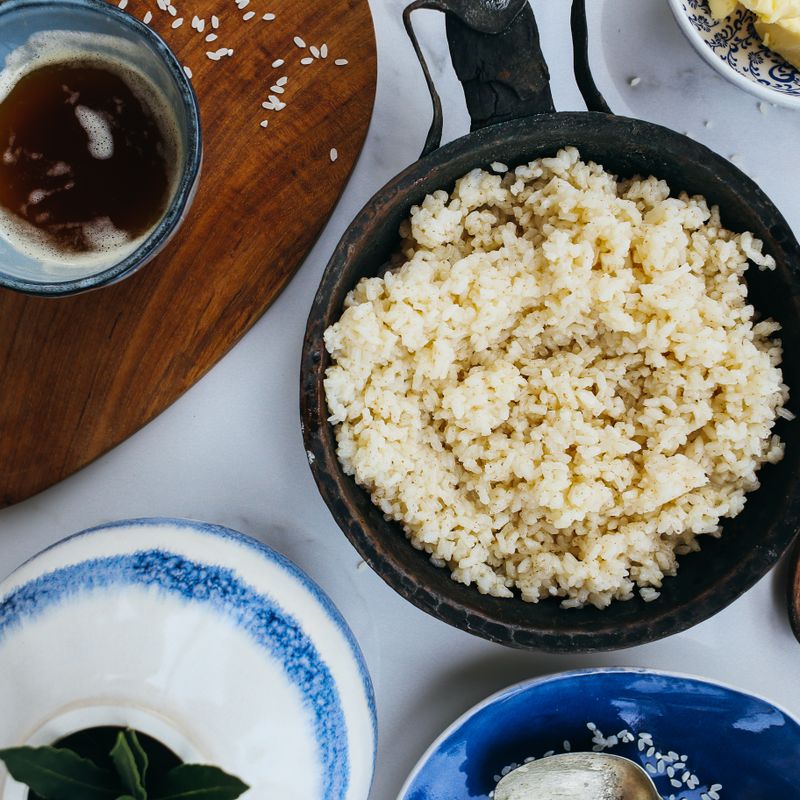
One-Pot Miso Butter Shiitake and Rice Pilaf
A quick, aromatic one-pot rice pilaf where short-grain white rice cooks in a savory dashi and miso broth studded with sautéed shiitake mushrooms and finished with a knob of butter. Japanese umami meets French technique in this 35-minute side dish.
- Prep
- 10 min
- Cook
- 20 min
- Wait
- 5 min
- Total
- 35 min
- Makes
- 4 servings (about 4½ cups)
Steps
Before you start
- Use fresh shiitake mushrooms if possible—their earthy flavor is central to this dish
- Have your dashi broth ready and warm (or use instant dashi dissolved in hot water)
- Measure all ingredients before you start, as the cooking moves quickly once you begin
Sauté mushrooms until golden
- Heat 2 tbsp (28 g) butter in your 3-quart pot over medium-high heat for 1 minute until foaming.
- Add the halved shiitake mushroom caps and sauté for 5–6 minutes, stirring occasionally, until they are golden brown on the cut sides and softened.
- Push them to the side of the pot.
+ Show details− Hide details
Ready when: Mushroom caps are golden brown and slightly caramelized at the edges
Tip: Don't move the mushrooms too much while cooking—let them develop a caramelized crust for deeper flavor.
Toast rice with aromatics
- Add the minced white and light-green scallion parts to the pot with the mushrooms and cook for 30 seconds, stirring, until fragrant.
- Add the rinsed short-grain rice to the pot and stir constantly for 2 minutes.
- The rice grains should become slightly translucent at the edges and smell toasty.
+ Show details− Hide details
Ready when: Rice grains appear slightly translucent and smell nutty
Tip: Toasting the rice before adding liquid helps it absorb the broth evenly and prevents mushiness.
Deglaze and add broth
- Pour the sake into the pot and stir, scraping any brown bits stuck to the bottom—this adds depth.
- Let the sake cook for 1 minute until it mostly evaporates.
- In a small bowl, whisk the white miso paste with ¼ cup (60 ml) of the warm dashi broth until smooth, then pour this mixture back into the pot along with the remaining dashi broth and soy sauce.
- Stir to combine.
+ Show details− Hide details
Ready when: Liquid is evenly mixed and no miso paste remains clumpy
Tip: Whisking miso with cold or room-temperature dashi before adding prevents lumps; adding it to hot liquid causes clumping.
Bring to a boil and cover
- Bring the liquid to a rolling boil, stirring occasionally, for about 2 minutes.
- Once boiling, reduce the heat to low, place the lid on the pot, and cook for 15 minutes without opening or stirring.
+ Show details− Hide details
Ready when: Liquid is nearly all absorbed and the pot is silent (no bubbling)
Tip: Avoid lifting the lid during cooking—this releases steam and uneven cooking.
Rest and finish
- Remove the pot from heat and let it sit, covered, for 5 minutes.
- This allows the rice to finish cooking gently using residual heat.
- Stir in the remaining 1 tbsp (14 g) of butter until melted and fully combined throughout the rice.
+ Show details− Hide details
Ready when: Rice is tender, fluffy, and grains are separate
Tip: Finishing with cold butter keeps the rice light and prevents it from becoming sticky.
Garnish and serve
- Transfer the rice pilaf to a serving bowl or individual dishes.
- Scatter the reserved dark-green scallion tops and toasted sesame seeds (if using) over the top.
- Serve immediately while warm.
+ Show details− Hide details
Tip: Add the sesame seeds just before serving so they stay crispy and don't absorb moisture.
Good to know
Tips
- This dish pairs beautifully alongside grilled or roasted proteins, especially fish, chicken, or pork. It's also hearty enough to serve as a vegetarian main with a simple miso soup and pickled vegetables.
- For a richer version, stir in 2 tbsp (30 ml) heavy cream or a beaten egg yolk at the end (off heat), stirring quickly to create a creamy risotto-like texture.
- If you don't have dashi on hand, make a quick version: simmer a 4-inch (10 cm) piece of kombu in 2.5 cups (600 ml) water for 5 minutes, remove the kombu, and add a pinch of bonito flakes or instant dashi powder.
- Toast the sesame seeds yourself in a dry skillet over medium heat for 2–3 minutes if you buy them raw—store-bought toasted seeds may lose crispness; toasting fresh ensures better texture.
Storage & reheating
Store leftovers in an airtight container in the refrigerator for up to 3 days. Reheat gently in a covered pot over low heat with a splash of dashi or water (about 2 tbsp / 30 ml) to restore moisture, or microwave in a covered bowl with a damp paper towel for 1–2 minutes. The dish is best eaten fresh but is still delicious reheated.
Substitutions
- white (or shiro) miso paste → red (aka) miso paste. Use the same amount; red miso will give a deeper, slightly saltier flavor. Reduce soy sauce to ¼ tbsp (3.75 ml) to avoid over-saltiness.
- dashi broth (or instant dashi prepared according to package directions) → chicken broth or vegetable broth. The umami will be less pronounced, but the pilaf will still be flavorful. If using store-bought broth, taste and reduce soy sauce to 1 tsp (5 ml) since broths can be saltier.
- fresh shiitake mushrooms → cremini or oyster mushrooms. Cremini will be milder; oyster mushrooms have a more delicate texture. Increase the amount to 10 oz (280 g) if using cremini to maintain earthiness.
- sake (or dry white wine) → dry white wine or water. Sake adds subtle sweetness; white wine is slightly acidic; water will make a more neutral dish. Any will work—just reduces the deglazing action and depth slightly.
More pilaf
See all →


Find more like this
- Meal
- Dinner
- Cuisine
- Japanese
- Diet
- Sugar-Free
- Method
- Stovetop