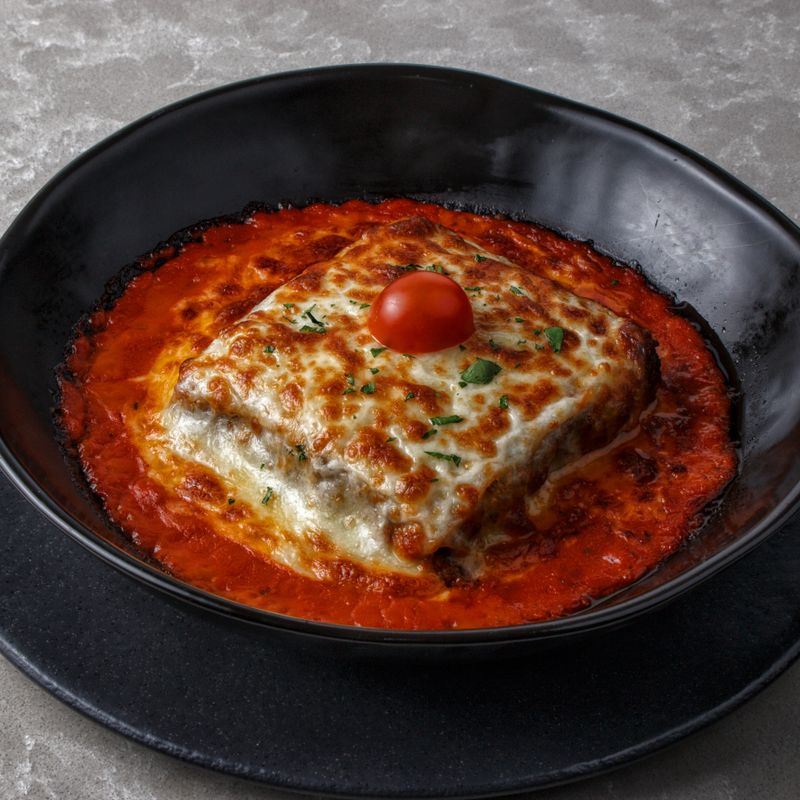
Okonomiyaki Lasagna
Layers of tender lasagna noodles, savory bacon-studded cabbage, and a dashi-spiked egg-enriched white sauce bake into a sliceable casserole that tastes like Osaka's famous cabbage pancake. Finished with sweet-tangy okonomiyaki sauce, zigzags of Kewpie mayo, and dancing bonito flakes.
- Prep
- 35 min
- Cook
- 1 hr 20 min
- Wait
- 15 min
- Total
- 2 hr 10 min
- Makes
- 1 lasagna in a 9×13-inch pan (8 generous squares)
Steps
Before you start
- Preheat the oven to 375°F (190°C) with a rack in the center when you begin cooking the cabbage.
- Core and slice the cabbage first; it is a big pile (about 14 cups raw) and will need to be cooked in batches.
- Okonomiyaki sauce, Kewpie mayo, dashi powder, aonori, and pickled red ginger are sold at Asian grocers and many supermarkets. Check you have the first three before starting.
- Cabbage must be cooked until its moisture has evaporated, or the lasagna will be watery. Read step 4 before you begin.
Prep the vegetables
- Slice the cabbage into ¼-inch (6 mm) ribbons, grate the carrot, slice the scallions (keeping whites and greens in separate piles), mince the garlic, and grate the ginger.
- Cut the bacon into ½-inch (1 cm) pieces.
- Measure the milk and let it come toward room temperature.
- Shred the mozzarella and divide it into ½ cup, ½ cup, and 1 cup portions.
+ Show details− Hide details
Ready when: Everything is prepped and portioned in bowls before any heat is turned on.
Tip: Keep the 3 mozzarella portions separate so you do not run out for the top.
Boil the noodles
- Bring a large pot of water to a rolling boil and add the kosher salt.
- Cook the 9 lasagna noodles 2 minutes less than the package directs, stirring in the first minute so they do not stick.
- Drain, rinse briefly with cool water, and lay them flat in a single layer on a parchment-lined baking sheet.
- Cover with a damp towel.
+ Show details− Hide details
Ready when: Noodles are flexible but still clearly firm in the center when bitten.
Tip: They finish cooking in the oven, so underdone now means perfect later.
Render the bacon
- Place the bacon in a cold 12-inch (30 cm) deep skillet or Dutch oven and set over medium heat.
- Cook, stirring occasionally, for 8 to 10 minutes until the fat has rendered and the pieces are golden and lightly crisp at the edges.
- Transfer the bacon with a slotted spoon to a bowl.
- Pour off all but about 3 tablespoons of fat, leaving the rest in the pan.
+ Show details− Hide details
Ready when: Bacon is golden brown with crisp edges and most of the fat has melted out.
Tip: Starting bacon in a cold pan renders the fat more evenly and prevents burning.
Cook down the cabbageOven 375°F / 190°C
- Raise the heat to medium-high.
- Add the cabbage in 3 handfuls, letting each wilt before adding the next.
- Cook, stirring often, 10 to 12 minutes until the cabbage is soft, lightly browned in spots, and the liquid at the bottom of the pan has completely evaporated.
- Add the carrot, scallion whites, garlic, ginger, and pepper and cook 2 minutes more until fragrant.
- Stir in the bacon and remove from the heat.
- You should have about 6 cups of filling.
- Preheat the oven to 375°F (190°C).
+ Show details− Hide details
Ready when: Cabbage is tender and shrunken to about ⅓ of its volume, and the pan bottom is dry with no pooled liquid.
Tip: Watery cabbage makes a soupy lasagna. If liquid remains, keep cooking, or drain the filling in a colander.
Make the white sauce
- In a medium saucepan over medium heat, melt the butter.
- Whisk in the flour and cook, whisking constantly, for 2 minutes until it smells nutty and looks like wet sand, without letting it brown.
- Slowly pour in the milk in 4 additions, whisking until smooth after each.
- Add the dashi powder and soy sauce.
- Cook, whisking often, 5 to 6 minutes until the sauce thickens enough to coat the back of a spoon and a finger drawn through it leaves a clear line.
+ Show details− Hide details
Ready when: Sauce coats a spoon and holds a clear line; it should be like thick pourable cream.
Tip: Add the milk gradually to avoid lumps. If lumpy, whisk vigorously or strain.
Enrich with egg
- Take the saucepan off the heat and let it cool 3 minutes.
- Whisk about ½ cup of the hot sauce into the beaten eggs, then pour the egg mixture back into the saucepan, whisking constantly until smooth.
- You should have about 3½ cups of sauce.
- The eggs give the lasagna its set, pancake-like texture.
+ Show details− Hide details
Ready when: Sauce is smooth and glossy with no visible bits of cooked egg.
Tip: Add the eggs only after cooling and tempering, or they will curdle.
Build the first layer
- Spread 1 cup of white sauce over the bottom of a 9×13-inch (23×33 cm) baking dish.
- Arrange 3 noodles side by side lengthwise, overlapping slightly.
- Spread half of the cabbage filling (about 3 cups) over the noodles, drizzle with ¼ cup of okonomiyaki sauce, sprinkle with half of the scallion greens and ½ cup of mozzarella, then spoon over 1¼ cups of white sauce.
+ Show details− Hide details
Ready when: The filling is spread in an even layer that reaches the corners.
Tip: Use the back of a spoon to nudge the filling to the corners so every square gets some.
Finish assembling
- Add a second layer of 3 noodles.
- Top with the remaining cabbage filling, ¼ cup okonomiyaki sauce, the remaining scallion greens, ½ cup mozzarella, and 1¼ cups white sauce.
- Finish with the last 3 noodles, the remaining white sauce (about 1 cup), ¼ cup okonomiyaki sauce spread thinly, and the final 1 cup of mozzarella.
- Cover tightly with foil, with the underside lightly greased or tented so cheese does not stick.
+ Show details− Hide details
Ready when: Top noodles are fully covered by sauce so they will not dry out and curl.
Tip: Make sure the top noodles are completely covered with white sauce, or their edges will turn hard.
Bake coveredOven 375°F / 190°C
- Set the dish on a rimmed baking sheet to catch drips.
- Bake covered with foil in the center of the oven at 375°F (190°C) for 30 minutes.
+ Show details− Hide details
Ready when: Sauce is bubbling gently at the edges of the dish.
Uncover and brownOven 375°F / 190°C
- Remove the foil and bake 15 to 18 minutes more at 375°F (190°C) until the cheese is melted and spotted golden brown and the center reads 160°F (71°C) on an instant-read thermometer.
+ Show details− Hide details
Ready when: Top is spotted golden brown, edges bubble, and the center reaches 160°F (71°C).
Tip: If the cheese browns too fast, loosely re-tent with foil.
Rest and top
- Let the lasagna rest on a rack for 15 minutes so the layers set and slice cleanly.
- Spoon the remaining ¼ cup okonomiyaki sauce over the top.
- Squeeze the Kewpie mayo from a zip-top bag with a snipped corner in thin zigzags across the surface.
- Scatter on the bonito flakes, aonori, and pickled ginger, if using.
- Cut into 8 squares and serve right away while the bonito flakes still sway.
+ Show details− Hide details
Ready when: Lasagna no longer sloshes when the pan is gently jiggled, and a knife leaves clean cuts.
Tip: Add the bonito flakes just before serving; they wilt and get soggy if they sit.
Good to know
Tips
- Cook the cabbage until it is truly dry in the pan. This is the single biggest factor for a sliceable lasagna.
- Okonomiyaki sauce is sweet and salty, and bacon is salty, so the filling is intentionally under-seasoned. Taste before adding salt.
- For clean slices, rest the lasagna the full 15 minutes and wipe your knife between cuts.
- Squeezing the mayo from a bag with a tiny snipped corner gives the classic fine zigzag pattern.
Make ahead
"Assemble the lasagna through step 8 (without baking), cover tightly, and refrigerate up to 24 hours. Bake straight from the fridge, adding 10 to 15 minutes to the covered baking time. Add the toppings after baking."
Storage & reheating
"Room temperature: up to 2 hours. Refrigerator: leftovers without toppings keep in an airtight container up to 4 days. Freezer: wrap individual squares well and freeze up to 2 months; thaw overnight in the fridge. Reheat covered at 350°F (175°C) for 20 to 25 minutes, or microwave a portion at 70% power for 2 to 3 minutes until hot in the center. Add fresh mayo and bonito flakes after reheating."
Substitutions
- okonomiyaki sauce → 2 tbsp ketchup + 2 tbsp Worcestershire sauce + 1 tbsp oyster sauce + 1 tsp sugar, per ¼ cup needed. Makes a close homemade approximation; scale up for the full 1 cup.
- Kewpie mayonnaise → regular mayonnaise plus a pinch of sugar and ½ tsp rice vinegar per ½ cup. Kewpie is richer and tangier, so this approximates it.
- thick-cut bacon → thinly sliced pork belly or ground pork (12 oz / 340 g). Brown ground pork thoroughly and season with an extra pinch of salt.
- dashi powder (hondashi) → 1 tbsp fish sauce, or ½ tsp extra soy sauce plus a pinch of salt. Adds savory depth, though less authentic.