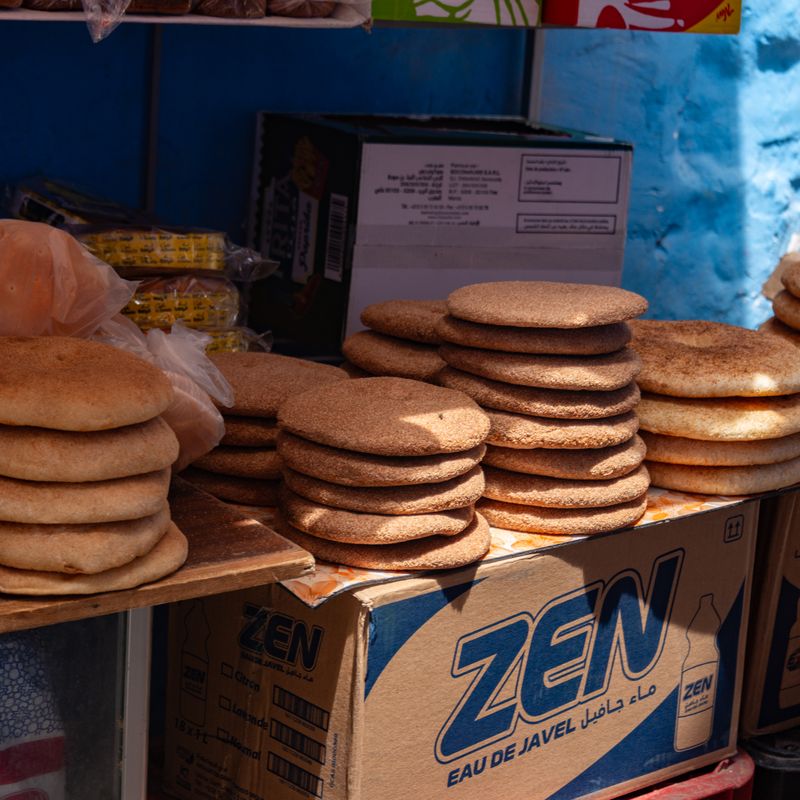
Moroccan Khobz Rolls with Anise and Sesame
Soft, golden Moroccan-style rolls made with fine semolina and flour, scented with anise and crowned with sesame seeds. They have a tender, slightly chewy crumb and a crisp crust, ideal for tagines, soups and dips.
- Prep
- 32 min
- Cook
- 18 min
- Wait
- 1 hr 55 min
- Total
- 2 hr 45 min
- Makes
- 8 rolls
Steps
Before you start
- Plan on about 2 hours 45 minutes from start to finish, most of it hands-off rising time.
- Use fine semolina (sometimes labeled semolina flour or pasta flour), not coarse semolina, or the crumb will be gritty.
- Measure the water with a thermometer if you can: 105–110°F (40–43°C) feels comfortably warm, not hot. Water above 120°F (49°C) can kill the yeast.
- Find a warm, draft-free spot (about 75–80°F / 24–27°C) for the dough to rise, such as an oven that is off with the light on.
Activate the yeast
- In a large mixing bowl, whisk the lukewarm water, instant yeast and sugar together.
- Let it stand for 5 minutes.
+ Show details− Hide details
Ready when: The surface looks foamy and smells yeasty
Tip: If there is no foam after 10 minutes, the yeast is dead or the water was too hot or cold. Start again with fresh yeast.
Mix the dough
- Add the flour, 160 g semolina, salt, anise seeds and 2 tbsp olive oil to the bowl.
- Stir with a wooden spoon or your hand for about 2 minutes until no dry flour remains and a shaggy, sticky dough forms.
+ Show details− Hide details
Ready when: No dry patches of flour remain and the dough is shaggy and tacky
Tip: Keep the salt away from the yeast water until the flour is added, so it doesn't slow the yeast.
Knead until smooth
- Turn the dough onto a lightly floured surface.
- Knead for 8–10 minutes, pushing with the heel of your hand, folding and turning, until the dough is smooth, elastic and slightly tacky.
- Add only a teaspoon of flour at a time if it sticks badly.
- Semolina dough will feel a little firmer than plain white dough.
+ Show details− Hide details
Ready when: A pinch of dough springs back slowly when poked, and a small piece stretches thin without tearing right away
Tip: Resist adding too much flour. A slightly tacky dough gives softer rolls.
First rise
- Rub a clean large bowl with 1 tsp olive oil.
- Add the dough, turn it once to coat, and cover with a towel or plastic wrap.
- Let it rise in a warm place for about 60 minutes.
+ Show details− Hide details
Ready when: Dough has doubled in size and a floured finger poke leaves a dent that springs back slowly
Tip: A cooler kitchen may need up to 90 minutes. Go by the dough, not the clock.
Divide and shape
- Line a baking sheet with parchment and sprinkle it with about half the dusting semolina.
- Turn the dough out onto a surface dusted with the remaining semolina and divide it into 8 equal pieces, about 90 g (3 oz) each.
- Shape each piece into a ball by cupping your palm over it and rolling in tight circles on the counter until smooth and taut.
- Place the balls 2 inches (5 cm) apart on the pan and flatten each gently into a disc about 3½ inches (9 cm) wide.
+ Show details− Hide details
Ready when: Each roll has a smooth, taut top and a pinched seam underneath
Tip: Weigh the pieces on a scale for even rolls that bake at the same rate.
Second riseOven 425°F / 220°C
- Cover the rolls loosely with a towel and let them rise for 30 minutes.
- About 15 minutes before the end, position a rack in the middle of the oven and preheat to 425°F (220°C).
+ Show details− Hide details
Ready when: Rolls look puffy and about 1½ times their original size; a gentle poke leaves a dent that fills back in slowly
Tip: Underproofed rolls bake dense, while overproofed rolls collapse. If a poke stays dented and doesn't fill back, bake right away.
Brush and add seedsOven 425°F / 220°C
- Lightly brush the tops of the rolls with the 2 tbsp water, then sprinkle each generously with sesame seeds, about ¾ tsp per roll.
- Press the seeds gently so they stick.
+ Show details− Hide details
Ready when: Tops are evenly coated with seeds
Tip: Brush gently so you don't deflate the risen rolls.
Bake the rollsOven 425°F / 220°C
- Bake in the preheated 425°F (220°C) oven for 16–18 minutes, rotating the pan front to back after 10 minutes, until the rolls are deep golden brown.
+ Show details− Hide details
Ready when: Tops are deep golden brown and the bottoms sound hollow when tapped; internal temperature is about 200°F (93°C)
Tip: If the sesame seeds darken too quickly, tent the pan loosely with foil for the last 5 minutes.
Cool before serving
- Transfer the rolls to a wire rack and let them cool for at least 20 minutes.
- Serve warm or at room temperature, torn open and filled or used for scooping up tagine sauces, dips and soups.
+ Show details− Hide details
Ready when: Rolls feel just warm to the touch, not hot
Good to know
Tips
- Lightly toast the anise seeds in a dry pan for 1 minute, then cool, for deeper flavor.
- Fine semolina gives the characteristic golden color and slightly sandy, tender bite; don't swap in coarse semolina.
- For an extra-crisp crust, set a pan of 1 cup hot water on the bottom oven rack while preheating.
- Rolls are best the day they are made, so freeze any extras the same day.
Make ahead
Shape the rolls, cover the pan tightly with oiled plastic wrap and refrigerate for up to 12 hours. Let them stand at room temperature for 30–40 minutes until puffy, then brush, top with seeds and bake as directed.
Storage & reheating
Room temperature in an airtight container or bag for up to 2 days. Freeze completely cooled rolls in a freezer bag for up to 3 months. Reheat from frozen, wrapped in foil, at 350°F (175°C) for 12–15 minutes, or refresh room-temperature rolls for 5 minutes at 350°F (175°C).
Substitutions
- instant yeast → active dry yeast. Use the same amount, but let it bloom in the warm water and sugar for 10 minutes until foamy.
- anise seeds → fennel seeds. Gives a similar, slightly milder licorice flavor. Use the same amount.
- all-purpose flour → bread flour. Gives a chewier crumb. Add 1–2 tbsp more water if the dough feels stiff.
- olive oil → neutral vegetable oil. Works fine, with a less fruity flavor.