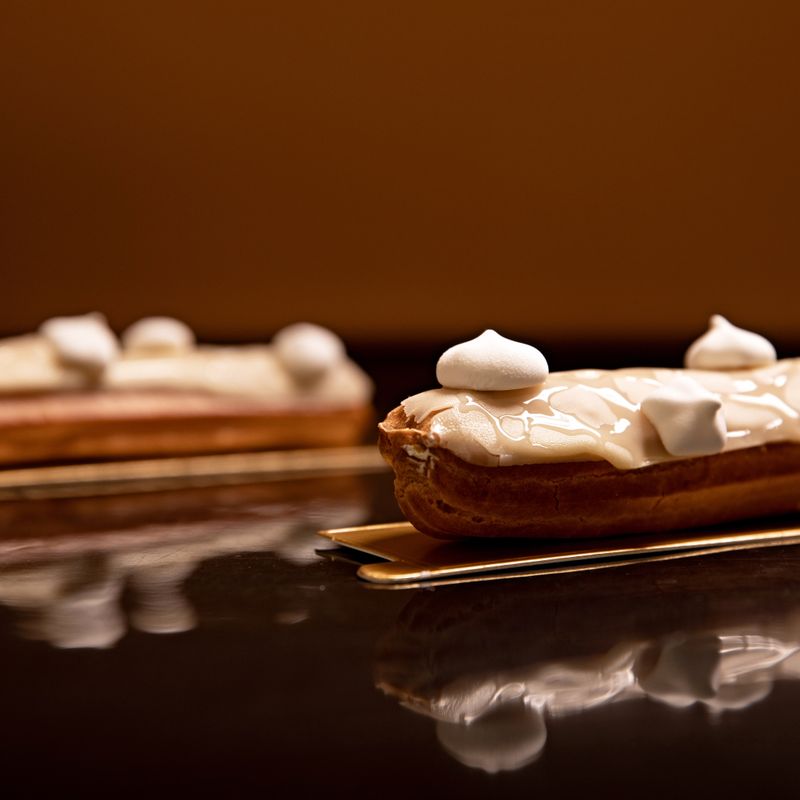
Miso Caramel Tahini Eclairs
Elegant choux pastry eclairs filled with silky tahini cream and topped with a umami-forward miso caramel glaze. The deep, complex sweetness of miso caramel pairs beautifully with the nutty tahini filling, creating a dessert that bridges Middle Eastern and Japanese flavor traditions. Light, airy pastry shells yield to creamy filling and a glossy, thin caramel coating in every bite.
- Prep
- 45 min
- Cook
- 55 min
- Wait
- 1 hr 30 min
- Total
- 3 hr 10 min
- Makes
- 12 eclairs
Steps
Before you start
- Preheat oven to 400°F (200°C) and line two baking sheets with parchment paper
- Have all ingredients at room temperature or as specified, including eggs and butter
- Use a piping bag fitted with a ½-inch (1.3 cm) round tip for the choux pastry
- Read through the entire recipe; timing is important for assembly before filling sets
Make the choux pastry
- In a medium saucepan, combine water, cold butter cubes, and salt.
- Heat over medium heat, stirring with a whisk until the butter completely melts and the mixture comes to a boil.
- The water should just begin to boil as the butter finishes melting.
- Remove from heat and add flour all at once, stirring vigorously with a wooden spoon until a rough dough forms and no dry flour remains (about 1 minute).
- Return the pan to medium heat and stir constantly for 2–3 minutes, pushing the dough against the sides of the pan.
- This dries out the dough slightly, which helps the pastry puff.
- Transfer to a bowl and let cool for 2 minutes.
+ Show details− Hide details
Ready when: Dough pulls away from pan sides and forms a ball; a thin film coats the bottom
Tip: Don't skip the 2–3 minute heating step after adding flour; it removes excess moisture so eclairs puff properly.
Incorporate eggs into choux
- With a hand mixer or wooden spoon, add the beaten room-temperature eggs to the cooled dough in four additions, beating well after each addition until fully incorporated before adding the next.
- The mixture will look broken at first, then come together into a smooth, glossy, pipeable batter.
- After the final egg addition, the dough should be pale, smooth, and fall slowly from a spoon—slightly thicker than cake batter but looser than cookie dough.
+ Show details− Hide details
Ready when: Mixture is pale, glossy, and falls in thick ribbons from a lifted spoon
Tip: Add eggs slowly; rushing this step or using cold eggs can cause the dough to break or not incorporate smoothly.
Pipe and bake eclairsOven 400°F / 205°C
- Transfer the choux batter to a piping bag fitted with a ½-inch (1.3 cm) round tip.
- Pipe 4-inch (10 cm) logs onto prepared baking sheets, spacing them 2 inches (5 cm) apart.
- You should have 12 eclairs.
- Bake at 400°F (200°C) for 15 minutes without opening the oven door.
- Reduce heat to 350°F (175°C) and bake for an additional 20–25 minutes, until the eclairs are golden brown and firm to the touch (they should not wobble).
- The pastry should sound slightly hollow when tapped.
- Do not open the oven during baking, as temperature fluctuations cause them to collapse.
+ Show details− Hide details
Ready when: Eclairs are deep golden, firm, and sound hollow when tapped; no beads of moisture on surface
Tip: Do not open the oven door during the first 15 minutes. Eclairs must puff in high, undisturbed heat before the structure sets.
Cool eclairs completely
- Transfer the baked eclairs to a wire rack and let cool at room temperature for 45 minutes to 1 hour.
- They will continue to firm up as they cool.
- Once cool, you can make a small hole in the bottom of each éclair with a small serrated knife or small piping tip to help release steam and allow for easier filling.
+ Show details− Hide details
Ready when: Eclairs are completely cool to the touch and firm throughout
Tip: Cooling is essential; filling warm eclairs causes the pastry to soften and the filling to melt.
Make tahini cream filling
- In a bowl, beat the room-temperature tahini and butter together with a hand mixer on medium speed for 1–2 minutes until pale and fluffy (this incorporates air).
- Add the sifted powdered sugar, salt, and vanilla extract.
- Beat on low speed at first to prevent sugar from flying, then increase to medium speed and beat for 2–3 minutes until the filling is light, creamy, and spreadable.
- If the filling seems too thick, add 1 teaspoon of milk or water at a time until it reaches the right consistency for piping—it should hold a soft peak but not be so stiff that it's difficult to work with.
- Don't overbeat or the filling will become grainy.
+ Show details− Hide details
Ready when: Filling is pale, smooth, fluffy, and holds a soft peak
Tip: Beat butter and tahini first to emulsify; this prevents the filling from separating or becoming grainy when the sugar is added.
Prepare miso caramel glazeOven 340°F / 170°C
- In a small saucepan, combine granulated sugar and water.
- Stir over medium heat until the sugar dissolves, then stop stirring.
- Let the mixture simmer without stirring until it reaches a medium amber color (around 330–340°F / 165–170°C on a candy thermometer), about 8–10 minutes.
- Watch carefully after 7 minutes, as caramel can darken quickly.
- When it reaches the right color (golden amber, not dark brown), remove from heat immediately.
- Whisk in the cold butter cubes one at a time, letting each piece melt before adding the next.
- The mixture will bubble slightly.
- Once all butter is incorporated, whisk in the white miso paste until fully dissolved and smooth.
- Let cool for 1 minute, then slowly whisk in the room-temperature heavy cream until combined.
- The glaze will be smooth, glossy, and pourable.
- Stir in the optional fleur de sel.
+ Show details− Hide details
Ready when: Caramel is medium amber (330–340°F / 165–170°C); miso and cream are fully incorporated and glaze is smooth and glossy
Tip: Do not stir the caramel once sugar has dissolved, or it will crystallize. Add butter off heat to avoid splattering. Miso paste can clump if whisked too vigorously; fold it in gently first, then whisk.
Assemble eclairs with filling
- Once eclairs are completely cool, transfer the tahini cream filling to a piping bag fitted with a small round or éclair filling tip (about ¼ inch / 0.6 cm diameter).
- If you made small holes in the bottoms, pipe filling through those holes until the éclair feels slightly full but not overstuffed (filling may appear at the hole, which is fine).
- Alternatively, you can pipe filling in from the ends or make shallow slits on the side using a small serrated knife and fill from there.
- Work quickly so the filling doesn't soften the pastry.
+ Show details− Hide details
Ready when: Eclairs are filled until just full; a small amount of filling may show at injection point
Tip: Fill eclairs as close to serving time as possible; they soften quickly when filled. If not serving within 2–3 hours, store unfilled and fill just before glazing.
Glaze and garnish eclairs
- If the miso caramel glaze has cooled and thickened, warm it gently over low heat or in short 10-second bursts in the microwave, stirring, until it reaches a dipping consistency (thick but pourable, like honey).
- It should coat the back of a spoon smoothly.
- Dip the top of each filled éclair into the warm glaze, angling gently to coat the top and upper sides.
- Let excess drip off, then place glazed éclair on a wire rack set over parchment (to catch drips).
- Immediately sprinkle a pinch of toasted white sesame seeds on each glazed éclair before the glaze sets (within 30 seconds).
- Let the glaze set at room temperature for 15–20 minutes.
+ Show details− Hide details
Ready when: Glaze is set and feels tacky (not sticky) to the touch; sesame seeds are adhered
Tip: Add sesame seeds immediately after glazing while the glaze is still slightly tacky so they adhere. If glaze becomes too thick, it will crack; if too thin, it won't coat evenly.
Good to know
Tips
- Choux pastry is temperature-sensitive; room-temperature eggs are non-negotiable. Cold eggs won't emulsify properly into the paste, and hot paste will cook the eggs, resulting in scrambled texture and poor rise.
- The 2–3 minute heating of the dough after flour is added removes excess moisture from the pastry. This step is what allows choux to puff dramatically in the oven; don't skip or rush it.
- Don't open the oven door during baking. Choux pastry must puff completely before the structure sets; opening the door causes pressure loss and collapse.
- Timing is key: fill eclairs close to serving time (within a few hours). Filled pastry softens quickly because the filling adds moisture. If you must prepare ahead, fill and glaze just 30 minutes to 1 hour before serving.
Make ahead
Baked unfilled eclairs can be made up to 2 days ahead; store in an airtight container at room temperature. Tahini filling can be made up to 1 day ahead and refrigerated in an airtight container. Miso caramel can be made up to 3 days ahead and reheated gently before use. For best results, fill and glaze eclairs no more than 3–4 hours before serving.
Storage & reheating
Assembled glazed eclairs keep for up to 3 days at room temperature in an airtight container, though the pastry will soften slightly over time. For longer storage (up to 5 days), refrigerate in an airtight container; the pastry will soften further but remain edible. Unfilled baked shells keep in an airtight container at room temperature for up to 2 days or in the freezer (in a freezer bag) for up to 3 months. Thaw frozen shells at room temperature for 30 minutes before filling and glazing. Do not freeze after filling or glazing, as the texture will suffer.
Substitutions
- tahini (sesame paste) → Almond butter or cashew butter. Use the same amount; the filling will be slightly less earthy but still creamy and delicious. Adjust powdered sugar slightly if the nut butter is sweeter.
- white miso paste → Red miso paste. Use the same amount; the glaze will be slightly saltier and deeper in color. Reduce the optional fleur de sel to ⅛ teaspoon if you prefer less salt.
- white sesame seeds → Crushed pistachio, black sesame seeds, or toasted chopped hazelnuts. Use the same amount; this changes the garnish but maintains the Middle Eastern-fusion aesthetic. Black sesame adds striking visual contrast.
- vanilla extract → Omit and add ½ teaspoon of rose or orange blossom extract. This deepens the Middle Eastern flavor profile; use half the amount of extract to avoid overpowering the tahini.
More no-bake desserts
See all →

Find more like this
- Meal
- Dessert
- Cuisine
- Japanese
- Diet
- VegetarianHalal