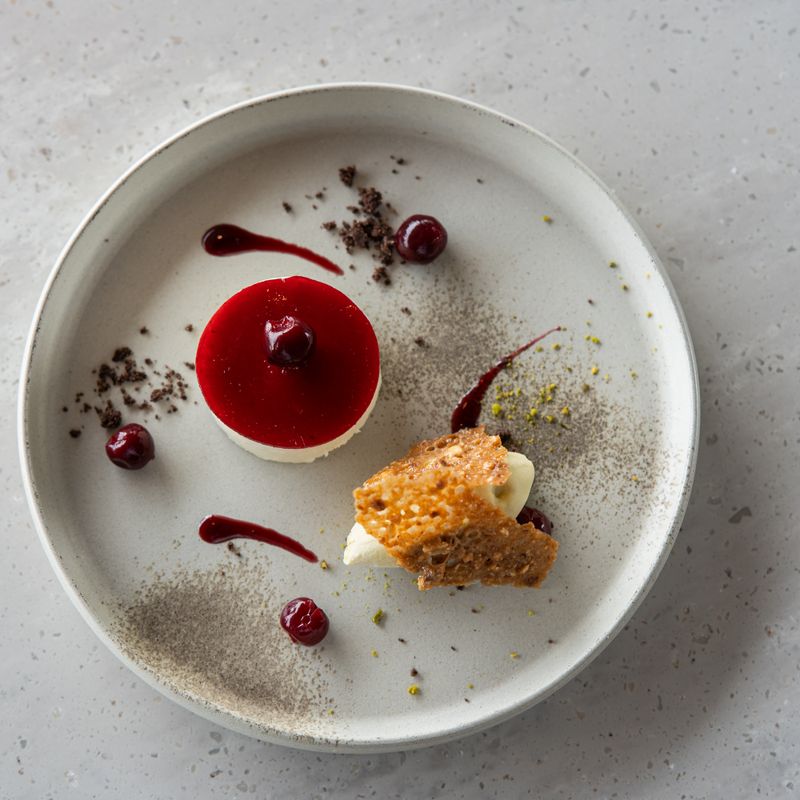
Mastic Panna Cotta with Sour Cherry Compote
A silky Middle Eastern custard infused with mastic gum's subtle piney sweetness, topped with a vibrant sour cherry compote. The panna cotta is delicate and creamy, while the tart compote cuts through the richness. Mastic gum—a resin from the mastic tree—adds aromatic complexity and a slightly grainy texture that's characteristic of the ingredient.
- Prep
- 20 min
- Cook
- 15 min
- Wait
- 5 hr
- Total
- 5 hr 35 min
- Makes
- 6 servings (about ¾ cup / 180 ml each)
Steps
Before you start
- Chill six 6-ounce (180 ml) ramekins or serving glasses in the refrigerator for at least 30 minutes before serving
- Bloom gelatin in cold water for at least 5 minutes (see step 1)
- Have all panna cotta ingredients measured before you begin heating the cream
- If using fresh sour cherries, pit them and reserve any juices
Bloom the gelatin
- Pour 3 tablespoons (45 ml) of cold water into a small bowl and sprinkle 2 teaspoons (6 g) of gelatin over the surface.
- Do not stir yet.
- Let it sit for 5 minutes until the gelatin absorbs the water and becomes spongy.
- This ensures the gelatin will dissolve smoothly without clumping.
+ Show details− Hide details
Ready when: Gelatin is spongy and has absorbed all the water
Tip: Never pour hot liquid over dry gelatin—always bloom it in cold water first to prevent lumps.
Infuse cream with masticOven 170°F / 75°C
- In a 2-quart (2 L) heavy-bottomed saucepan, combine 2 cups (480 ml) heavy cream, 1 cup (240 ml) whole milk, and 1 teaspoon (2 g) of mastic gum pieces.
- Heat over medium heat, stirring gently with a whisk, until the mixture reaches 170°F (77°C) or is steaming and just beginning to form small bubbles around the edges (do not boil).
- This takes about 10–12 minutes.
- The mastic pieces will soften and begin to infuse the cream.
+ Show details− Hide details
Ready when: Cream reaches 170°F (77°C) and is steaming; small bubbles form at edges
Tip: Watch the temperature carefully—overheating will cause the cream to scald and develop a skin, which affects texture.
Dissolve sugar and gelatin
- Remove the saucepan from heat.
- Add 0.5 cup (100 g) of sugar and whisk until dissolved, about 1 minute.
- Then add the bloomed gelatin (gently squeeze out excess water first) and whisk until completely dissolved, about 2–3 minutes.
- The mixture should be smooth with no visible gelatin particles.
- Strain the mixture through a fine-mesh sieve or cheesecloth into a clean bowl to remove any mastic pieces that haven't completely softened.
+ Show details− Hide details
Ready when: Sugar and gelatin are fully dissolved; mixture is smooth and pourable
Tip: Straining is essential to capture any remaining mastic pieces and ensure a silky texture in the final panna cotta.
Cool and flavor panna cotta
- Let the strained mixture cool to room temperature, about 10 minutes, stirring occasionally.
- Once cooled, stir in 1 teaspoon (5 ml) of vanilla extract.
- Divide the mixture evenly among six chilled 6-ounce (180 ml) ramekins or serving glasses, filling each about three-quarters full.
+ Show details− Hide details
Ready when: Mixture is barely warm to the touch
Tip: Pour when the mixture is still pourable but no longer hot; if it begins to set before pouring, gently rewarm it over low heat for 30 seconds.
Set panna cotta in refrigerator
- Cover the ramekins loosely with plastic wrap and refrigerate for at least 4 hours, or up to overnight, until the panna cotta is set and has a soft, spoonable custard texture.
+ Show details− Hide details
Ready when: Panna cotta jiggles slightly when gently shaken but holds its shape; a spoon can break through with gentle pressure
Tip: Do not skip the chilling time—the panna cotta will not set properly without adequate refrigeration.
Prepare sour cherry compote
- In a medium saucepan, combine 1.5 cups (350 g) of pitted sour cherries (fresh or thawed frozen), 0.25 cup (50 g) of sugar, 2 tablespoons (30 ml) of fresh lemon juice, 0.25 teaspoon (0.5 g) of ground cinnamon, and a small pinch of fine sea salt.
- (If using frozen cherries, include any reserved liquid in addition to the measured cherries.) Stir well.
+ Show details− Hide details
Tip: Weigh the cherries after pitting to ensure accuracy; frozen cherries often release liquid that counts toward the total weight.
Cook compote until syrupy
- Place the saucepan over medium heat and bring the compote to a gentle simmer, stirring occasionally, until the cherries begin to break down and the liquid thickens into a light syrup, about 8–10 minutes.
- The mixture should be jammy but still have visible cherry pieces; it will thicken further as it cools.
+ Show details− Hide details
Ready when: Compote is syrupy and coats the back of a spoon; cherries are soft and partially broken down
Tip: Stir frequently to prevent sticking to the bottom of the pan and to ensure even cooking.
Cool compote completely
- Transfer the compote to a clean bowl and let it cool to room temperature, about 15–20 minutes, stirring occasionally.
- The compote will continue to thicken as it cools.
- Taste and adjust seasoning with additional lemon juice or a pinch of salt if needed.
+ Show details− Hide details
Ready when: Compote is completely cool and has reached desired thickness
Tip: Cool the compote before serving or assembling so it won't melt the panna cotta.
Assemble and serve
- Remove the panna cotta from the refrigerator.
- Top each serving with 2–3 tablespoons (30–45 ml) of the cooled sour cherry compote.
- Garnish with a small handful of roughly chopped roasted pistachios, if desired.
- Serve chilled.
+ Show details− Hide details
Tip: If the panna cotta becomes too soft as it sits at room temperature (more than 15 minutes), return it to the refrigerator briefly before serving.
Good to know
Tips
- Mastic gum is sold in small quantities (often 1 ounce / 28 g containers) at Middle Eastern markets and some specialty spice shops; it has a subtle piney, slightly medicinal flavor that is essential to this recipe. Mastic pieces will soften when heated but may not dissolve completely—straining is non-negotiable.
- For the silkiest texture, strain the warm panna cotta mixture not once but twice: once after dissolving the gelatin and sugar, and again through fresh cheesecloth before pouring into ramekins, removing any impurities or undissolved mastic.
- The panna cotta should have a light jiggle when nudged, not solid firmness. If it's too stiff, reduce the gelatin slightly (start with 1.75 teaspoons / 5 g) in your next batch; if too soft, increase it by 0.25 teaspoon (0.75 g).
- Sour cherries are often sold frozen in larger quantities than fresh; they work beautifully here. If using very fresh cherries from the market, taste for tartness—some varieties are milder and may require an extra tablespoon of lemon juice.
Make ahead
Panna cotta can be prepared up to 2 days ahead; cover and refrigerate. Compote can be made up to 3 days ahead; store in an airtight container in the refrigerator. Assemble no more than 2 hours before serving to maintain the creamy texture of the panna cotta.
Storage & reheating
Panna cotta (in ramekins, loosely covered) keeps in the refrigerator for up to 3 days. Do not freeze—the gelatin texture will break down upon thawing. Sour cherry compote keeps in an airtight container in the refrigerator for up to 5 days or in the freezer for up to 3 months. Reheat compote gently over low heat or microwave for 30–45 seconds before serving if desired.
Substitutions
- Mastic gum (mastix) → Finely ground cardamom (use 0.5 teaspoon / 1 g) or a drop of rose water or orange blossom water. These aromatics provide a different but equally elegant flavor. Mastic's unique piney sweetness is irreplaceable, so use cardamom or floral waters only if mastic is unavailable.
- Sour cherries, fresh or frozen → Sour cherry juice or concentrate (if using concentrate, reduce to 1.5 tablespoons / 22 ml and add 0.5 cup / 120 ml water) or substitute with morello cherries, tart plum compote, or raspberry jam. The compote character will change slightly, but tartness is key. Adjust sugar to taste if using very sweet cherries.
- Heavy cream (36% fat or higher) → Crème fraîche mixed with whole milk (1.5 cups / 360 ml crème fraîche + 0.5 cup / 120 ml whole milk). This creates a slightly tangier panna cotta with a richer, more delicate texture. Do not use ultra-pasteurized cream, as it may not set as firmly.
- Roasted, shelled pistachios → Chopped blanched almonds, candied rose petals, or toasted pine nuts. Pistachios are traditional in Middle Eastern custards, but these garnishes maintain the elegant aesthetic and complement the mastic flavor.
More puddings & custards
See all →


Find more like this
- Meal
- Dessert
- Cuisine
- Middle Eastern
- Diet
- Gluten-Free