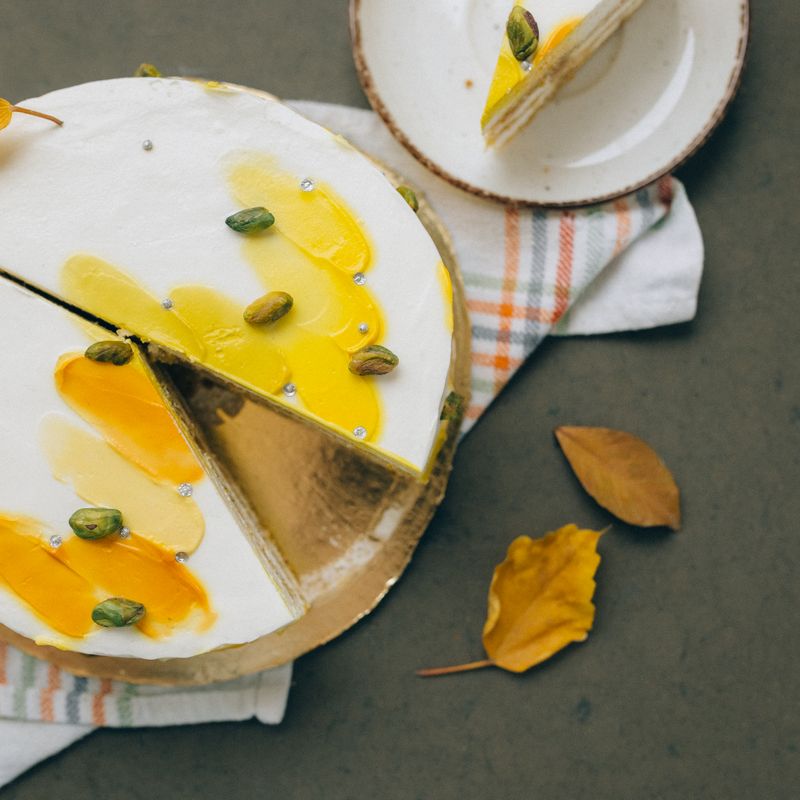
Mastic and Pistachio Morning Loaf Cake
A fragrant Middle Eastern–inspired butter cake infused with mastic resin's subtle floral notes and studded with roasted pistachios. The mastic creates a delicate, almost perfume-like aroma while the pistachios provide bursts of toasty flavor and color. Tender and moist, this loaf is perfect for breakfast, afternoon tea, or a light dessert.
- Prep
- 20 min
- Cook
- 50 min
- Wait
- 15 min
- Total
- 1 hr 25 min
- Makes
- 1 loaf (8 slices)
Steps
Before you start
- Preheat oven to 350°F (175°C) and position a rack in the center
- Bring eggs and butter to room temperature (about 1 hour)
- Grind mastic tears with 1 tablespoon of the measured sugar to prevent clumping
- Line a 9×5-inch (23×13 cm) loaf pan with parchment paper, leaving an overhang on two sides for easy removal
Cream butter and sugar
- In a large bowl, beat the room-temperature butter and the remaining sugar (not the 1 tablespoon reserved for mastic) with an electric mixer on medium-high speed for 3–4 minutes, until pale, fluffy, and the mixture increases in volume by about 50%.
- Scrape down the bowl halfway through.
+ Show details− Hide details
Ready when: Mixture is pale, light, and increased in volume
Tip: Do not skip this step—creaming incorporates air that makes the cake tender. Cold butter won't cream properly, so ensure it's truly soft.
Add eggs one at a time
- With the mixer on medium speed, add the eggs one at a time, beating for about 1 minute after each addition until fully incorporated.
- The batter may look slightly curdled at first—this is normal.
- After adding all three eggs, continue beating on medium-high for another minute until the mixture is smooth and homogeneous.
+ Show details− Hide details
Ready when: Batter is smooth, homogeneous, and slightly increased in volume
Tip: Adding eggs slowly and beating between additions ensures they emulsify with the butter-sugar mixture, creating a stable, light batter.
Mix in mastic, vanilla, and milk
- Reduce the mixer to low speed.
- Add the ground mastic powder and vanilla extract, beating for 30 seconds until the mastic is evenly distributed (the batter may have a faint greenish-beige tint).
- Alternate adding the milk and the dry ingredients in two additions: add half the milk, mix for 15 seconds, then add half the flour mixture (see next step), mix for 15 seconds, repeat with the remaining milk and flour mixture.
- Do not overmix—stop as soon as no dry streaks remain.
+ Show details− Hide details
Ready when: Batter is uniform, no visible dry streaks, mastic is evenly distributed
Tip: Overmixing will develop gluten and make the cake tough. Stop mixing the moment you see no white streaks of flour.
Combine dry ingredients
- In a small bowl, whisk together the flour, baking powder, and salt to aerate and distribute the leavening evenly.
- Set aside.
- (This step is done before mixing into the wet ingredients in step 3.)
+ Show details− Hide details
Ready when: Dry ingredients are evenly mixed with no lumps
Tip: Whisking the dry ingredients ensures the baking powder is distributed, preventing dense patches in the cake.
Fold in pistachios
- Using a rubber spatula, gently fold the chopped pistachios into the batter with 8–10 strokes, turning the bowl as you fold.
- Be gentle to avoid crushing the pistachios further and keep the batter light.
+ Show details− Hide details
Ready when: Pistachios are evenly scattered throughout the batter
Tip: Folding (not stirring or mixing) preserves the airiness of the batter. Chop pistachios coarsely so they don't sink to the bottom and get lost.
Transfer to prepared pan
- Pour the batter into the lined loaf pan, smoothing the top gently with a spatula.
- Tap the pan on the counter a few times to release any large air bubbles.
- The batter should reach about three-quarters full.
+ Show details− Hide details
Ready when: Batter is evenly distributed and tops are level
Tip: Do not overfill the pan, or the cake may rise above the edges and brown too much on the sides.
Bake the loafOven 350°F / 175°C
- Place the loaf pan in the preheated 350°F (175°C) oven on the center rack.
- Bake for 48–52 minutes.
- The cake is done when a toothpick inserted into the center comes out with just a few moist crumbs (not wet batter).
- The top should be golden brown and spring back lightly when gently touched.
- If the top is browning too quickly before the center is done, loosely cover the pan with aluminum foil for the last 10 minutes.
+ Show details− Hide details
Ready when: Toothpick inserted in the center comes out with just a few moist crumbs; top is golden brown
Tip: Oven temperatures vary. Start checking at 45 minutes if your oven runs hot. A cake tester is more reliable than relying on time alone.
Cool in pan and turn out
- Remove the loaf from the oven and let it rest in the pan for 10 minutes at room temperature.
- The residual heat continues to set the crumb gently.
- Then, run a thin knife around the edges to loosen the cake, grip the parchment paper overhang, and carefully lift the loaf from the pan.
- Set it on a wire cooling rack (or a baking sheet) and let it cool completely for at least 5 minutes before slicing, though it can be served warm or at room temperature.
+ Show details− Hide details
Ready when: Cake is firm enough to handle and transfer to a cooling rack
Tip: Cooling in the pan for a few minutes prevents the cake from breaking apart. If you remove it too soon, it's fragile; too late, and moisture can condense on the surface.
Good to know
Tips
- Mastic resin (gum mastic) is sold in specialty Middle Eastern, Mediterranean, and Indian markets, often in small containers. It is expensive but lasts for months when stored in a cool, dry place. Grinding it with a small amount of sugar prevents it from clumping or turning oily when mixed into the batter.
- Room-temperature ingredients—butter, eggs, and milk—emulsify evenly and create a lighter, more uniform crumb. Cold ingredients can cause the batter to curdle and make the final texture dense.
- Resist the urge to overmix once the dry ingredients are added. Mixing past the point of visible dry streaks develops gluten, which toughens the cake.
- This cake is at its best served slightly warm with a cup of tea or coffee. The mastic's subtle perfume-like aroma is more pronounced when the cake is warm.
Make ahead
Prepare the dry ingredients (flour, baking powder, salt) and grind the mastic with sugar up to 1 day ahead. Store the mastic powder in an airtight container. Soften the butter at room temperature for 1 hour before you begin mixing.
Storage & reheating
Room temperature: up to 2 days in an airtight container or wrapped in plastic wrap. The cake dries out slightly but remains pleasant. Refrigerator: up to 5 days in a sealed container; slice and serve at room temperature or warm gently. Freezer: up to 3 months wrapped tightly in plastic wrap and foil; thaw at room temperature for 2–3 hours. Do not freeze after frosting or glazing (none in this recipe).
Substitutions
- mastic resin tears (gum mastic) → 0.5 teaspoon of ground cardamom or a pinch of anise seed (ground). These warm spices echo the floral note of mastic but are more assertive. Reduce the amount slightly and taste the batter if adjusting.
- unsalted roasted pistachios → 0.75 cup (100 g) of coarsely chopped roasted almonds or hazelnuts. Almonds are milder, hazelnuts are richer and earthier. The cake's structure remains the same; only the flavor profile changes.
- whole milk → 0.5 cup (120 ml) of unsweetened Greek yogurt or sour cream (thinned with 2 tablespoons water). Yogurt or sour cream add tanginess and moisture, resulting in a slightly denser, more tender crumb. Adjust water as needed for proper batter consistency.
- all-purpose flour → 1.75 cup (215 g) of cake flour or a blend of 1.5 cup all-purpose flour mixed with 2.5 tablespoons cornstarch. Cake flour or cornstarch reduces protein and tenderizes the crumb, making it more delicate. Do not use whole-wheat flour, as it will overpower the subtle mastic flavor.
More brownies & bars
See all →



Find more like this
- Meal
- Breakfast
- Cuisine
- Middle Eastern
- Diet
- VegetarianHalal
- Quick & Easy
- Easy