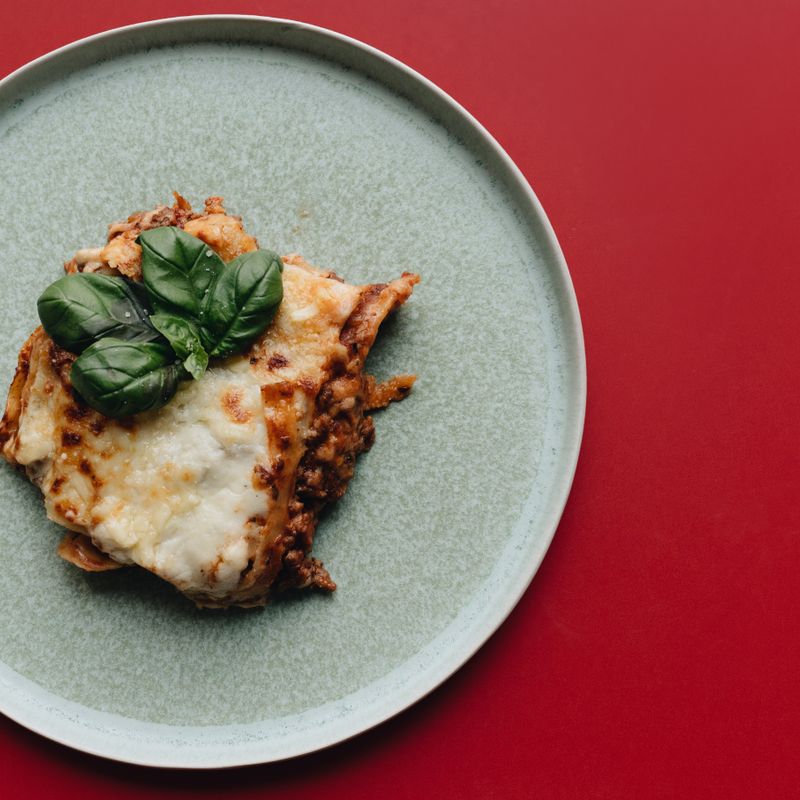
Massaman Beef Lasagna
Layers of tender noodles, a fragrant massaman-spiced beef and potato ragu, and a silky coconut béchamel, all blanketed in melted mozzarella and crunchy roasted peanuts. It has the comfort of classic lasagna with the warm, sweet-savory spice of a Thai massaman curry.
- Prep
- 45 min
- Cook
- 1 hr 25 min
- Wait
- 20 min
- Total
- 2 hr 30 min
- Makes
- 1 lasagna in a 9×13-inch dish (8 generous squares)
Steps
Before you start
- Shred the mozzarella from a block if you can; it melts more smoothly than pre-shredded cheese.
- Read the method through once: the ragu simmers while you make the béchamel and boil the noodles, so you will be multitasking in the middle.
- Use a 9×13-inch (23×33 cm) baking dish at least 2½ inches (6 cm) deep and set a rack in the center of the oven.
- Check that your roasted peanuts are unsalted or lightly salted; if heavily salted, reduce the salt in the ragu to ½ teaspoon.
Prep the ingredients
- Peel and dice the onions, mince the garlic, grate the ginger, and peel and cut the potatoes into ½-inch (1.25 cm) cubes.
- Chop both portions of peanuts and keep them in separate small bowls.
- Shred the mozzarella.
- Cut the lime into wedges.
- Put the potatoes in a bowl of cold water until needed so they do not brown.
+ Show details− Hide details
Ready when: Potatoes are an even ½-inch dice so they cook at the same rate.
Tip: Cut the potatoes no larger than ½ inch, or they will still be firm after baking.
Brown beef and onions
- Heat the oil in a 12-inch (30 cm) deep skillet or Dutch oven over medium-high heat until it shimmers.
- Add the onions and 1 teaspoon salt and cook, stirring often, for 5 minutes until soft and translucent.
- Add the beef and break it into small crumbles with a wooden spoon.
- Cook for 7 to 8 minutes, stirring now and then, until no pink remains and the beef is lightly browned with some crisp edges.
+ Show details− Hide details
Ready when: Beef is fully gray-brown with no pink, and the pan bottom has browned bits.
Tip: If the beef releases a lot of liquid, let it cook off before moving on so the ragu does not turn watery.
Bloom the curry paste
- Reduce the heat to medium.
- Push the beef to one side, spoon off all but about 2 tablespoons of excess fat if the pan looks greasy, then add the garlic, ginger, and 4 tablespoons massaman paste.
- Stir the paste into the beef and cook for 2 minutes until very fragrant and a shade darker.
+ Show details− Hide details
Ready when: The paste smells toasty and spicy and has coated the beef in an even rusty-orange color.
Tip: Keep stirring so the paste does not scorch on the bottom of the pan.
Simmer the ragu
- Drain the potatoes and add them to the pan with 1 can coconut milk, the stock, fish sauce, brown sugar, tamarind paste, and bay leaves.
- Stir well and scrape up any browned bits.
- Bring to a steady simmer over medium heat, then reduce to medium-low and simmer, partly covered and stirring every 5 minutes, for 20 minutes.
+ Show details− Hide details
Ready when: A potato cube is just tender when pierced with a knife (it will finish in the oven), and the sauce is thick enough that a spoon dragged across the bottom leaves a trail that closes slowly.
Tip: Use this time to make the béchamel and boil the noodles (next two steps).
Finish the ragu
- Remove the bay leaves.
- Stir in the ½ cup (60 g) peanuts.
- Taste and adjust: add a splash more fish sauce for salt, a pinch of sugar for sweetness, or a little more tamarind for tang.
- Remove from the heat.
- The ragu should be thick and scoopable, not soupy; if it is loose, simmer 3 to 5 minutes more.
+ Show details− Hide details
Ready when: Ragu mounds on a spoon and balances salty, sweet, and tangy flavors.
Tip: Make the ragu slightly saltier than you think necessary; the noodles and béchamel will mellow it.
Make coconut béchamel
- In a 3-quart (3 L) saucepan, melt the butter over medium heat.
- Whisk in the flour and cook for 1 minute, whisking constantly, until it smells nutty but has not browned.
- Whisk in the 1 tablespoon curry paste.
- Slowly pour in the coconut milk and whole milk in a thin stream, whisking constantly to prevent lumps.
- Add ¾ teaspoon salt.
- Cook, whisking, for 6 to 8 minutes until the sauce thickens and just starts to bubble.
+ Show details− Hide details
Ready when: The sauce coats the back of a spoon and a finger drawn across leaves a clean line; it should be pourable, like thin custard.
Tip: Add the liquid slowly at first. If lumps form, whisk vigorously or pass the sauce through a fine sieve.
Boil the noodlesOven 375°F / 190°C
- Preheat the oven to 375°F (190°C).
- Bring a large pot of generously salted water to a boil over high heat.
- Cook the 9 lasagna noodles for 2 minutes less than the package time, usually about 8 to 9 minutes, stirring in the first minute so they do not stick.
- Drain and lay them flat in a single layer on a lightly oiled baking sheet or in a bowl of cool water.
+ Show details− Hide details
Ready when: Noodles are pliable but still slightly firm in the center (al dente).
Tip: Do not fully cook the noodles; they will absorb moisture from the sauces in the oven.
Assemble the layers
- Spread ¾ cup (180 ml) of béchamel over the bottom of the 9×13-inch dish.
- Lay 3 noodles side by side, slightly overlapping.
- Top with one-third of the ragu (about 2 cups), then one-quarter of the remaining béchamel, then ¾ cup (85 g) mozzarella.
- Repeat for a second layer.
- Finish with the last 3 noodles, all remaining béchamel spread to the edges so no noodle is exposed, and the remaining mozzarella.
- Scatter the ⅓ cup (40 g) peanuts over the top.
+ Show details− Hide details
Ready when: Three noodle layers with two ragu layers between them, and the top noodles completely covered with sauce.
Tip: Fully covering the top noodles with sauce keeps them from drying out and turning hard.
Bake coveredOven 375°F / 190°C
- Cover the dish tightly with foil, tented slightly so it does not touch the cheese (or spray the foil with oil).
- Place the dish on a rimmed baking sheet to catch any drips.
- Bake at 375°F (190°C) on the center rack for 30 minutes.
+ Show details− Hide details
Ready when: Edges are bubbling and the sauce at the corners is steaming when you lift a corner of the foil.
Tip: The foil keeps the surface moist while the center heats through.
Uncover and brownOven 375°F / 190°C
- Remove the foil carefully, away from your face, to avoid steam.
- Bake uncovered at 375°F (190°C) for 18 to 20 minutes more until the cheese is melted, spotted golden brown, and the sauce is bubbling around the edges.
- An instant-read thermometer inserted into the center should read at least 165°F (74°C).
+ Show details− Hide details
Ready when: Golden-brown cheese with bubbling edges and a 165°F (74°C) center temperature.
Tip: If the peanuts brown too fast, loosely tent the dish with foil for the last few minutes.
Rest the lasagna
- Transfer the dish to a wire rack and let the lasagna rest for 20 minutes.
- This allows the layers to set so squares cut cleanly rather than sliding apart.
+ Show details− Hide details
Ready when: Bubbling has stopped and the sauce no longer runs when you press the surface with a spatula.
Tip: Do not skip the rest, or the first squares will collapse.
Garnish and serve
- Sprinkle the lasagna with the chopped cilantro and crispy fried shallots, if using.
- Cut into 8 squares with a sharp knife and lift out with a wide spatula.
- Serve each portion with a lime wedge to squeeze over the top.
+ Show details− Hide details
Tip: A squeeze of lime just before eating brightens the rich coconut sauce.
Good to know
Tips
- Massaman paste brands vary a lot in heat and salt. Taste the ragu before assembling and adjust the fish sauce, sugar, and tamarind to balance it.
- Shake the coconut milk cans well or whisk them in a bowl before measuring so the cream and thin milk are evenly mixed.
- Cut the potatoes small and simmer them until just tender; they continue to soften in the oven and should hold their shape rather than collapse.
- Use regular noodles rather than no-boil here: the ragu is thick and the pre-cooked noodles give a more tender result.
Make ahead
"Make the ragu and béchamel up to 2 days ahead and refrigerate separately in airtight containers (press plastic wrap onto the béchamel's surface). You can assemble the whole lasagna up to 24 hours ahead, cover, and refrigerate; add 10 to 15 minutes to the covered baking time, as the dish will be cold. Let it stand at room temperature for 30 minutes before baking if possible."
Storage & reheating
"Room temperature: up to 2 hours after baking. Refrigerator: covered airtight up to 4 days. Freezer: individually wrapped squares or the whole dish, tightly wrapped, up to 3 months; thaw overnight in the fridge. Reheat portions covered with foil in a 350°F (175°C) oven for 20 to 25 minutes (30 to 40 for a frozen-thawed whole dish), or microwave single squares at 70% power for 2 to 3 minutes, until steaming hot and 165°F (74°C) in the center."
Substitutions
- ground beef, 80% lean → Ground lamb or ground chicken thigh. Lamb is traditional in massaman-style dishes; chicken makes a lighter version (cook to 165°F / 74°C).
- tamarind paste (concentrate) → Fresh lime juice (1 tablespoon). Gives a similar tang, though without tamarind's fruity depth.
- low-moisture whole-milk mozzarella → Monterey Jack or a mild white cheddar. Both melt well and keep the spiced flavors in front.
- roasted unsalted peanuts → Roasted cashews. Use for both peanut amounts if you have a peanut allergy in the house only if cashews are safe for your guests; otherwise omit.