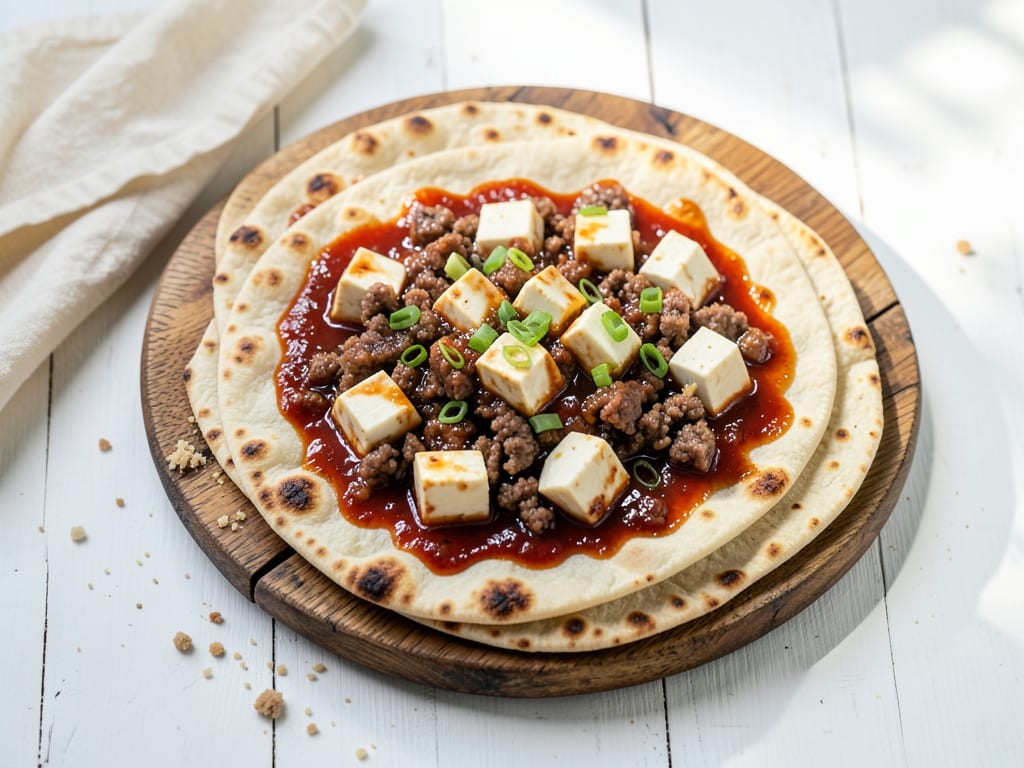
Mapo Tofu Manakish
Soft, chewy Lebanese-style flatbreads topped with a thick, fiery doubanjiang pork sauce, silky tofu cubes and a numbing hit of Sichuan pepper. Baked hot and finished with scallions and sesame, they taste like mapo tofu you can eat by hand.
- Prep
- 54 min
- Cook
- 35 min
- Wait
- 1 hr 15 min
- Total
- 2 hr 44 min
- Makes
- 8 six-inch (15 cm) manakish (2 per serving)
Steps
Before you start
- Read the timing: the dough needs about 1 hour to rise, and you can make the pork sauce while it rises.
- Doubanjiang is salty, so don't add extra salt to the filling. Brands vary in heat, so taste a little first.
- Set a rack in the lower third of the oven and put a heavy rimmed baking sheet on it before preheating, so the bread bakes on a hot surface.
- Have two parchment sheets cut to fit your baking sheet, because you will bake in two batches of 4.
Mix the dough
- In a large bowl or stand mixer bowl, whisk the bread flour, instant yeast, sugar_dough and fine salt.
- Add the warm water and 3 tbsp (45 ml) olive oil.
- Stir with a wooden spoon or the dough hook on low until no dry flour remains and a shaggy dough forms, about 2 minutes.
+ Show details− Hide details
Ready when: No dry flour is left and the dough looks shaggy and sticky.
Tip: Salt and yeast can be whisked together safely in the flour; just don't pour hot water onto the yeast, since it can kill it.
Knead until smooth
- Knead with the dough hook on medium-low for 6 minutes, or by hand on a lightly floured counter for 8–10 minutes.
- The dough should be soft and slightly tacky.
- Shape it into a ball and place it in a lightly oiled bowl.
+ Show details− Hide details
Ready when: Dough is smooth and springs back slowly when you press it with a finger.
Tip: Resist adding much more flour. A slightly tacky dough bakes into a softer manakish.
First rise
- Cover the bowl with a damp towel or plastic wrap and leave at warm room temperature (about 75°F/24°C) for 60 minutes.
- Use this time to prepare the topping.
+ Show details− Hide details
Ready when: Dough has doubled and a floured finger leaves a dent that fills back in slowly.
Prep tofu and spice
- Toast the Sichuan peppercorns in a small dry skillet over medium-low heat for 1–2 minutes until fragrant, then grind finely.
- Bring the blanch water and 1 tsp kosher salt to a gentle simmer (small bubbles, not a rolling boil).
- Slide in the tofu cubes and cook 2–3 minutes to firm them.
- Lift out with a slotted spoon, then drain in a sieve and pat dry gently on paper towels.
- Mince the garlic, grate the ginger and slice the scallions, keeping whites and greens separate.
+ Show details− Hide details
Ready when: Peppercorns smell citrusy and floral; tofu cubes feel slightly firmer and hold their edges.
Tip: Handle the tofu as little as possible. Dry cubes bake better, because wet tofu will make the bread soggy.
Brown the pork
- Heat 1 tbsp neutral oil in a 12-inch (30 cm) skillet over medium-high heat until it shimmers.
- Add the ground pork, breaking it into small crumbles, and cook 4–5 minutes until the liquid evaporates and the edges are browned.
- Push the pork aside, add the doubanjiang to the open space and fry 30–40 seconds until the oil turns red and smells savory.
- Stir in the garlic, ginger and scallion whites and cook 30 seconds.
+ Show details− Hide details
Ready when: Pork is no longer pink, with browned bits, and the oil is red from the paste.
Tip: If the paste starts to scorch, lower the heat. Burnt doubanjiang tastes bitter.
Thicken the sauce
- Pour in the chicken stock, soy sauce and sugar_topping and bring to a simmer.
- Stir the cornstarch with the cold water, then stir it into the pan.
- Simmer 2–3 minutes, stirring, until the sauce clings to the pork like a thick paste.
- Remove from the heat and stir in half the ground Sichuan pepper.
- You should have about 1 cup (250 ml) of filling.
- Cool 10 minutes.
+ Show details− Hide details
Ready when: Dragging a spoon through the pan leaves a trail that closes slowly; no pooling liquid. Pork reads at least 160°F (71°C).
Tip: A thin, runny filling will slide off the dough. Keep simmering until it's spoonable and thick.
Divide and restOven 475°F / 245°C
- Preheat the oven with the baking sheet inside to 475°F (245°C).
- Punch down the risen dough, turn it out onto a lightly floured counter, and cut into 8 pieces of about 107 g each.
- Roll each into a smooth ball, cover with a towel and rest 15 minutes.
+ Show details− Hide details
Ready when: Balls are smooth and puffy, and spring back slowly when poked.
Tip: Weigh the pieces so the manakish bake evenly.
Shape the rounds
- On a lightly floured counter, roll or pat 4 balls into 6-inch (15 cm) rounds, about ¼ inch (6 mm) thick.
- Pinch and fold the outer ½ inch (1.25 cm) into a raised rim.
- Place on a sheet of parchment sized for your baking sheet.
- Dimple the centers with your fingertips so they don't puff.
+ Show details− Hide details
Ready when: Rounds have a defined rim and a flat, dimpled center.
Tip: Keep the remaining dough covered so it doesn't dry out and form a crust.
Top and bake batch oneOven 475°F / 245°C
- Spread 2 tbsp of the filling over the center of each round, staying inside the rim.
- Scatter 5–6 tofu cubes (about 42 g) over each and press them gently into the filling so they stay put.
- Brush the rims with olive oil.
- Slide the parchment onto the hot baking sheet and bake at 475°F (245°C) for 8–9 minutes.
+ Show details− Hide details
Ready when: Rims are golden brown, the underside is lightly browned, and the filling is bubbling at the edges.
Tip: Don't overload the centers. Heavy toppings keep the dough from baking through.
Shape and bake batch twoOven 475°F / 245°C
- While batch one bakes, roll and shape the remaining 4 balls onto a second sheet of parchment.
- Move the first batch to a wire rack, reheat the oven if the temperature dipped, then top, oil and bake batch two exactly as before, 8–9 minutes.
+ Show details− Hide details
Ready when: Rims are deeply golden and the filling is bubbling.
Tip: Keep the second batch of dough covered until you shape it.
Finish and serve
- Sprinkle all the manakish with the scallion greens, toasted sesame seeds and the remaining Sichuan pepper.
- Drizzle with chili oil, if using.
- Let them cool 3 minutes, then serve warm.
+ Show details− Hide details
Tip: Add the scallion greens after baking so they stay bright green and fresh.
Good to know
Tips
- Make the filling thicker than you think you need. The tofu releases a little moisture as it bakes.
- Toast and grind the Sichuan peppercorns fresh. Pre-ground pepper loses its numbing, floral quality quickly.
- A preheated baking sheet or baking steel gives the dough an immediate lift and a crisp underside.
- For more heat, add 1 tsp chili flakes to the pork with the doubanjiang; for less, cut the doubanjiang to 1 tbsp.
Make ahead
"The dough can rise in the fridge for 8–24 hours (covered, in an oiled bowl); let it sit at room temperature for 30 minutes before dividing. The pork filling can be made up to 2 days ahead and refrigerated. Blanch the tofu and assemble just before baking."
Storage & reheating
"Best eaten the day it's baked. Cool leftovers completely, then refrigerate in an airtight container up to 3 days. Reheat on a baking sheet at 375°F (190°C) for 6–8 minutes. Freezing isn't ideal with tofu on top, but the baked bases with filling (no tofu) freeze up to 1 month; thaw overnight, reheat as above, and top with fresh tofu cubes."
Substitutions
- ground pork → ground beef, ground chicken thigh or finely chopped shiitake mushrooms. Use mushrooms with vegetable stock for a vegetarian version; cook until their moisture evaporates. Poultry must reach 165°F (74°C).
- doubanjiang (spicy fermented broad bean paste) → gochujang plus 1 tsp miso. Milder and sweeter; use 2 tbsp total and skip the sugar.
- soft tofu → firm tofu. Easier to handle and drains better; blanch 2 minutes and pat dry as written.
- bread flour → all-purpose flour. Gives a slightly softer, less chewy crumb; reduce the water to 280 ml.