Maple Dijon Mustard Marinade For Root Vegetables
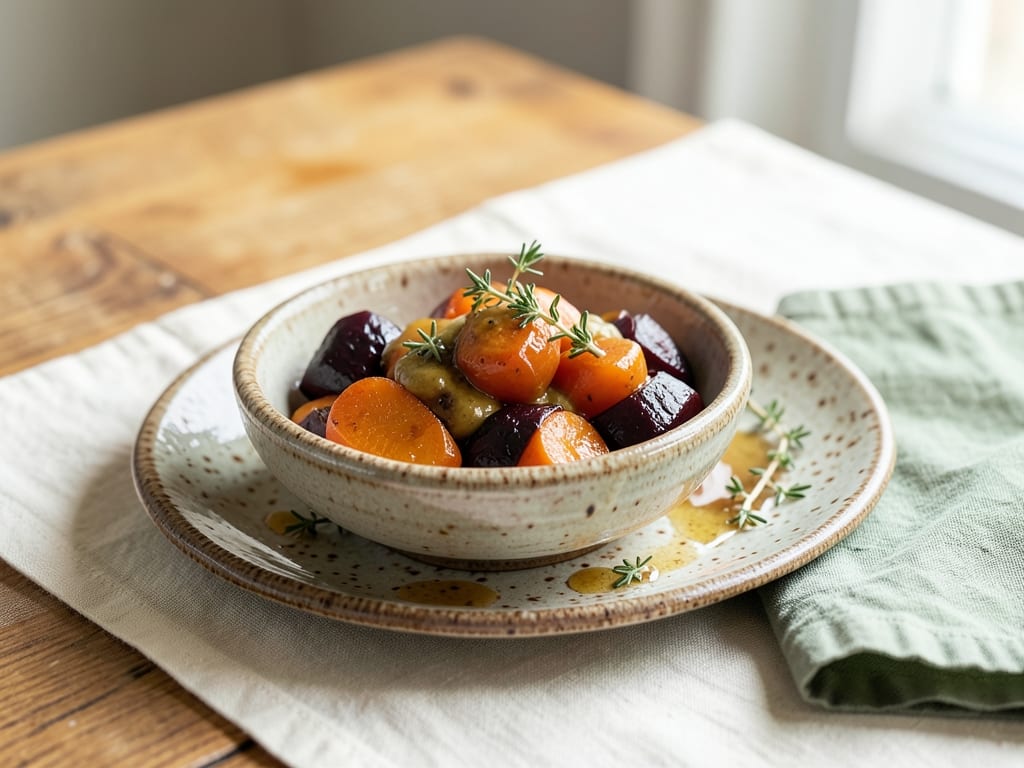
A sweet and tangy cold marinade infused with maple syrup, Dijon mustard, and fresh thyme that transforms raw root vegetables into a tender, flavorful side dish. The combination of maple's subtle sweetness, mustard's sharpness, and aromatic thyme creates a sophisticated accompaniment perfect for entertaining or meal prep. Vegetables soften gently as they absorb the complex flavors, improving over time.
- Prep
- 20 min
- Cook
- —
- Wait
- 1 hr
- Total
- 1 hr 20 min
- Makes
- Serves 4–6 as a side dish (about 1.75 lbs or 800 g marinated vegetables)
Steps
Before you start
- Use fresh thyme if available for the best flavor—dried thyme will work but use only 1 teaspoon instead of 2 tablespoons
- Wash and peel all vegetables before you begin cutting
- Cut vegetables into uniform 1/2-inch pieces so they marinate evenly and look polished
- This marinade improves with time—make it 1–2 days ahead for even deeper flavor development
Prep and Cut Vegetables
- Wash all vegetables thoroughly under cold running water to remove any dirt.
- Using a vegetable peeler or sharp knife, peel the carrots, beets, parsnips, and turnips completely.
- On a clean cutting board, cut all peeled vegetables into uniform 1/2-inch cubes or batons.
- Consistent sizing is crucial because it ensures all pieces marinate at the same rate and will have the same texture.
- Place the cut vegetables into a large mixing bowl.
+ Show details− Hide details
Ready when: All vegetables are peeled, cut into uniform 1/2-inch pieces, and ready for marinating.
Tip: Cut beets last or in a separate bowl—their pigment will stain other vegetables pink or red if allowed to sit together during cutting.
Whisk Together Marinade
- In a separate large mixing bowl or the same bowl holding the vegetables (if it's large enough), whisk together the maple syrup, Dijon mustard, balsamic vinegar, and olive oil.
- Add the minced garlic, fresh thyme leaves (or dried thyme if substituting), coarse sea salt, and freshly ground black pepper.
- Whisk vigorously for about 1 minute until the mustard is fully incorporated and the mixture looks smooth and slightly emulsified, with no visible streaks of mustard remaining.
+ Show details− Hide details
Ready when: The marinade is smooth, well-combined, and uniform in color with no visible mustard streaks.
Tip: If you like, whisk the mustard with the vinegar and maple syrup first before adding the oil—this helps the mustard dissolve evenly rather than clumping up.
Coat Vegetables with Marinade
- Add all of the prepared vegetable pieces to the bowl with the marinade (or transfer the vegetables to the marinade bowl if you made them separately).
- Using a rubber spatula or wooden spoon, toss everything gently but thoroughly for about 2–3 minutes, turning vegetables over repeatedly and making sure every piece gets coated with the marinade.
- Scrape along the bottom of the bowl to ensure no vegetables are sitting dry.
+ Show details− Hide details
Ready when: Every piece of vegetable is glistening with marinade; no dry vegetables visible at the bottom of the bowl.
Tip: If your vegetables are very wet from washing, pat them gently with clean kitchen towels or paper towels first—excess water will dilute the marinade and mute the flavors.
Chill and Marinate
- Cover the bowl tightly with plastic wrap or transfer to an airtight container with a fitted lid.
- Refrigerate the vegetables for at least 30 minutes for a quick, light marinade.
- For considerably better flavor depth and for the vegetables to become tender, aim for 1–2 hours of marinating.
- For the absolute best results, marinate for 4 hours or overnight, stirring gently every 30–60 minutes if you're nearby.
- The vegetables will gradually soften and their flavors will deepen as they absorb the marinade.
+ Show details− Hide details
Ready when: Vegetables are tender when pierced with a fork and taste rich with balanced sweetness, tang, and sharp mustard notes.
Tip: Don't hesitate to let them marinate longer than recommended—overnight or even 2 days ahead will make them even more flavorful and tender. The vegetables are often best the day after marinating.
Taste and Adjust Seasoning
- Remove the marinated vegetables from the refrigerator.
- Taste a piece of vegetable and a small amount of the surrounding liquid to check the flavor balance.
- The taste should be pleasant across all elements: the subtle sweetness of maple, the tanginess of vinegar, the sharpness of mustard, and the savory salt and pepper.
- If the flavors taste flat or muted, add a pinch more salt and stir well.
- If you want more sweetness, drizzle in 1 teaspoon of maple syrup.
- If you want more tang, add 1 teaspoon of balsamic vinegar.
- Taste again and adjust as needed.
+ Show details− Hide details
Ready when: Flavors are balanced and delicious; you are satisfied with the sweetness, tang, and savory notes.
Tip: Remember that flavors will intensify and become more concentrated as the vegetables sit longer, so avoid over-seasoning at the end. It's better to under-season slightly and adjust later than to add too much salt early on.
Good to know
Tips
- Beets will stain the other vegetables pink or red if they sit together while cutting or marinating. To prevent this, either cut them separately and add them to the marinade in the last 30 minutes before serving, or marinate them separately in half the marinade and combine when serving.
- This marinade also works beautifully with roasted vegetables. Roast any of these vegetables at 400°F (200°C) for 20–25 minutes until tender, then toss with the marinade while still warm and let cool in the refrigerator. The warm vegetables will absorb the flavors even faster.
- The leftover marinade is delicious as a salad dressing for mixed greens or as a drizzle for roasted vegetables and grains. Don't discard it—it's liquid gold.
- For a warm version, you can lightly roast the marinated vegetables at 400°F (200°C) for 15–20 minutes to enhance their natural sweetness while warming through, then serve immediately.
Make ahead
Yes. This marinade improves with time. Prepare up to 2 days ahead and store in the refrigerator in an airtight container. The vegetables will continue to marinate and develop richer flavor, making them even better the next day. Stir gently once or twice during storage to redistribute the marinade."
Storage & reheating
Refrigerate in an airtight container for up to 5 days. The vegetables will become increasingly tender and flavorful with time. Serve chilled straight from the refrigerator or bring to room temperature by removing from the fridge 30 minutes before serving. Do not freeze—the vegetables will become mushy and unpleasant when thawed."
Substitutions
- large carrots → celery root, radishes, rutabaga, or sweet potatoes, cut to the same 1/2-inch size. Each root vegetable adds its own unique flavor and texture. Celery root is earthy, radishes add peppery crunch, rutabaga is slightly sweet, and sweet potatoes add soft sweetness.
- pure maple syrup → honey (use 2 tablespoons for a less maple-forward flavor), agave nectar, or light brown sugar dissolved in 1 tablespoon warm water. Honey will create a different flavor profile—slightly more floral. Brown sugar gives a molasses-like depth. Avoid dark maple syrup as it can overpower the other flavors.
- Dijon mustard → whole grain mustard (use 2.5 tablespoons for texture) or smooth yellow mustard (use 2 tablespoons). Whole grain mustard creates a chunkier marinade with visible seeds, while yellow mustard is milder and sweeter. Avoid spicy mustards unless you specifically want heat.
- fresh thyme → fresh rosemary (1 tablespoon), oregano (1.5 tablespoons), or dried Italian seasoning (1 teaspoon). Rosemary is more robust and woody, oregano adds an earthy Mediterranean note, and Italian seasoning brings a complex herb blend. Use half the amount if using dried herbs.