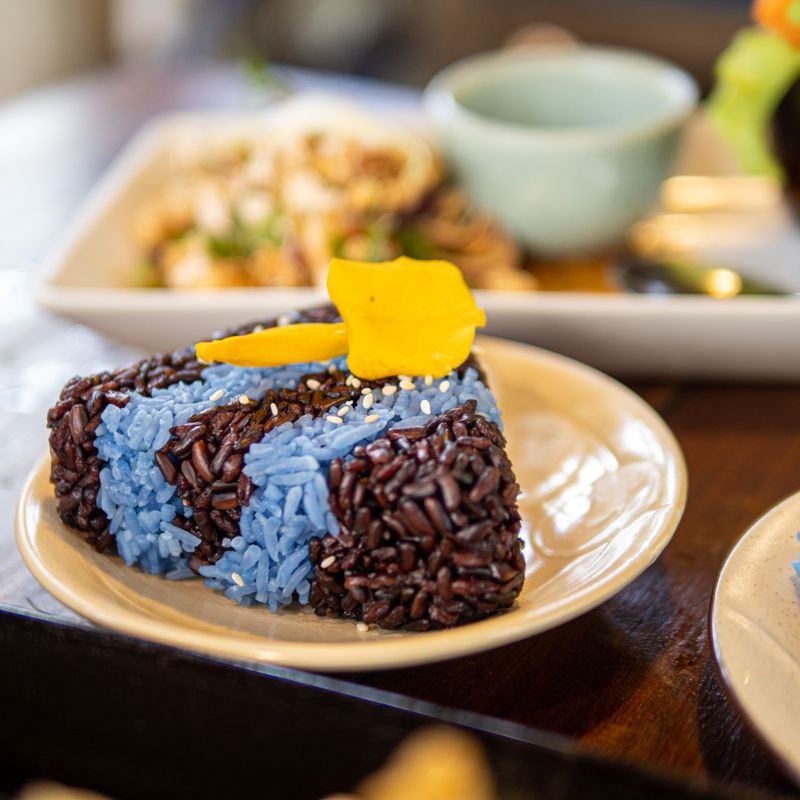
Mango Sticky Rice Muhallebi
A silky, rose-scented rice-flour pudding made with coconut milk, spooned into glasses and topped with fresh mango, a bright mango-lime sauce and toasted sesame. It borrows the flavors of Thai mango sticky rice and the soft, spoonable texture of Middle Eastern muhallebi.
- Prep
- 25 min
- Cook
- 17 min
- Wait
- 3 hr 15 min
- Total
- 3 hr 57 min
- Makes
- 6 puddings (about 5–6 oz / 150–180 ml each)
Steps
Before you start
- Plan ahead: the puddings need at least 3 hours to chill and set, so start the morning of the day you plan to serve them.
- Use full-fat canned coconut milk and shake the can hard before opening so the cream and liquid are blended. Light coconut milk will give a looser, less rich pudding.
- Use plain white rice flour (not glutinous or 'sweet' rice flour, which turns gluey and stretchy).
- Choose very ripe, fragrant mangoes that give slightly when pressed. Ataulfo/honey mangoes are least fibrous.
- Set out six 5–6 oz (150–180 ml) glasses, ramekins or small bowls before you start cooking.
Make the rice slurry
- Put the rice flour in a medium saucepan.
- Pour in ½ cup (120 ml) of the cold milk a little at a time, whisking until completely smooth with no lumps or dry pockets of flour.
- Whisk in the sugar for the pudding and the salt.
+ Show details− Hide details
Ready when: The slurry looks like thin, smooth cream with no lumps.
Tip: Adding the milk gradually to the flour, not the reverse, prevents lumps.
Add the remaining liquids
- Whisk the remaining 1 cup (240 ml) cold milk and the 2 cups (480 ml) shaken coconut milk into the slurry until evenly combined and uniform in color.
+ Show details− Hide details
Ready when: No streaks of coconut cream remain.
Tip: Rice flour sinks quickly, so give the pot a quick whisk right before it goes on the heat.
Cook until thick
- Set the pan over medium heat and whisk constantly, scraping the corners and bottom.
- After about 5 minutes the mixture will steam and begin to thicken.
- Reduce the heat to medium-low and keep stirring with a spatula for 4–5 more minutes, until it is thick like a loose custard and large, slow bubbles plop on the surface.
- Keep cooking 1–2 minutes after it thickens so the flour loses any raw taste.
+ Show details− Hide details
Ready when: The pudding coats the back of a spoon thickly, and a finger drawn across leaves a clean line that holds for a couple of seconds.
Tip: Do not walk away; rice flour thickens suddenly and scorches on the bottom. Lower the heat if it sticks.
Flavor and portion
- Take the pan off the heat and stir in the rose water.
- Whisk briskly for 20 seconds to smooth the texture.
- Pour into a spouted jug and divide evenly among six 5–6 oz (150–180 ml) glasses, filling each about three-quarters full to leave room for topping.
- Tap each glass gently on the counter to level the surface.
+ Show details− Hide details
Ready when: Surfaces are level and no longer steaming heavily.
Tip: Rose water is strong; stick to 1 teaspoon, as more tastes soapy.
Chill until set
- Press a piece of plastic wrap directly onto the surface of each pudding to stop a skin forming.
- Refrigerate for at least 3 hours.
+ Show details− Hide details
Ready when: Puddings are cold and wobble as a single mass when a glass is gently shaken; a spoon leaves a clean dent.
Toast the sesame seeds
- While the puddings chill, heat a small dry skillet over medium-low heat.
- Add the sesame seeds and stir or shake constantly for 2–3 minutes.
- Tip them onto a plate right away to stop cooking.
+ Show details− Hide details
Ready when: Seeds are light golden and smell nutty; a few may pop.
Tip: Seeds go from golden to bitter in seconds, so don't leave the pan.
Blend the mango sauce
- Put the chopped mango for the sauce, lime juice and sugar for the sauce in a blender.
- Blend until completely smooth, about 30 seconds.
- Taste and add a little more sugar or lime if needed.
- If the mango is fibrous, press the sauce through a fine-mesh sieve.
- Refrigerate until serving.
+ Show details− Hide details
Ready when: The sauce is smooth, pourable and slightly tangy.
Tip: If it is too thick to pour, blend in 1 tablespoon of water.
Dice the mango
- Cut the second mango's flesh into ½-inch (1 cm) dice.
- Keep refrigerated until you assemble so it stays cold and firm.
+ Show details− Hide details
Ready when: Pieces are even and hold their shape.
Tip: Dice just before serving, within 1–2 hours, so the mango doesn't weep.
Top and serve
- Remove the plastic wrap from the chilled puddings.
- Spoon about 2 tablespoons of mango sauce over each, then pile on the diced mango.
- Sprinkle each with toasted sesame seeds and serve cold.
+ Show details− Hide details
Ready when: Each glass has an even layer of sauce, a mound of mango and a scatter of golden sesame.
Tip: Add the sesame at the last minute so it stays crunchy.
Good to know
Tips
- Whisk constantly and scrape the corners of the pan; rice flour sticks and scorches easily.
- Pressing plastic wrap directly onto the warm pudding stops a skin from forming.
- Taste the mango before choosing how much sugar to add to the sauce. A very sweet mango needs none.
- For cleaner layers, pour the pudding into glasses without touching the rims, and wipe any drips before chilling.
Make ahead
"The plain puddings can be made up to 2 days ahead, covered with plastic pressed onto the surface and refrigerated. The mango sauce keeps 1 day in the fridge. Toast the sesame and dice the mango on the day of serving."
Storage & reheating
"Room temperature: not more than 1 hour. Fridge: store topped puddings up to 1 day and plain puddings up to 3 days, covered. Freezing is not recommended because the texture turns grainy. Serve straight from the fridge; do not reheat."
Substitutions
- white rice flour → cornstarch, 3 tablespoons (24 g). Gives a slightly glossier, more set pudding with a neutral flavor; cook as directed.
- whole milk → additional coconut milk, or unsweetened oat milk. Makes the pudding dairy-free. Coconut milk gives a richer result.
- rose water → orange blossom water, ½–1 tsp, or ½ tsp vanilla extract. Orange blossom is a close floral match, so start with less. Vanilla is milder.
- ripe mango → thawed frozen mango chunks. Drain well and pat dry. Use if fresh mangoes are not in season.