Maltese Ftira Rolls
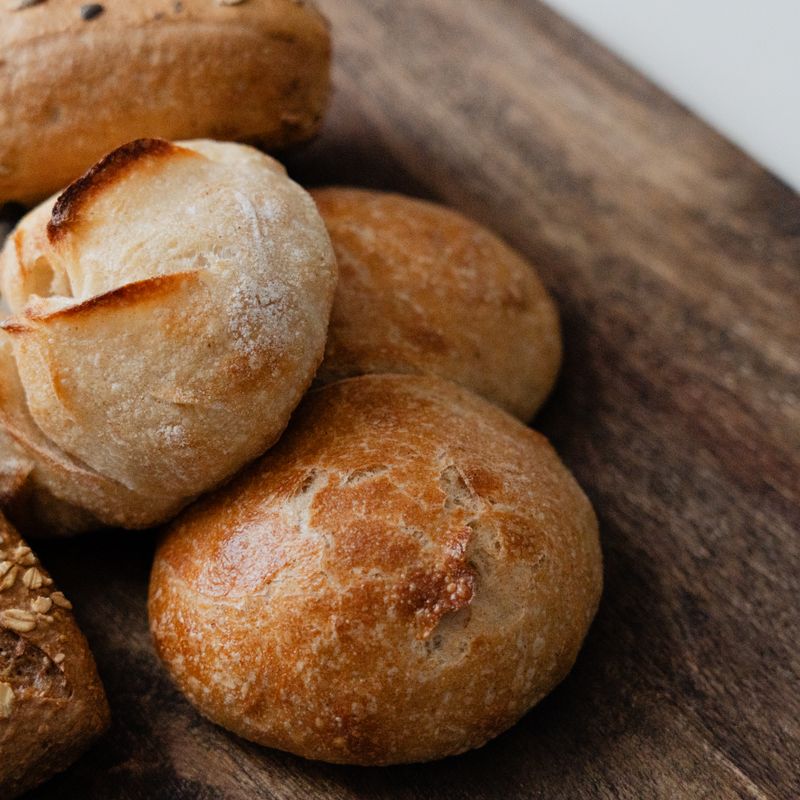
Individual ring-shaped rolls inspired by Maltese ftira bread, with a crackly golden crust and a soft, chewy crumb. Fine semolina and olive oil give a subtle sweetness and a faint golden color. They are excellent split and filled with tomato, tuna, olives, and capers.
- Prep
- 41 min
- Cook
- 25 min
- Wait
- 2 hr 10 min
- Total
- 3 hr 16 min
- Makes
- 8 ring-shaped rolls
Steps
Before you start
- Plan on about 3¼ hours from start to finish, most of it hands-off rising time.
- Use fine semolina flour (sold as semola rimacinata or durum flour). Coarse semolina will make the crumb gritty.
- Warm the water to about 105°F (40°C), which feels comfortably warm but not hot on your wrist. Water that is too hot will kill the yeast.
- Make sure you have a rimmed metal pan (not glass) that fits on the lowest oven rack for the steam.
Mix the dough
- In a large bowl, whisk the bread flour, 100 g fine semolina, instant yeast, fine salt, and sugar.
- Add the warm water and 2 tablespoons (30 ml) olive oil.
- Stir with a wooden spoon or your hand for about 2 minutes until no dry flour remains and the dough looks shaggy and sticky.
+ Show details− Hide details
Ready when: No dry flour pockets remain and the dough forms a rough, sticky mass.
Tip: Keep the salt and yeast on opposite sides of the bowl until you add the water, so the salt doesn't slow the yeast.
Knead until smooth
- Turn the dough onto a lightly oiled counter and knead for 10 minutes, pushing it away with the heel of your hand, folding it back, and turning it a quarter turn each time.
- (Or use a stand mixer with the dough hook on medium-low for 7 minutes.) The dough will start sticky but become smooth and elastic.
+ Show details− Hide details
Ready when: Dough is smooth, slightly tacky but not sticky, and springs back slowly when poked. A small piece stretches thin enough to see light through without tearing.
Tip: Resist adding extra flour. A slightly tacky dough gives a softer, more open crumb.
First rise
- Pour 1 tablespoon (15 ml) olive oil into a clean large bowl, add the dough, and turn it to coat.
- Cover with a towel or plastic wrap.
- Leave in a warm spot (75–80°F / 24–27°C) for 60 to 75 minutes.
+ Show details− Hide details
Ready when: Dough has doubled and a fingertip dent springs back slowly, leaving a shallow impression.
Tip: In a cool kitchen, the rise may take up to 90 minutes. Judge by the dough, not the clock.
Divide the dough
- Line two baking sheets with parchment and dust each with 1 tablespoon (10 g) dusting semolina.
- Turn the dough onto a work surface lightly dusted with a little more semolina and press gently to deflate it.
- Weigh it (about 880 g) and cut it into 8 equal pieces of about 110 g each.
- Shape each piece into a tight ball by cupping your hand over it and rolling it in small circles on the counter.
+ Show details− Hide details
Ready when: Eight smooth, taut balls of equal size with the seams tucked underneath.
Tip: Cover finished balls with a towel while you work so they don't form a dry skin.
Shape into rings
- Poke a floured thumb through the center of a ball to make a hole.
- Insert two fingers and gently stretch and rotate the dough until the ring is about 4 inches (10 cm) wide with a hole about 1½ inches (4 cm) across.
- The ring should be about ¾ inch (2 cm) thick.
- Place on the prepared sheets, 4 per sheet, at least 2 inches (5 cm) apart.
+ Show details− Hide details
Ready when: Each ring is even in thickness with a clean center hole and no thin, tearing spots.
Tip: Make the hole larger than seems necessary. It shrinks as the dough proofs and bakes.
Proof and preheatOven 450°F / 230°C
- Cover the rings loosely with towels and let them proof for 30 to 40 minutes.
- After 15 minutes, put an empty metal pan on the lowest oven rack, position another rack in the center, and preheat the oven to 450°F (230°C).
+ Show details− Hide details
Ready when: Rings look visibly puffy, and a gentle fingertip press leaves a dent that fills back in slowly.
Tip: Don't over-proof. If the rings press down and stay dented, bake right away.
Bake with steamOven 450°F / 230°C
- If using sesame seeds, mist or brush the tops of the rolls lightly with water and sprinkle with sesame seeds.
- Slide one sheet onto the center rack, then carefully pour 1 cup (240 ml) boiling water into the hot pan on the bottom rack and quickly close the door.
- Bake at 450°F (230°C) for 20 to 22 minutes, rotating the sheet halfway through.
- For the second sheet, either bake it in a second batch or use two racks and swap them halfway.
+ Show details− Hide details
Ready when: Crust is deep golden brown, the bottoms sound hollow when tapped, and the center of a roll reads 200–210°F (93–99°C).
Tip: Pour the boiling water away from yourself and keep your face back from the steam burst.
Cool on a rack
- Transfer the rolls to a wire rack and cool for at least 20 minutes before slicing.
- The crust will crackle as it cools, and the crumb finishes setting.
+ Show details− Hide details
Ready when: Rolls feel just warm, not hot, and the crust is crisp.
Good to know
Tips
- Weigh the ingredients for the most consistent dough. Cup measures for flour can vary by 20% or more.
- Steam in the first 10 minutes keeps the crust flexible so the rolls expand fully, then helps create a thin, crackly crust.
- For a traditional filling, split the rolls and spread with tomato paste, then add tuna, olives, capers, sliced tomato, and a drizzle of olive oil.
- If the bottoms brown too fast, slide a second baking sheet under the first for extra insulation.
Make ahead
After shaping, cover the rings and refrigerate on the baking sheets for up to 12 hours. Let them stand at room temperature for 30 minutes while the oven preheats, then bake as directed, adding 2 to 3 minutes if needed.
Storage & reheating
Room temperature: store in a paper bag or loosely wrapped for up to 2 days (the crust softens in plastic). Freezer: freeze fully cooled rolls in a zip-top bag for up to 3 months. Reheat: warm from frozen at 375°F (190°C) for 10 to 12 minutes, or at 375°F (190°C) for 5 minutes if thawed, to re-crisp the crust.
Substitutions
- bread flour → all-purpose flour. Gives a slightly softer, less chewy crumb. Reduce the water to 315 ml (1⅓ cups).
- instant yeast → active dry yeast, 2¼ tsp (7 g). Dissolve in the warm water with the sugar and let stand 5–10 minutes until foamy before mixing.
- fine semolina flour (semola rimacinata) → more bread flour (100 g). The rolls will be paler and less sweet, but still good.
- sesame seeds → nigella seeds or fennel seeds. Both pair well with the savory fillings typically used in Malta.