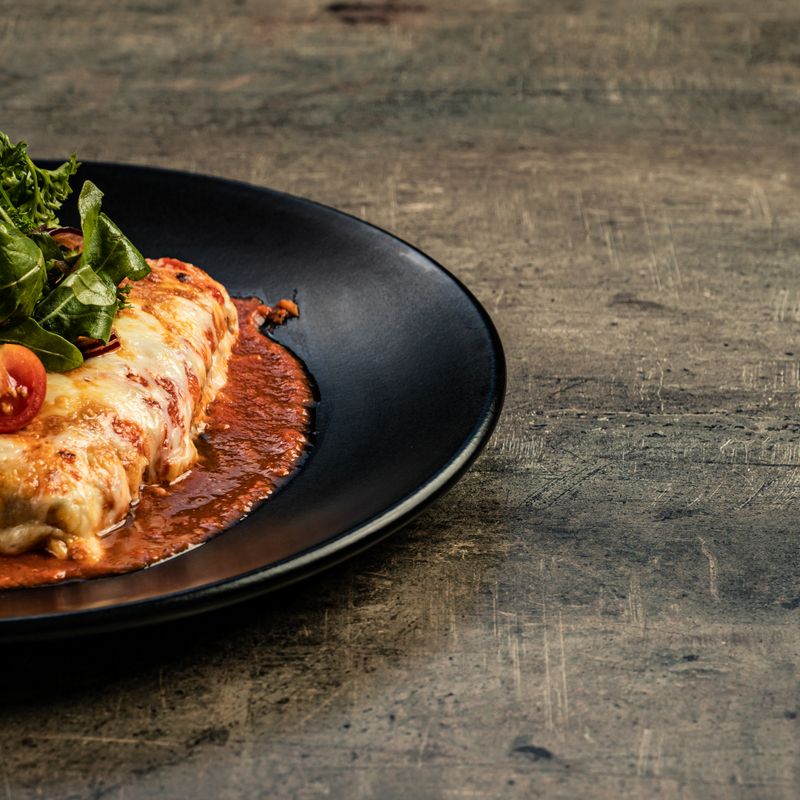
Lemongrass Pork Lasagna with Herbed Ricotta
Layers of tender noodles, a fragrant lemongrass-and-fish-sauce pork ragù, lime-scented herb ricotta and creamy béchamel, all under a blanket of bubbling mozzarella. It's inspired by the flavors of Vietnamese grilled pork, with a bright finish of fresh Thai basil, mint and lime.
- Prep
- 40 min
- Cook
- 1 hr 36 min
- Wait
- 20 min
- Total
- 2 hr 36 min
- Makes
- 1 lasagna in a 9×13-inch pan (8 generous squares)
Steps
Before you start
- Shred the mozzarella from a block (pre-shredded cheese melts less smoothly) and keep it cold until assembly.
- Set a rack in the middle of the oven. You'll preheat to 375°F (190°C) while you assemble the lasagna.
- Plan the order: start the pork sauce, then boil the noodles while the sauce simmers, then make the béchamel and ricotta mixture.
- Lemongrass is fibrous: use only the pale, tender lower part and mince it very finely so it doesn't feel stringy.
- Fish sauce brands vary in saltiness. The recipe adds no other salt to the pork sauce, so taste it before the simmer ends.
Prep the aromatics
- Peel and finely chop the shallots, mince the garlic, grate the ginger, and mince the chilies if using.
- Trim the lemongrass: cut off the root end and the dry green tops, peel away the tough outer 2 layers, then mince the pale tender bottom 4–5 inches as finely as you can (about ⅓ cup).
- Combine the garlic, ginger, lemongrass and chilies in one small bowl, and keep the shallots separate.
- Shred the mozzarella and divide it into 3 equal portions.
+ Show details− Hide details
Ready when: Lemongrass is minced into pieces no bigger than a grain of rice.
Tip: Smash the lemongrass stalks once with the flat of your knife before mincing; it releases more aroma and makes the fibers easier to cut.
Brown the pork
- Heat 1 tbsp (15 ml) of the oil in a 12-inch (30 cm) deep skillet or Dutch oven over medium-high heat until shimmering.
- Add the ground pork and break it into small crumbles with a wooden spoon.
- Let it sit undisturbed for 2 minutes at a time, then stir, so it browns instead of steaming.
- Cook about 8–10 minutes total.
+ Show details− Hide details
Ready when: No pink remains and the pork is lightly golden in places with browned bits on the pan bottom.
Tip: If the pork releases a lot of liquid, keep cooking until the pan is nearly dry again before adding aromatics.
Build the sauce base
- Reduce the heat to medium.
- Add the shallots and cook, stirring, for 2 minutes until softened.
- Add the garlic-lemongrass-ginger mixture and cook 1 minute until very fragrant.
- Stir in the tomato paste and cook 1 minute, scraping the pan, until it darkens slightly.
- Pour in the fish sauce and brown sugar and stir for 30 seconds, then add the crushed tomatoes and black pepper.
+ Show details− Hide details
Ready when: Shallots are translucent, the paste is brick-red, and the kitchen smells strongly of lemongrass.
Tip: Don't let the garlic brown; turn the heat down if it sizzles hard.
Simmer the ragù
- Bring the sauce to a gentle bubble, then lower the heat to medium-low and simmer, partially covered, for 20 minutes, stirring every 5 minutes.
- Start boiling water for the noodles (next step) during this time.
- Taste and add a splash more fish sauce if it needs salt, or a pinch of sugar if it tastes sharp.
+ Show details− Hide details
Ready when: Sauce is thick enough that a spoon dragged across the pan bottom leaves a trail that closes slowly, and no watery liquid pools on top.
Tip: A watery sauce makes a soupy lasagna, so simmer longer if needed.
Boil the noodles
- While the sauce simmers, bring a large pot of water to a boil with the 1 tbsp salt.
- Cook the lasagna noodles 2 minutes less than the package time (usually about 8 minutes), stirring in the first minute so they don't stick.
- Drain and lay them flat on a baking sheet, brushing or tossing lightly with about 2 tsp of the remaining oil.
- Use the last 1 tsp of oil to grease the baking dish.
+ Show details− Hide details
Ready when: Noodles are flexible but still slightly firm in the center; they finish cooking in the oven.
Tip: Keep the noodles in a single layer, not stacked, or they'll glue together.
Make the béchamel
- In a 3-quart (3 L) saucepan over medium heat, melt the butter.
- Whisk in the flour and cook 1 minute, whisking constantly, until it smells nutty but hasn't colored.
- Pour in the milk in a thin stream while whisking.
- Raise the heat to medium-high, then whisk until it comes to a gentle simmer.
- Lower the heat and cook 4–5 minutes, whisking often.
- Stir in the ½ tsp salt.
+ Show details− Hide details
Ready when: Sauce coats the back of a spoon and a finger drawn across it leaves a clean line; about the thickness of heavy cream.
Tip: Add the milk gradually at first; dumping it in all at once makes lumps. If lumps form, whisk hard or strain.
Mix the herbed ricotta
- In a medium bowl, stir together the ricotta, egg, cilantro, mint, scallions, lime zest and ½ tsp salt until evenly combined and flecked with green.
- Divide the mixture in half in the bowl so you can portion it easily for 2 layers.
+ Show details− Hide details
Ready when: Mixture is thick, spreadable and uniform, with no streaks of egg.
Assemble the layersOven 375°F / 190°C
- Preheat the oven to 375°F (190°C).
- Spread about 1 cup of the pork sauce over the bottom of the greased 9×13-inch dish.
- Lay 3 noodles lengthwise over the sauce, trimming to fit if needed.
- Over the noodles spread: half the ricotta mixture, 1½ cups pork sauce, about 1 cup béchamel, and one-third of the mozzarella.
- Repeat with 3 more noodles, the remaining ricotta, 1½ cups pork sauce, 1 cup béchamel and another third of the mozzarella.
- Finish with the last 3 noodles, the remaining sauce, the remaining béchamel, the last third of mozzarella and the Parmigiano.
+ Show details− Hide details
Ready when: Three noodle layers are stacked, the top is evenly covered with cheese, and the dish is filled about ½ inch below the rim.
Tip: Place the dish on a foil-lined baking sheet in the oven to catch any bubbling overflow.
Bake coveredOven 375°F / 190°C
- Cover the dish tightly with foil, tenting it slightly so it doesn't stick to the cheese (or spray the foil with oil).
- Bake on the middle rack at 375°F (190°C) for 30 minutes.
+ Show details− Hide details
Ready when: Sauce is bubbling at the edges and steam escapes when you lift a corner of foil.
Uncover and brownOven 375°F / 190°C
- Remove the foil and bake another 15 minutes at 375°F (190°C).
- If you'd like deeper color, switch to the broiler for the last 1–2 minutes, watching constantly.
+ Show details− Hide details
Ready when: Top is golden with browned spots, the edges bubble vigorously, and an instant-read thermometer in the center reads at least 165°F (74°C).
Tip: Broilers vary a lot, so don't walk away.
Rest and garnish
- Let the lasagna rest on a wire rack for 20 minutes so the layers set and slice cleanly.
- Scatter the Thai basil and crispy shallots over the top, and cut into 8 squares with a sharp knife.
- Serve with lime wedges to squeeze over each portion.
+ Show details− Hide details
Ready when: Sauce stops flowing when a knife cuts through, and the squares hold their shape.
Tip: Add the herbs only after resting; they wilt and darken if baked.
Good to know
Tips
- Mince the lemongrass finer than you think you need to; it will not soften much in the sauce.
- Simmer the pork sauce until thick. Excess liquid is the number one cause of a watery, collapsing lasagna.
- Cooking the noodles a little under keeps them from turning mushy in the oven.
- Rest the lasagna a full 20 minutes before slicing; cutting early gives sloppy squares.
Make ahead
"Make the pork sauce up to 3 days ahead and refrigerate it; the béchamel can be made 2 days ahead (press plastic wrap onto the surface). Assemble the entire lasagna up to 24 hours ahead, cover and refrigerate, then bake covered for 40 minutes (instead of 30), uncover, and bake 15 minutes more until the center reaches 165°F (74°C). Add herbs and lime only after baking."
Storage & reheating
"Room temperature: up to 2 hours after baking. Refrigerator: covered, up to 4 days. Freezer: wrap individual squares tightly and freeze up to 3 months; thaw overnight in the fridge. Reheat covered with foil at 350°F (175°C) for 20–25 minutes (single portions in the microwave, 2–3 minutes), until steaming hot at 165°F (74°C) in the center."
Substitutions
- lemongrass stalks → Lemongrass paste (about 3 tbsp) or the zest of 2 limes plus 1 tsp grated extra ginger. Fresh gives the best aroma; paste is milder, so add it with the garlic. Lime zest gives brightness but not the same flavor.
- ground pork → Ground chicken or turkey (thigh meat preferred). Add 1 extra tbsp oil because poultry is leaner; cook to 165°F (74°C).
- Thai basil leaves → Regular basil plus a few extra mint leaves. Thai basil has an anise note that regular basil lacks.
- fish sauce → Light soy sauce (3 tbsp). Gives saltiness without the funky depth; taste before adding more salt.