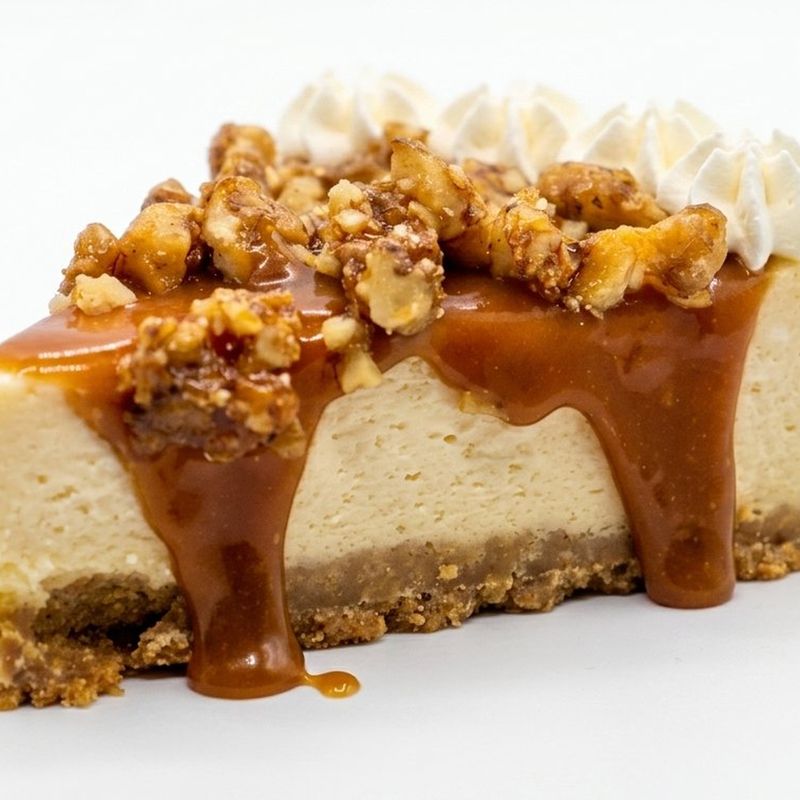
Labneh Cheesecake with Fig and Walnut Crust
A creamy, tangy cheesecake made with labneh (strained yogurt), balanced with honey and topped with a crunchy fig and walnut crust. This Middle Eastern-inspired dessert has a delicate yogurt flavor with warm spice notes, served at room temperature or chilled. The crust is studded with chewy dried figs and toasted walnuts, creating a textural contrast to the silky filling.
- Prep
- 25 min
- Cook
- 50 min
- Wait
- 3 hr
- Total
- 4 hr 15 min
- Makes
- One 9-inch (23 cm) cheesecake (12 slices)
Steps
Before you start
- Preheat your oven to 325°F (165°C) and position a rack in the center
- Have all ingredients at room temperature, especially eggs and labneh
- Prepare a water bath: you'll need a roasting pan large enough to hold a 9-inch springform pan with room for hot water
- Line the bottom and sides of a 9-inch (23 cm) springform pan with parchment paper, extending up the sides
Toast the walnutsOven 325°F / 165°C
- Spread chopped walnuts on a small baking sheet and toast in the preheated 325°F (165°C) oven for 6–7 minutes, stirring once halfway through, until fragrant and lightly golden.
- Watch carefully so they don't burn.
- Remove and let cool for 2 minutes.
+ Show details− Hide details
Ready when: Walnuts are fragrant and lightly golden brown
Tip: Toast walnuts separately so you can control the timing and avoid over-browning the crust
Make the crust mixture
- In a food processor, pulse the toasted walnuts with chopped figs, melted butter, honey, and sea salt until the mixture is crumbly and clumps together when pressed (about 8–10 pulses).
- The texture should resemble wet breadcrumbs with visible walnut and fig pieces, not a fine paste.
+ Show details− Hide details
Ready when: Mixture is crumbly and holds together when pressed, with visible walnut and fig pieces
Tip: Don't over-process—you want texture, not a paste. If it seems dry, add 1 teaspoon water at a time
Press crust into pan
- Transfer the crust mixture to the prepared springform pan.
- Using the bottom of a measuring cup or your fingers (lightly dampened), press the mixture firmly and evenly across the bottom of the pan, creating a compact, even layer about ¼ inch (6 mm) thick.
- Don't press all the way up the sides—just the bottom.
+ Show details− Hide details
Ready when: Crust is firmly packed, even, and compact on the bottom of the pan
Tip: A thin crust is better than a thick one—it won't overpower the filling and will stay crispy
Bake crust brieflyOven 325°F / 165°C
- Bake the crust alone in the preheated 325°F (165°C) oven for 8 minutes to set and lightly firm up.
- Remove from the oven and set aside while you prepare the filling.
+ Show details− Hide details
Ready when: Crust is lightly set, edges are slightly darker, no longer wet-looking
Tip: Pre-baking prevents a soggy crust from absorbing moisture from the filling
Prepare filling ingredients
- In a large mixing bowl, add room-temperature labneh and cream cheese.
- Using a whisk or electric mixer on medium-low speed, blend them together until completely smooth with no lumps, about 2 minutes.
- The mixture should be creamy and uniform.
+ Show details− Hide details
Ready when: Labneh and cream cheese are fully blended, smooth, and uniform in color
Tip: Room temperature ingredients blend more smoothly without lumps. If cream cheese is cold, let it sit out for 30 minutes before starting
Add honey and sugar
- Add honey and granulated sugar to the labneh mixture.
- Whisk together on medium speed for 1–2 minutes until the sugar dissolves completely and the mixture is pale and uniform.
- You should not see any sugar crystals when you rub a bit between your fingers.
+ Show details− Hide details
Ready when: Sugar is completely dissolved, mixture is pale and smooth
Tip: Dissolving the sugar fully prevents gritty texture in the finished cheesecake
Incorporate eggs
- Add the room-temperature eggs one at a time, whisking each egg fully into the mixture on medium speed before adding the next.
- After all three eggs are incorporated, whisk for another 30 seconds.
- The filling should be smooth, creamy, and slightly paler than before.
+ Show details− Hide details
Ready when: Eggs are fully incorporated, mixture is smooth and creamy
Tip: Don't over-mix after adding eggs—this can incorporate too much air and cause cracks. Stop as soon as they're combined
Add flavorings and spices
- Add vanilla extract, cardamom, cinnamon, and sea salt to the filling.
- Whisk on medium speed for 30 seconds until the spices are fully distributed throughout and no streaks remain.
- The filling should have a warm, aromatic scent.
+ Show details− Hide details
Ready when: Spices are evenly distributed with no streaks, mixture smells warm and fragrant
Tip: Don't skip the sea salt—it enhances the labneh's tanginess and balances the sweetness of the honey
Pour filling into pan
- Pour the filling onto the pre-baked crust, smoothing the top with a rubber spatula.
- The filling should come about ¾ inch (2 cm) from the top of the pan.
- If there are any air bubbles on the surface, gently tap the pan on the counter and smooth again.
+ Show details− Hide details
Ready when: Filling is poured and smooth, sitting about ¾ inch below the rim
Tip: Leaving space at the top prevents overflow during baking
Set up water bath
- Place the springform pan in a roasting pan.
- Pour enough hot (not boiling) water into the roasting pan to come halfway up the sides of the springform pan (about 1½ inches / 4 cm).
- Use a kettle or carefully from the tap to avoid splashing filling.
+ Show details− Hide details
Ready when: Water level is halfway up the side of the springform pan
Tip: Water bath prevents the top from browning too quickly and the middle from cracking as it cools
Bake the cheesecakeOven 325°F / 165°C
- Carefully place the water bath in the preheated 325°F (165°C) oven and bake for 40–50 minutes.
- The cheesecake is done when the edges are set and pale golden (they should not jiggle when tapped), but the center still has a slight tremor when you gently shake the pan—about a 2-inch (5 cm) circle in the middle should wobble just a bit.
- An instant-read thermometer inserted 1 inch (2.5 cm) from the edge should read 150–155°F (65–68°C).
+ Show details− Hide details
Ready when: Edges are set and pale golden; center has a slight jiggle (about 2-inch circle), thermometer reads 150–155°F at the edge
Tip: Don't overbake—a slightly underdone center will firm up as it cools. Overbaking causes drying and cracking
Cool in oven
- Turn off the oven and crack the door open about 2 inches (5 cm).
- Let the cheesecake sit in the warm oven for 30 minutes.
- This gradual cooling prevents thermal shock and reduces cracking.
+ Show details− Hide details
Ready when: Cheesecake is no longer piping hot, feels warm to the touch
Tip: This resting period is crucial for avoiding cracks—don't skip it
Remove from oven and water bath
- Using oven mitts, carefully remove the springform pan from the water bath and place it on a wire rack.
- Using a thin knife or offset spatula, gently run the blade around the inside edge of the springform, between the cheesecake and the pan, to loosen it.
- Do not remove the springform ring yet.
- Let the cheesecake cool completely at room temperature for at least 1 hour.
+ Show details− Hide details
Ready when: Cheesecake is completely cool to the touch, not warm
Tip: Running the knife around the edge while the cake is still slightly warm prevents the edges from tearing when the springform is removed
Chill and serve
- Cover the cheesecake (still in the springform) loosely with plastic wrap and refrigerate for at least 4 hours, or until fully set and chilled through.
- To serve, run a warm knife around the edge again, then carefully release and remove the springform ring.
- Optional: drizzle lightly with rose water and top with chopped pistachios.
- Slice with a thin, warm (wiped clean between slices) knife for clean edges.
+ Show details− Hide details
Ready when: Cheesecake is fully chilled, set, and firm when a knife passes through easily
Tip: Warming the knife under hot water and wiping it clean between cuts creates neat, clean slices without crumbling
Good to know
Tips
- Labneh must be at room temperature before mixing—cold labneh can cause lumps and will affect how smoothly it blends with the cream cheese. Remove it from the fridge 1–2 hours before starting.
- The water bath is non-negotiable. It insulates the cheesecake from the dry oven heat, keeping the texture creamy in the center and preventing cracks. Without it, the filling will overbake and become dense.
- Do not skip the gradual cooling step in the oven—it prevents thermal shock that causes cracking. Many cheesecake failures come from pulling it straight from the oven into a cold room.
- For a vegan version, substitute the cream cheese and labneh with 2 pounds (900 g) of cashew-based 'cream cheese' or blended silken tofu mixed with plant-based yogurt. Replace eggs with a commercial egg replacer (follow package directions for 3 eggs). The results will be slightly less tangy but still delicious.
Make ahead
The cheesecake can be baked up to 2 days in advance. Cover it tightly with plastic wrap once fully chilled and refrigerate. On serving day, let it sit at room temperature for 15–20 minutes before serving for the best flavor and texture. It is best enjoyed within 3 days of baking.
Storage & reheating
Room temperature: up to 2 hours (remove parchment and release springform once fully set). Refrigerator: covered, up to 4 days. Freezer: wrapped tightly in plastic wrap and then foil, up to 2 months. To thaw, place in the refrigerator overnight and let sit at room temperature for 15–20 minutes before serving. Do not microwave.
Substitutions
- labneh (strained yogurt), at room temperature → Greek yogurt (2 pounds / 900 g, strained through cheesecloth for 2 hours to remove excess whey) or sour cream mixed with yogurt (1 pound / 450 g each). Labneh is essential for the tangy Middle Eastern character, but strained Greek yogurt produces a similar flavor and texture. Sour cream adds richness if using Greek yogurt alone
- dried figs → dried apricots, coarsely chopped, or a mix of both figs and apricots. Apricots add a brighter tartness. You can also use chopped dried dates for a darker, molasses-like sweetness
- ground cardamom → ½ teaspoon ground ginger or ¼ teaspoon ground cloves. Ginger adds brightness; cloves add warmth. Cardamom is preferred for authentic flavor but these work in a pinch
- rose water (optional) → orange zest (finely grated) or a splash of orange juice. Rose water is optional and adds floral, delicate notes. Citrus offers freshness instead
More cakes
See all →


Find more like this
- Meal
- Dessert
- Cuisine
- Middle Eastern
- Method
- Oven
- Quick & Easy
- Make Ahead