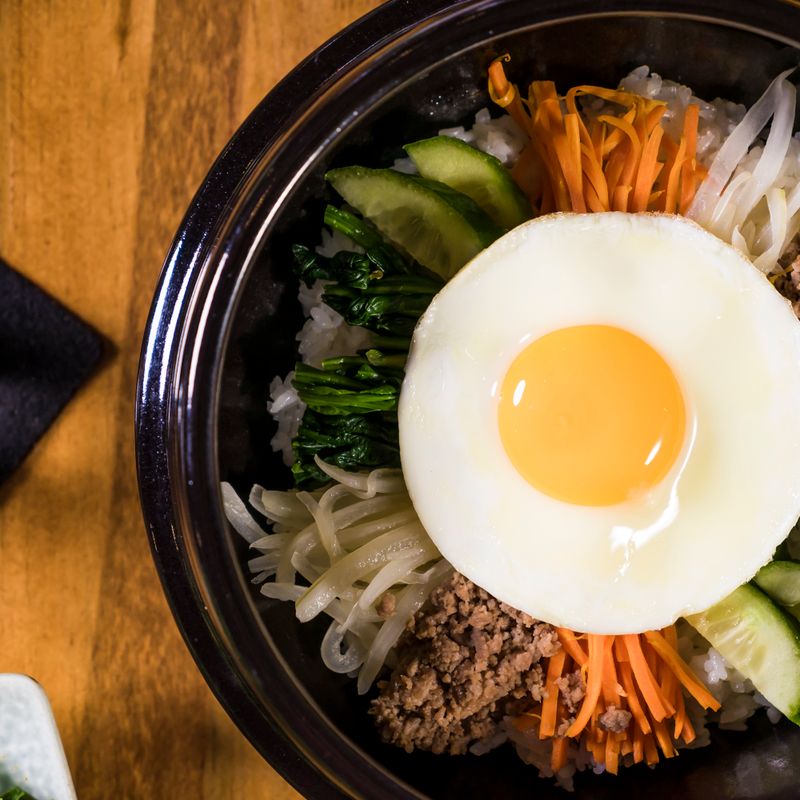
Korean Bibimbap with Beef, Spinach, Carrots and Zucchini
Warm short-grain rice topped with garlicky marinated beef, three seasoned vegetables and a crispy-edged fried egg, then stirred together with a sweet-tangy gochujang sauce. Every topping is cooked separately so each keeps its own flavor and texture.
- Prep
- 30 min
- Cook
- 25 min
- Wait
- 25 min
- Total
- 1 hr 20 min
- Makes
- 4 large rice bowls
Steps
Before you start
- Put the beef in the freezer for 20 minutes before slicing; partly frozen beef is much easier to slice thinly.
- Start the rice first. The beef marinates in the refrigerator and the vegetables are prepped while the rice simmers and rests, so everything finishes together in about 80 minutes.
- Egg safety: runny yolks carry a small Salmonella risk, especially for young children, pregnant people, older adults and anyone with a weakened immune system. Cook yolks firm for them, or use pasteurized eggs if serving runny.
- Have all vegetables cut and all small bowls and plates ready before heating the pan. The cooking steps move quickly.
- Gochujang brands vary in heat and sweetness. Taste the sauce and adjust before serving.
Cook the rice
- Rinse the rice in a bowl with cold water, swishing and draining 3 to 4 times until the water is mostly clear.
- Drain well.
- Combine the rice and 1¾ cups (415 ml) cold water in a 3-quart (3 L) saucepan.
- Bring to a boil over medium-high heat, stir once, cover tightly, and reduce to low.
- Cook for 15 minutes without lifting the lid, then turn off the heat and let it rest, covered, for 10 minutes.
- Fluff with a fork.
- (A rice cooker works too; use the same rice and water.) Use these 25 minutes to complete the next four steps.
+ Show details− Hide details
Ready when: Grains are tender, plump and sticky with no hard center and no water left in the pot
Tip: Lifting the lid lets steam escape and leaves the top layer undercooked.
Marinate the beef
- In a medium bowl, combine the sliced beef, soy sauce, 1 tsp of the sugar, 1 minced garlic clove, 1 tsp of the sesame oil and the black pepper.
- Mix with your hands until every strip is coated.
- Cover and refrigerate for at least 20 minutes and up to 8 hours.
- If you are short on fridge space, the beef may sit at room temperature for no more than 30 minutes total.
- Wash your hands and the bowl's rim after handling raw beef.
+ Show details− Hide details
Ready when: Beef strips look evenly glossy and dark with no dry spots
Tip: Slice against the grain and as thin as you can, about ⅛ inch (3 mm), so the beef cooks in under 2 minutes. Never leave raw beef out for more than 30 minutes.
Cut and salt zucchini
- Put the zucchini matchsticks in a small bowl and toss with ½ tsp of the salt.
- Leave for 10 minutes while you cut the carrots into matchsticks and slice the scallion if using.
- Then squeeze the zucchini gently in your hands or press it in a sieve to remove the liquid it has released.
- Pat dry with a paper towel.
+ Show details− Hide details
Ready when: Zucchini looks slightly translucent and feels limp but not mushy
Tip: Squeezing too hard bruises it; a firm gentle press is enough.
Mix the sauce
- In a small bowl, stir together the gochujang, 1 tbsp of the sesame oil, the rice vinegar, the remaining 1 tsp sugar and 1 tbsp water until smooth and spoonable like thick ketchup.
- Taste: it should be spicy, slightly sweet and tangy.
- Add a splash of water if too thick.
+ Show details− Hide details
Ready when: Sauce is smooth with no streaks of paste
Sauté the zucchini
- Heat 1 tbsp of the neutral oil in a 12-inch (30 cm) skillet over medium-high heat until shimmering.
- Add the zucchini and cook, tossing often, for 2 to 3 minutes.
- Slide onto a plate and spread out to cool.
- Wipe the skillet with a paper towel.
+ Show details− Hide details
Ready when: Zucchini is bright green with lightly golden edges and still has a slight bite
Tip: Don't overcook; it keeps softening on the plate.
Sauté the carrots
- Return the skillet to medium-high heat and add 1 tbsp of the neutral oil.
- Add the carrots and ¼ tsp of the salt.
- Cook, stirring often, for 3 to 4 minutes.
- Transfer to the plate beside the zucchini, keeping the vegetables in separate piles.
+ Show details− Hide details
Ready when: Carrots are tender-crisp, vivid orange, and bend without snapping
Blanch and season spinach
- Bring the 2 quarts (1.9 L) of water to a rolling boil in a large pot and set a bowl of ice water nearby.
- Add the spinach and cook for 30 to 45 seconds, just until wilted.
- Lift into the ice water, then drain and squeeze firmly with your hands to remove as much water as possible.
- Loosen the clump and toss with 1 minced garlic clove, 1 tsp sesame oil, ¼ tsp salt and ½ tsp sesame seeds.
+ Show details− Hide details
Ready when: Spinach is bright green, fully wilted and feels like a damp, compact ball after squeezing
Tip: Squeeze well; wet spinach will make the rice bowl soggy and dilute the seasoning.
Cook the beef
- Take the beef from the refrigerator.
- Heat the skillet over high heat for 1 minute, then add 1 tbsp of the neutral oil.
- Add the beef in a single layer (work in 2 batches if it crowds the pan).
- Cook without stirring for 45 seconds, then stir and cook 1 to 2 minutes more.
- Cut into the thickest strip to check, then transfer to a clean plate.
+ Show details− Hide details
Ready when: No pink remains in the center of the strips, juices run clear and edges are browned (equals 160°F / 71°C, but thin strips are too small to probe)
Tip: Crowding the pan steams the beef and turns it gray. Use batches.
Fry the eggs
- Wipe out the skillet and heat over medium heat.
- Add the last 1 tbsp neutral oil and swirl.
- Crack in the eggs, season lightly if you like, and cook 2 to 3 minutes for a runny yolk, with whites fully opaque.
- For anyone in a higher-risk group (young children, pregnant people, older adults, immunocompromised), cover the pan and cook 3 to 4 minutes more, or flip and cook, until the yolk is firm with no runny center.
- Slide onto a plate.
+ Show details− Hide details
Ready when: Whites are fully opaque with crisp lacy edges. Runny style: yolk glossy and liquid. Safe style: yolk firm and opaque all the way through (160°F / 71°C)
Tip: Cook the eggs last so they're still hot at the table. Runny yolks carry a Salmonella risk; use pasteurized eggs if serving them runny to vulnerable people.
Assemble and serve
- Divide the warm rice among 4 wide bowls.
- Arrange the beef, spinach, carrots and zucchini in separate sections on top of each.
- Place a fried egg in the center.
- Drizzle each with ¼ tsp of the sesame oil, sprinkle with remaining sesame seeds and the scallion, and add a generous spoonful of gochujang sauce.
- Serve right away and mix everything thoroughly with a spoon before eating.
+ Show details− Hide details
Ready when: Bowls are steaming with each topping in its own section
Tip: Start with half the sauce, mix, then add more to taste.
Good to know
Tips
- For crispy rice (like dolsot bibimbap), press the rice into a hot oiled cast-iron pan over medium-high heat for 4 to 5 minutes before adding toppings.
- Cut all vegetables to a similar matchstick size so they cook evenly and look neat.
- Keep each topping separate when assembling; the colorful arrangement is part of the dish.
- Add the sauce gradually; different gochujang brands vary a lot in heat.
Make ahead
Marinate the raw beef in the refrigerator up to 8 hours ahead. Cook and season the vegetables and beef up to 1 day ahead and refrigerate separately in covered containers. Mix the sauce up to 5 days ahead. Cook the rice and fry the eggs fresh. Rewarm the toppings, and reheat the beef until steaming hot, in a skillet or microwave before serving.
Storage & reheating
Refrigerate leftover components separately in airtight containers for up to 3 days (fried eggs are best eaten fresh). Cooked rice and beef can be frozen up to 1 month. Reheat rice and toppings in the microwave with a splash of water, covered, for 1 to 2 minutes until steaming hot, or stir-fry in a skillet over medium heat. Leftover gochujang sauce keeps in the refrigerator for up to 2 weeks. Do not leave raw or cooked components at room temperature more than 2 hours.
Substitutions
- beef sirloin or ribeye steak → Extra-firm tofu (14 oz / 400 g), pressed, cubed and pan-fried, or thinly sliced mushrooms. Use the same marinade; cook tofu until golden, about 6 minutes, or mushrooms until browned and dry.
- gochujang (Korean chili paste) → 1 tbsp sriracha plus 1 tbsp white or yellow miso. Not identical but gives similar heat and savory depth; adjust the sugar to taste.
- short-grain white rice (sushi rice) → Medium-grain rice such as Calrose. Use the same amount of water; texture will be slightly less sticky.
- fresh flat-leaf or baby spinach → Bean sprouts (8 oz / 225 g). Boil 3 to 4 minutes, drain, then season the same way.
More rice bowls
See all →
Find more like this
- Meal
- Dinner
- Cuisine
- Korean
- Diet
- Dairy-FreeHalal
- Method
- Stovetop