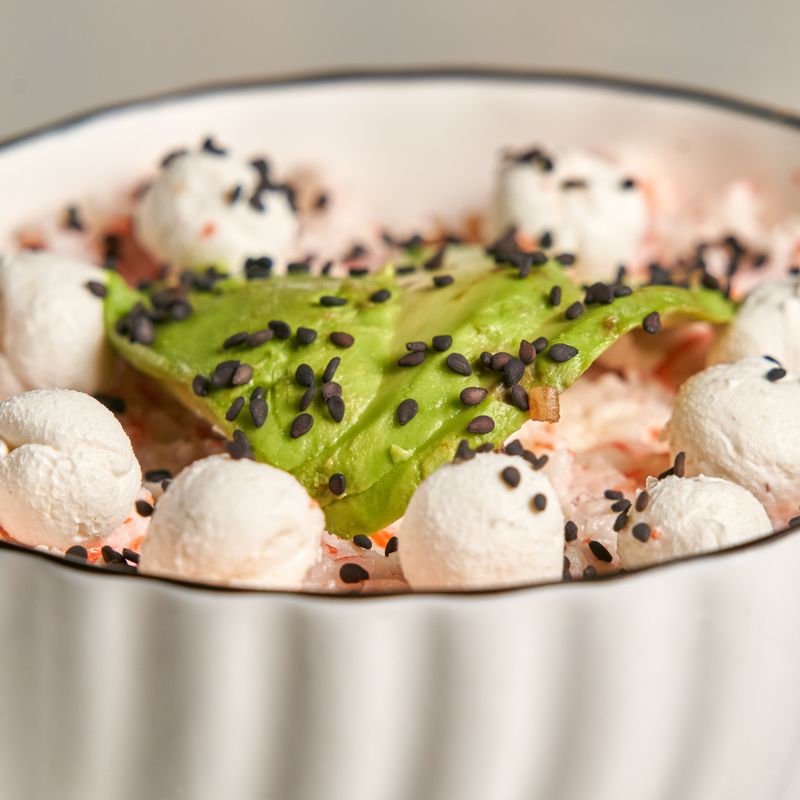
Konafa with Sesame Cream and Lychee Syrup
Crispy shredded phyllo pastry layered with silky sesame cream and cream cheese, then soaked in a fragrant lychee-rose syrup. This Middle Eastern-Asian fusion dessert balances nutty sesame richness with the delicate floral notes of lychee and rose water. The contrast between the golden, crunchy konafa shell and the creamy filling makes for an elegant, sophisticated treat.
- Prep
- 25 min
- Cook
- 35 min
- Wait
- 45 min
- Total
- 1 hr 45 min
- Makes
- 8 servings (one 9-inch round pastry)
Steps
Before you start
- Preheat oven to 350°F (175°C)
- Remove cream cheese from fridge 30 minutes before assembling so it's soft and spreadable
- Have a 9-inch (23 cm) round cake pan or springform pan ready; line with parchment paper or lightly butter it
- If using fresh lychees, pit and juice them; if using canned, drain and reserve juice
Make the Lychee Syrup
- In a small saucepan, combine water, granulated sugar, lemon juice, and lychee juice.
- Bring to a boil over medium-high heat, stirring occasionally to dissolve the sugar.
- Once boiling, reduce heat to medium and simmer for 8–10 minutes until the syrup thickens slightly and coats the back of a spoon.
- Remove from heat, stir in rose water, and let cool completely to room temperature.
- This should take about 20 minutes.
+ Show details− Hide details
Ready when: Syrup is fragrant, slightly thickened, and coats the back of a spoon
Tip: Don't boil the rose water or it will lose its delicate floral notes; add it after cooling.
Prepare the Sesame Cream
- In a medium bowl, whisk together softened cream cheese, tahini, powdered sugar, and vanilla extract until smooth and creamy.
- The mixture should have no lumps and be spreadable.
- If it seems too stiff, warm it gently by placing the bowl over a pot of warm (not hot) water for 1–2 minutes, stirring occasionally.
+ Show details− Hide details
Ready when: Mixture is smooth, homogeneous, and creamy, with no visible lumps
Tip: Warm cream cheese is essential; if it's cold, the tahini will not incorporate smoothly.
Coat Phyllo with Ghee
- In a medium bowl, toss the shredded phyllo with melted ghee until every strand is coated.
- Use your fingers or a wooden spoon to gently work the ghee through the pastry without breaking or compressing it too much.
- The phyllo should feel moist and evenly saturated but not clumped together.
+ Show details− Hide details
Ready when: All phyllo strands glisten with ghee and are evenly coated
Tip: Work gently to keep the phyllo strands intact; this ensures a crispy, delicate texture when baked.
Layer the Konafa Base
- Press half of the ghee-coated phyllo into the bottom of the prepared 9-inch cake pan, creating an even, slightly compact layer.
- Use your fingers to press it gently into the corners and smooth the surface.
- This base layer will crisp up during baking.
+ Show details− Hide details
Ready when: Phyllo forms an even, compact base layer that covers the pan
Tip: Don't press too hard or the delicate strands will compress into a dense bottom crust; you want some air pockets for crispness.
Spread Sesame Cream Filling
- Spread the sesame cream mixture evenly over the phyllo base, using an offset spatula or the back of a spoon.
- Distribute it in an even layer, leaving about ½ inch (1 cm) from the edges.
- The filling layer should be approximately ¼ inch (6 mm) thick.
+ Show details− Hide details
Ready when: Sesame cream is spread evenly and smoothly across the phyllo
Tip: Leave a small border so the cream doesn't spill over the edges during baking and prevent the top phyllo from crisping.
Top with Remaining Phyllo
- Press the remaining half of the ghee-coated phyllo over the sesame cream filling, creating the top layer.
- Gently press down and smooth the top with your fingers or a spatula, trying to even out any big bumps.
- The top should be slightly textured but generally flat.
+ Show details− Hide details
Ready when: Top phyllo layer is smooth, evenly distributed, and fully covers the filling
Tip: Don't overpress the top layer or you'll crush the shreds; the goal is a rustic, slightly textured surface.
Bake the KonafaOven 350°F / 175°C
- Transfer the pan to the preheated 350°F (175°C) oven.
- Bake for 30–35 minutes until the top is golden brown and crispy, and the edges are darker.
- The phyllo should be crunchy when you tap it with a spoon.
- If the top is browning too quickly (after 20 minutes), loosely tent it with foil, but remove the foil for the last 5 minutes to allow final crisping.
+ Show details− Hide details
Ready when: Top phyllo is deep golden brown and sounds crispy when tapped; edges are darker; filling is set underneath
Tip: Every oven varies; check at 30 minutes to avoid overbrowning. The pastry should be crispy, not burnt.
Cool Briefly and Soak with Syrup
- Remove the konafa from the oven and let it cool in the pan for 5 minutes.
- While still warm, slowly pour the cooled lychee syrup evenly over the entire surface, allowing it to soak in gradually.
- Work in stages, pouring about one-third at a time and pausing between pours so the syrup is absorbed.
- The warm pastry will absorb the syrup more readily than a cold one.
+ Show details− Hide details
Ready when: All syrup is poured and absorbed; pastry is glossy and fragrant
Tip: Pouring syrup onto warm pastry is key; the heat allows absorption while keeping the phyllo crispy on the surface.
Final Cooling and Setting
- Let the konafa cool in the pan for at least 30 minutes at room temperature.
- The filling will firm up slightly and the pastry will become fully crispy as it cools.
- If you prefer to serve it cold, refrigerate for up to 2 hours before unmolding.
+ Show details− Hide details
Ready when: Konafa is room temperature or chilled, pastry is crispy throughout, and filling is firm
Tip: Don't skip this step; cooling is essential for the konafa to set properly and for clean slicing.
Unmold and Garnish
- Run a thin knife around the edges of the pan to loosen the konafa.
- If using a springform pan, release the sides.
- For a regular cake pan, invert the konafa onto a serving plate or leave it in the pan and cut into wedges directly.
- Sprinkle the top with chopped pistachios and sesame seeds if desired.
- Serve at room temperature or chilled.
+ Show details− Hide details
Ready when: Konafa is unmolded or loosened, and garnishes are applied
Tip: Cut with a sharp, warm knife for the cleanest slices; wipe the blade between cuts if the filling is sticky.
Good to know
Tips
- Shredded phyllo (kataifi) is the key to authentic konafa; it creates a delicate, crispy texture unlike regular phyllo sheets. Find it in the frozen section of Middle Eastern or specialty grocery stores.
- Ghee (clarified butter) is essential for its high smoke point and rich, nutty flavor; regular butter may brown too quickly or burn. Clarified butter is a suitable substitute.
- The sesame cream filling bridges Middle Eastern tahini traditions with the richness of cream cheese; this combination prevents the filling from becoming grainy or separated when baked.
- Lychee is naturally delicate and floral; don't overpower it with too much lemon or sugar. The 1 tablespoon of rose water enhances the lychee's own floral notes without overshadowing them.
Make ahead
The lychee syrup can be made up to 2 days ahead and stored in an airtight container in the refrigerator. The sesame cream can be prepared 1 day ahead and refrigerated; let it come to room temperature before spreading. The entire konafa can be assembled and baked up to 6 hours ahead; keep it in the pan at room temperature, covered loosely with foil. Do not refrigerate the baked konafa before serving, as it will lose crispness; refrigerate only leftovers.
Storage & reheating
Room temperature: Cover loosely with foil and store for up to 2 days; the pastry will gradually soften. Refrigerator: Store covered for up to 3 days; reheat briefly in a 300°F (150°C) oven for 5–8 minutes to re-crisp before serving. Freezer: Not recommended, as the phyllo becomes soggy when thawed. Leftover syrup keeps refrigerated for up to 1 week.
Substitutions
- tahini (sesame paste) → almond butter or peanut butter. Use the same amount (½ cup/120 ml). The flavor will shift away from Middle Eastern but remain creamy and rich; reduce powdered sugar to 2 tablespoons if using almond butter to avoid excess sweetness.
- fresh lychee juice or canned lychee juice → peach or apricot nectar, or white grape juice. Use the same volume (1 cup/240 ml). The syrup will be less floral; add an extra ½ teaspoon of rose water to maintain the aromatic character.
- rose water → orange blossom water or a strip of lemon zest steeped during cooking. Use ½ tablespoon (7.5 ml) of orange blossom water or simmer the lemon zest in the syrup and remove before serving. Each adds a different floral note.
- unsalted roasted pistachios, chopped → walnuts, almonds, or pine nuts, chopped. Use the same volume (¼ cup/30 g). Pistachios are traditional and add color, but any nut works. Toast lightly before sprinkling for more flavor.
More middle eastern sweets
See all →


Find more like this
- Meal
- Dessert
- Cuisine
- Middle Eastern
- Diet
- VegetarianHalal
- Method
- Oven