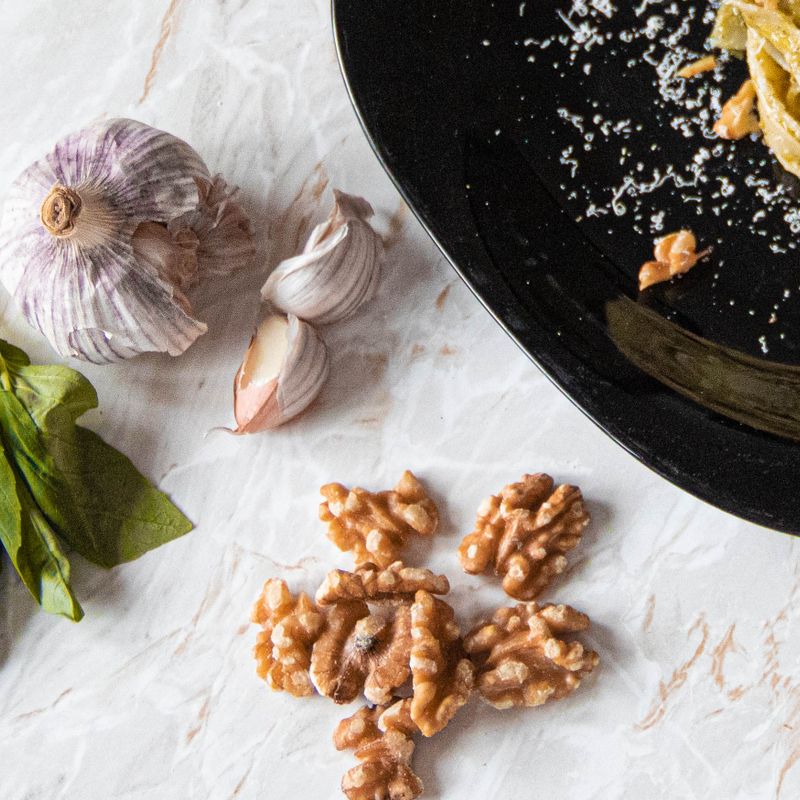
Italian Pesto Rosso and Roasted Walnut Dip
A vibrant, creamy dip that marries the sweet char of roasted red peppers with the rich earthiness of toasted walnuts and the bright herbaceous notes of fresh basil. This Italian-inspired spread balances garlic, Parmesan, and a hint of red wine vinegar for depth. Perfect served with crostini, crackers, fresh vegetables, or torn bread.
Steps
Before you start
- Measure out all ingredients before blending
- If using fresh peppers, roast them ahead or use jarred roasted peppers (no need to drain completely—a bit of liquid helps the dip)
- Toast the walnuts while gathering other ingredients—don't skip this step, as it deepens their flavor
Toast the walnuts
- Place the 0.75 cup (90 g) raw walnuts in an 8-inch (20 cm) skillet over medium heat.
- Stir frequently for 4–5 minutes, until fragrant and lightly golden.
- Be careful not to burn them—they should smell nutty and warm, not acrid.
- Transfer to a plate to cool for 1 minute.
+ Show details− Hide details
Ready when: Walnuts are fragrant and lightly golden, not burnt
Tip: Don't skip toasting—raw walnuts will taste bitter and won't contribute the rich, roasted flavor this dip needs.
Combine all ingredients in food processor
- Add the toasted walnuts, 1.5 cups (360 g) roasted red peppers (with a bit of their juice), 0.75 cup (20 g) packed fresh basil leaves, 2 garlic cloves, 0.5 cup (50 g) grated Parmesan, and 1 tablespoon (15 ml) red wine vinegar to a food processor.
+ Show details− Hide details
Tip: Use a food processor rather than a blender for better texture—you want a chunky-smooth dip, not a completely smooth purée.
Pulse to rough texture
- Pulse the mixture 4–5 times, about 1 second per pulse, until the walnuts and peppers are broken down but still have some visible texture.
- You should see small pieces of walnut and red pepper, not a uniform paste.
+ Show details− Hide details
Ready when: Mixture is chunky and rough, with visible walnut and pepper pieces, not puréed
Tip: Resist the urge to over-process—a rustic texture is what makes this dip appealing and prevents it from becoming gluey.
Stream in olive oil and blend
- With the processor running on low, slowly drizzle in the 0.25 cup (60 ml) extra virgin olive oil through the feed tube.
- Continue processing for 10–15 seconds after the oil is fully incorporated, until the dip is creamy and well combined but still has visible texture.
+ Show details− Hide details
Ready when: Dip is creamy, well-blended, and holds together while still showing flecks of walnut and basil
Tip: Add the oil slowly while the processor runs—this emulsifies it into the dip rather than pooling on top.
Season to taste
- Taste the dip and season with sea salt and freshly ground black pepper.
- Start with a generous pinch of salt (about 1/4 teaspoon) and a few grinds of pepper, then adjust.
- The Parmesan adds saltiness, so go easy at first.
+ Show details− Hide details
Ready when: Flavors are balanced—the sweet peppers, nutty walnuts, and bright basil are all present
Tip: Add salt gradually; you can always add more, but you cannot remove it.
Transfer and serve
- Scrape the dip into a serving bowl.
- Drizzle lightly with additional extra virgin olive oil if desired, and serve at room temperature with crostini, crackers, or fresh vegetables.
+ Show details− Hide details
Tip: A final drizzle of high-quality olive oil adds visual appeal and reinforces the Italian character of the dish.
Good to know
Tips
- Do not wring or squeeze the roasted peppers dry—a small amount of their liquid helps create a creamy dip rather than a crumbly paste.
- For a looser, more spreadable consistency, increase the olive oil to 1/3 cup (80 ml). For a thicker dip, reduce it to 3 tablespoons (45 ml).
- This dip is best served at room temperature, which allows the flavors—especially the fresh basil and garlic—to shine without being muted by cold.
- Make a grain bowl topping: swirl this dip into hummus or labneh and serve alongside roasted vegetables, chickpeas, and grains for a Mediterranean-inspired lunch.
Make ahead
Prepare the dip up to 2 days ahead and store covered in the refrigerator. Let it come to room temperature for 15 minutes before serving, or serve chilled if you prefer.
Storage & reheating
Room temperature: up to 2 hours. Refrigerator: up to 3 days in an airtight container. Freezer: up to 2 months in a freezer-safe container. Thaw in the refrigerator overnight and stir well before serving. The texture may become slightly looser after thawing; if needed, blend in 1–2 tablespoons of olive oil to restore creaminess.
Substitutions
- roasted red peppers, jarred or homemade → Roasted red peppers homemade from fresh peppers, or fire-roasted tomatoes plus 1 tablespoon tomato paste. If roasting fresh peppers, char 3–4 large red bell peppers over a gas flame or under the broiler, then peel and seed. Jarred peppers are more convenient and yield the same result.
- raw walnuts → Toasted pine nuts, hazelnuts, or almonds (reduce to 0.5 cup / 60 g if using stronger-flavored nuts). Pine nuts or hazelnuts provide a milder, more delicate flavor. Almonds work well but use slightly less, as they're denser.
- fresh basil leaves, packed → Fresh mint (use 0.5 cup / 12 g) plus 0.25 cup (6 g) fresh parsley, or dried basil (reduce to 2 tablespoons). Fresh mint and parsley create a different but equally Italian profile. Dried basil is acceptable in winter when fresh is unavailable, but use sparingly as it's more intense.
- Parmigiano-Reggiano cheese, finely grated → Pecorino Romano or aged Asiago. Pecorino Romano is tangier and saltier; Asiago is nuttier. Both pair beautifully with walnuts.
More dips & spreads
See all →



Find more like this
- Meal
- Snack
- Cuisine
- Italian
- Main ingredient
- Bell Peppers
- Method
- Stovetop