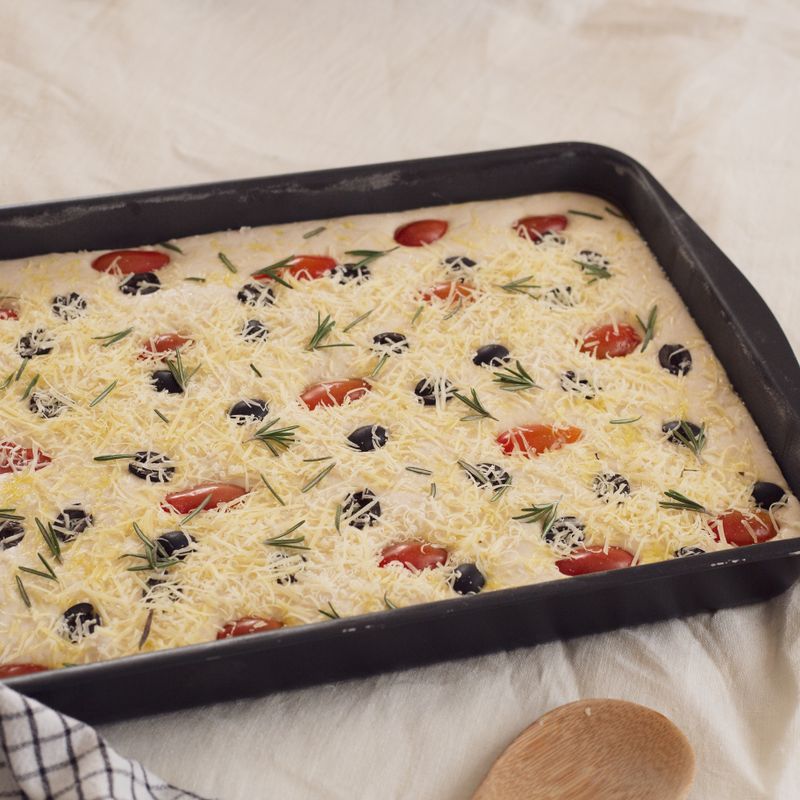
Italian Focaccia Rolls with Rosemary
Soft, airy rolls with a crisp, olive-oil-golden bottom, dimpled tops and fragrant fresh rosemary. The wet dough is built with simple stretch-and-folds, so there is no kneading, and the rolls bake together in one pan for pull-apart tenderness.
- Prep
- 42 min
- Cook
- 22 min
- Wait
- 2 hr 30 min
- Total
- 3 hr 34 min
- Makes
- 12 rolls
Steps
Before you start
- Plan on about 3½ hours from start to finish; most of it is hands-off rising time.
- The dough is wet and sticky (72% hydration) on purpose. Use wet hands and a bench scraper instead of adding extra flour.
- Strip the rosemary leaves from the woody stems and chop them finely before you need them.
- Weigh the flour and water with a kitchen scale if you can; it gives the most reliable result.
Mix the dough
- In a large bowl, whisk the bread flour, instant yeast, sugar and fine sea salt.
- Add the lukewarm water and 2 Tbsp (30 ml) olive oil.
- Stir with a wet spatula or your hand for about 2 minutes until no dry flour remains and you have a shaggy, very sticky dough.
- Cover the bowl with a damp towel or plastic wrap and let it rest for 20 minutes.
+ Show details− Hide details
Ready when: No dry flour pockets remain; dough looks shaggy and sticky
Tip: Check that the water feels just warm on your wrist. Hot water above 120°F (49°C) can kill the yeast.
First stretch and fold
- With wet hands, grab the edge of the dough at one side, stretch it up until it resists, and fold it over onto the center.
- Rotate the bowl a quarter turn and repeat 8 to 10 times total, working all the way around.
- Cover and rest for 30 minutes.
+ Show details− Hide details
Ready when: Dough tightens into a smoother, rounder mass that resists stretching
Tip: Keep a small bowl of water nearby and re-wet your hands whenever the dough starts to stick.
Second fold and rise
- Repeat the stretch and fold 8 to 10 times.
- Cover the bowl and let the dough rise at warm room temperature (75°F / 24°C) for 45 minutes.
+ Show details− Hide details
Ready when: Dough is billowy, jiggles when the bowl is shaken and has visible bubbles at the edges
Tip: In a cool kitchen, add 15 to 20 minutes. Judge by the dough's volume rather than the clock.
Prep pan and rosemary
- Pour 2 Tbsp (30 ml) olive oil into a 9×13-inch (23×33 cm) pan and tilt to coat the bottom and sides generously.
- Finely chop the rosemary leaves and set them aside for topping.
+ Show details− Hide details
Ready when: The whole pan bottom shines with oil
Tip: Don't skimp on the oil. It fries the bottoms of the rolls to a golden crisp.
Divide and shape
- Oil your hands lightly from the pan.
- Turn the dough out onto an unfloured counter and cut it into 12 pieces of about 75 g each with a bench scraper.
- Gently pull the edges of each piece toward the center to make a rough ball, flip seam-side down, and cup your hand over it, dragging it in small circles to tighten the surface.
- Place the rolls in the pan in 3 rows of 4, turning each to coat in oil, with small gaps between them.
+ Show details− Hide details
Ready when: Each roll is a smooth, taut ball and all 12 sit snugly in the pan
Tip: Handle the dough gently to keep the air bubbles that give the rolls their open crumb.
Second riseOven 425°F / 220°C
- Cover the pan loosely with a damp towel or oiled plastic wrap and let the rolls rise for 40 minutes.
- After 20 minutes, place a rack in the center of the oven and preheat to 425°F (220°C).
+ Show details− Hide details
Ready when: Rolls have grown by about half, touch each other and feel pillowy; a gently pressed finger dent springs back slowly
Tip: If the dent springs back immediately, give them 10 more minutes.
Dimple and top
- Drizzle 1 Tbsp (15 ml) of the topping olive oil over the rolls.
- Oil your fingertips and press straight down into each roll to dimple it, nearly to the pan bottom.
- Scatter the chopped rosemary over the rolls and sprinkle with the flaky sea salt.
+ Show details− Hide details
Ready when: Each roll has 3 to 4 deep dimples with small pools of oil
Tip: Press the rosemary into the dimples so it doesn't scorch on the surface.
Bake the rollsOven 425°F / 220°C
- Bake at 425°F (220°C) on the center rack for 20 to 24 minutes, rotating the pan after 12 minutes, until the tops are deep golden brown and the bottoms are crisp when you lift a roll with a spatula.
+ Show details− Hide details
Ready when: Deep golden brown tops and an internal temperature of 200 to 210°F (93 to 99°C) on an instant-read thermometer
Tip: If the rosemary darkens too quickly, tent the pan loosely with foil for the last 5 minutes.
Brush and cool
- As soon as the pan comes out, brush the hot rolls with the remaining 1 Tbsp (15 ml) olive oil.
- Let them sit in the pan for 5 minutes, then transfer to a wire rack and cool for at least 10 more minutes before serving warm.
+ Show details− Hide details
Ready when: Rolls release easily from the pan and feel light for their size
Tip: Moving them to a rack keeps the crisp bottoms from steaming soft.
Good to know
Tips
- Use a good extra-virgin olive oil for the pan and topping. It is a major flavor in the finished rolls.
- A metal pan gives the crispest bottoms. If using glass or ceramic, bake 3 to 5 minutes longer.
- Dimple firmly. Shallow dimples let the rolls puff into smooth domes instead of the classic focaccia texture.
- For extra flavor, add 1 thinly sliced garlic clove to the oil you drizzle on top, or finish with a squeeze of lemon zest.
Make ahead
"After shaping (step 5), cover the pan tightly and refrigerate for 8 to 16 hours. When ready, leave it at room temperature for 45 to 60 minutes until puffy, then preheat the oven, dimple, top and bake as directed."
Storage & reheating
"Room temperature: store in an airtight container or bag for up to 2 days. Refrigerator: not recommended, as it dries out the crumb. Freezer: wrap individually and freeze for up to 3 months. Reheat room-temperature rolls or thawed frozen rolls on a baking sheet at 350°F (175°C) for 8 to 10 minutes, or 12 to 15 minutes from frozen, until warm and the crust crisps."
Substitutions
- bread flour → all-purpose flour. Rolls will be a little softer and less chewy. Reduce the water to 330 ml (1⅓ cups) because all-purpose flour absorbs less.
- instant yeast → active dry yeast. Use the same amount, dissolve it in the lukewarm water with the sugar, and let it sit for 5 minutes until foamy before mixing.
- fresh rosemary leaves → dried rosemary. Use 2 tsp, crushed between your fingers. Press it into the oil so it doesn't burn.
- flaky sea salt → coarse kosher salt. Use ¾ tsp, since the crystals are denser and saltier by volume.