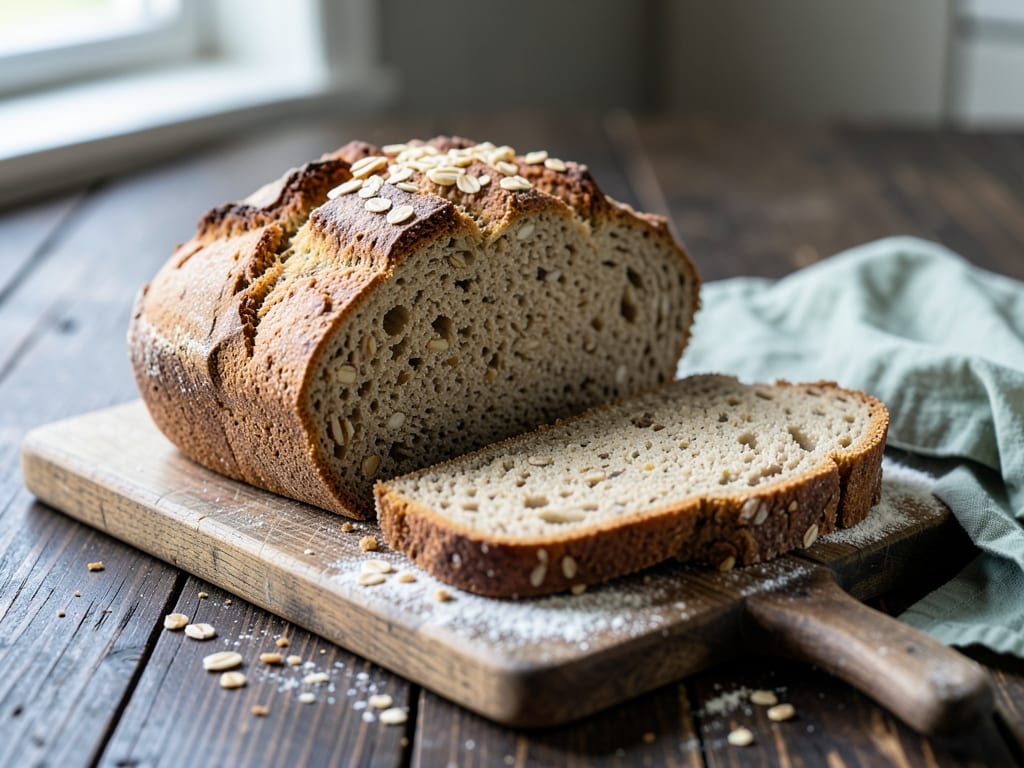
Irish Brown Soda Bread
A rustic, no-yeast Irish loaf with a crackly, craggy crust and a tender, nutty crumb from whole wheat flour and oats. It's mixed in one bowl in about 15 minutes and goes from pantry to table in under two hours.
- Prep
- 15 min
- Cook
- 45 min
- Wait
- 45 min
- Total
- 1 hr 45 min
- Makes
- 1 round loaf (8 wedges)
Steps
Before you start
- Take the buttermilk out of the fridge 20 minutes ahead so it isn't ice cold, but keep the butter cold.
- Check that your baking soda is fresh (it should fizz when a pinch is stirred into a spoonful of vinegar). Old soda gives a dense, flat loaf.
- Have the oven fully preheated before you mix. Soda bread starts rising the moment the buttermilk hits the baking soda, so it must go into a hot oven right away.
- Plan on about 1 hour 45 minutes total, including 45 minutes of cooling before slicing.
Preheat and prepare panOven 425°F / 220°C
- Position an oven rack in the center and preheat the oven to 425°F (220°C).
- Line a large baking sheet with parchment paper.
- Set the buttermilk on the counter.
+ Show details− Hide details
Ready when: Oven thermometer or display reads 425°F (220°C).
Tip: Let the oven preheat for at least 15 minutes so it's truly hot. Mixing takes about the same time.
Whisk dry ingredients
- In a large bowl, whisk together the whole wheat flour, all-purpose flour, ½ cup (45 g) oats, baking soda, salt and brown sugar (if using) for about 30 seconds.
- Make sure the baking soda is evenly distributed with no visible lumps.
+ Show details− Hide details
Ready when: The mixture looks uniform in color with flecks of oats and bran throughout.
Tip: Pockets of unmixed baking soda leave bitter, soapy spots in the finished bread.
Rub in the butter
- Add the cold butter cubes.
- Using your fingertips, rub and pinch the butter into the flour for 1–2 minutes until it is broken into small pieces about the size of peas and coated in flour.
+ Show details− Hide details
Ready when: No large chunks of butter remain and the mixture looks sandy with some pea-sized pieces.
Tip: Work quickly so the butter stays cold and doesn't melt into the flour.
Add the buttermilk
- Make a well in the center and pour in all of the buttermilk at once.
- With a wooden spoon or your hand held like a claw, stir from the center outward in broad circles for about 20–30 seconds until the flour is just moistened and a soft, shaggy, sticky dough forms.
+ Show details− Hide details
Ready when: No dry flour remains at the bottom of the bowl; the dough is sticky and rough-looking, not smooth.
Tip: Don't overmix or knead. Overworking makes the loaf tough and dense. A sticky dough is correct for whole wheat, which absorbs liquid as it sits.
Shape the round
- Lightly flour your hands and a clean counter with some of the dusting flour.
- Turn the dough out and, handling it as little as possible, fold the edges in toward the center 3–4 times to form a round about 7 inches (18 cm) across and 1½ inches (4 cm) thick.
- Transfer to the lined baking sheet with a bench scraper.
+ Show details− Hide details
Ready when: The dough holds a domed round shape; it will still feel soft and slightly tacky.
Tip: If the dough sticks to your hands, dust them with flour rather than working more flour into the dough.
Score and top
- Dust the top lightly with a little flour.
- With a sharp knife, cut a deep cross into the loaf, going about ¾ inch (2 cm) deep and almost to the edges.
- Brush off excess flour and sprinkle the 1 tablespoon topping oats over the surface, pressing them in gently.
+ Show details− Hide details
Ready when: The cross is deep enough that the dough visibly opens into four quarters.
Tip: Deep cuts let heat reach the center so the middle bakes through.
Bake at high heatOven 425°F / 220°C
- Immediately slide the baking sheet into the 425°F (220°C) oven.
- Bake for 15 minutes without opening the door, until the loaf has risen, puffed and the crust has begun to set and turn golden brown.
+ Show details− Hide details
Ready when: The loaf is risen, the cross has opened, and the crust is lightly golden.
Tip: Don't delay between mixing and baking, since the leavening reaction starts as soon as the buttermilk is added.
Lower heat and finishOven 400°F / 205°C
- Reduce the oven temperature to 400°F (200°C).
- Continue baking for 28–32 minutes more, until the crust is deep golden brown and firm.
- If the top browns too quickly, tent loosely with foil for the last 10 minutes.
+ Show details− Hide details
Ready when: The loaf sounds hollow when tapped on the bottom, and an instant-read thermometer in the center reads 200–210°F (93–99°C).
Tip: Carefully lift the loaf with oven mitts to tap the base. A dull thud means it needs 5 more minutes.
Cool before slicing
- Transfer the loaf to a wire rack.
- Let it cool for at least 45 minutes, or until barely warm.
- For a softer crust, wrap the loaf in a clean dry tea towel while it cools.
+ Show details− Hide details
Ready when: The loaf feels just warm to the touch and the base is no longer steamy.
Tip: Slicing too early makes the crumb gummy. Patience gives a cleaner, more tender slice.
Slice and serve
- Use a serrated knife to cut the loaf along the scored cross into four quarters, then cut each quarter in half to make 8 wedges, or slice across into ¾-inch (2 cm) slices.
- Serve with good butter, jam, smoked salmon or alongside soup.
Good to know
Tips
- Measure flour by spooning it into the cup and leveling, or better, weigh it. Packed whole wheat flour makes a dry, heavy loaf.
- Keep the dough sticky and handle it minimally; soda bread relies on a light touch rather than gluten development.
- Different brands of whole wheat flour absorb different amounts of liquid. If the dough looks dry and crumbly, add 1–2 tablespoons more buttermilk.
- For an extra-crisp crust, bake without the foil and cool uncovered on the rack.
Make ahead
You can measure the dry ingredients (flours, oats, baking soda, salt, sugar) into the bowl up to 1 day ahead, covered at room temperature. Add the butter and buttermilk only when the oven is hot and you're ready to bake. The baked loaf can be made a day ahead.
Storage & reheating
Room temperature: wrap in a clean tea towel or paper bag for up to 2 days (best the day it's baked). Fridge: wrap tightly and keep up to 5 days. Freezer: slice, wrap well and freeze up to 3 months. Reheat slices in a toaster, or warm a whole loaf at 350°F (175°C) for 10–15 minutes until the crust crisps.
Substitutions
- full-fat buttermilk → 1¾ cups (420 ml) whole milk mixed with 1½ tablespoons lemon juice or white vinegar, rested 10 minutes; or thinned plain yogurt. The acid is needed to activate the baking soda. The crumb will be slightly less tangy and tender.
- all-purpose flour → Additional whole wheat flour (90 g / ¾ cup). Gives a denser, more traditional wholemeal loaf. You may need 1–2 tablespoons extra buttermilk.
- unsalted butter → Cold vegetable shortening or omit entirely. Traditional brown soda bread often has little or no fat. The loaf will be slightly drier without it.
- light brown sugar → Honey or treacle (molasses), 1 tablespoon, stirred into the buttermilk. Adds a deeper, malty flavor.
More quick breads
See all →
Find more like this
- Meal
- Breakfast
- Diet
- VegetarianHalal
- Method
- Oven
- Quick & Easy
- EasyMake AheadFreezer Friendly