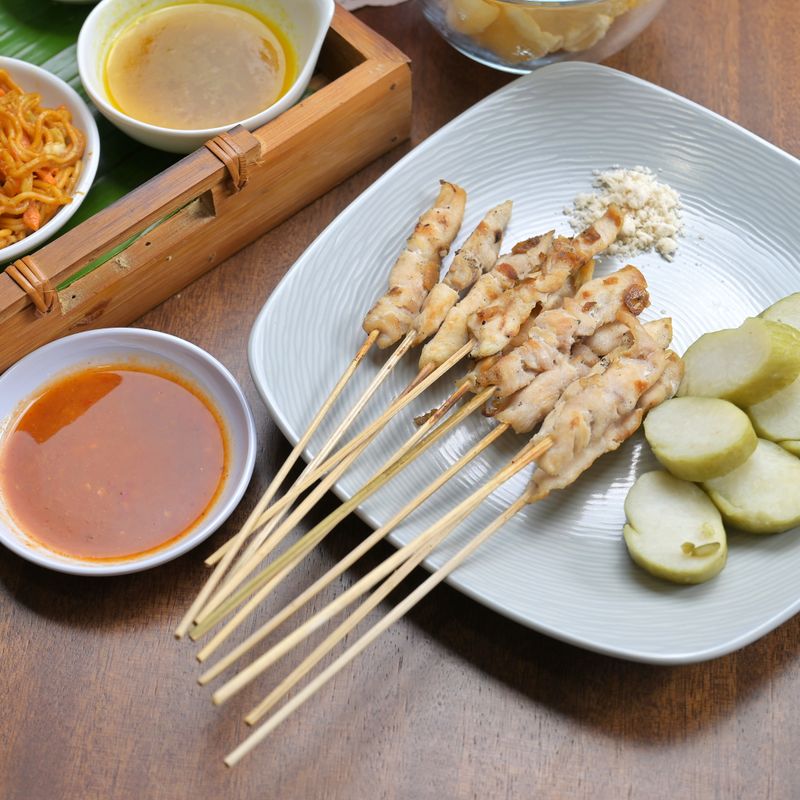
Indonesian Squid Satay
Tender grilled squid threaded on skewers and brushed with a vibrant lime-chili marinade, served with a creamy and aromatic peanut sauce infused with coconut milk, garlic, and shallots. This Indonesian street-food favorite is quick to grill and packed with savory umami. The squid is scored for even cooking and textural appeal, while the dipping sauce balances rich, salty, sour, and spicy notes.
- Prep
- 20 min
- Cook
- 15 min
- Wait
- 32 min
- Total
- 1 hr 7 min
- Makes
- 8–10 skewers (4 servings, 2–3 skewers per person)
Steps
Before you start
- Buy the freshest squid available—ask your fishmonger when it was caught or check the date on frozen squid
- Soak 8–10 bamboo skewers (10-inch / 25 cm) in cold water for at least 30 minutes to prevent burning
- Preheat your grill or grill pan to medium-high heat (about 400°F / 200°C) just before threading the skewers
- Have all ingredients measured and prepped before you start (this is a quick-cooking dish)
Clean and cut the squid
- Rinse the squid under cold running water.
- Lay a squid body sac on a cutting board.
- Using a sharp knife, cut it in half lengthwise to open it like a book and lay it flat, skin-side up.
- If desired, leave the skin on for visual appeal, or gently scrape it off with the back of your knife for a whiter appearance.
- Score the inside of the squid by making shallow crosshatch cuts (about ¼ inch / 6 mm deep), cutting horizontally and then diagonally without cutting all the way through the flesh.
- This scoring helps the squid cook evenly and gives it an attractive curled texture when cooked.
- Now cut the scored body into 2-inch (5 cm) rectangular pieces.
- Repeat with the remaining squid.
- Pat dry with paper towels.
- You should have about 24–30 pieces.
+ Show details− Hide details
Ready when: All squid cleaned and cut into uniform 2-inch (5 cm) pieces, patted dry
Tip: Fresh squid is easier to clean when cold. If the skin is slippery, grip it with a damp paper towel. Don't skip the scoring—it's what gives satay its distinctive texture.
Make the marinade
- In a small bowl, combine the 3 minced garlic cloves, 1 minced red chili pepper, 3 tablespoons (45 ml) lime juice, 2 tablespoons (30 ml) fish sauce, 2 tablespoons (30 ml vegetable oil, and ½ teaspoon (3 g) salt.
- Stir well with a spoon until the salt dissolves and the mixture is evenly combined.
+ Show details− Hide details
Ready when: Marinade is homogeneous and salt is dissolved
Marinate the squid
- Place the cleaned and dried squid pieces in a medium bowl.
- Pour the marinade over the squid and toss gently but thoroughly to coat all pieces evenly.
- Cover the bowl with plastic wrap or a lid and refrigerate for 30 minutes.
- (While the squid marinates, you can soak the bamboo skewers and prepare the peanut sauce—see next steps.)
+ Show details− Hide details
Ready when: Squid is evenly coated and fragrant
Tip: Don't marinate longer than 2 hours or the acid in the lime juice will make the squid mushy.
Soak the bamboo skewers
- Place 8–10 bamboo skewers in a shallow dish (such as a baking dish) and cover them completely with cold water.
- Let them soak for at least 30 minutes.
- You can do this while the squid marinates.
+ Show details− Hide details
Ready when: Skewers are fully submerged and flexible
Tip: Don't skip this step—dry bamboo will burn and ruin your skewers.
Make the peanut sauce
- Heat 1 tablespoon (15 ml) oil in a small saucepan over medium heat.
- Once hot, add the 2 thinly sliced shallots, 2 minced garlic cloves, and 1 minced red chili pepper.
- Cook for 2–3 minutes, stirring occasionally, until the shallots soften and the mixture is fragrant.
- Stir in 1 cup (260 g) peanut butter, ¾ cup (180 ml) coconut milk, 3 tablespoons (45 ml) lime juice, 1.5 tablespoons (22 ml) fish sauce, 2 tablespoons (25 g) palm sugar or brown sugar, and ½ teaspoon (1 g) ground turmeric (if using).
- Bring the mixture to a gentle simmer, stirring frequently, and cook for 3–4 minutes until the sauce is smooth, creamy, and well combined.
- If the sauce is too thick to dip, add water 1 tablespoon (15 ml) at a time until you reach a pourable consistency.
- Taste and adjust the seasoning with salt, lime juice, or fish sauce as needed.
- (The sauce can be made while the squid marinates.) Transfer to a serving bowl and set aside, covering loosely with foil to keep it warm, or serve at room temperature.
+ Show details− Hide details
Ready when: Sauce is smooth, creamy, coats the back of a spoon, and shows no lumps of peanut butter
Tip: Stir constantly to prevent sticking and scorching on the bottom. Add water in small amounts if it becomes too thick; you can't remove it, so be conservative.
Thread the skewers
- Remove the marinated squid from the refrigerator.
- Drain the soaked bamboo skewers and pat them dry with a paper towel.
- Working quickly, thread 5–6 pieces of squid onto each skewer, leaving a small space (about ¼ inch / 6 mm) between pieces so hot air can circulate around them.
- As you thread, try to alternate the orientation of the squid pieces (some with the scored side up, some with the scored side down) for visual appeal.
- Arrange the loaded skewers on a plate, dab them with any remaining marinade from the bowl, and have them ready by the grill.
+ Show details− Hide details
Ready when: All squid is evenly distributed on skewers with small gaps between pieces
Tip: Don't overcrowd the skewers. Spacing allows direct heat to contact the squid, creating browning. Crowded skewers will steam instead of grill.
Heat and oil the grillOven 400°F / 205°C
- Preheat your grill or grill pan to medium-high heat (about 400°F / 200°C).
- If using a stovetop grill pan, place it on the burner set to medium-high.
- Let it heat for 3–5 minutes until it's very hot and a drop of water sizzles immediately on contact.
- Just before grilling, very lightly oil the grill grates or pan surface using an oiled paper towel or grill brush to prevent the squid from sticking.
+ Show details− Hide details
Ready when: Water droplets sizzle and evaporate immediately when dropped on the grill or pan
Tip: A properly preheated grill is essential. If it's too cool, the squid will stick and not brown; if it's too hot, the outside will char before the inside cooks.
Grill the squid satay
- Carefully lay the loaded skewers directly on the hot, oiled grill or grill pan, arranging them so they don't touch each other.
- Grill without moving or turning for 2–2.5 minutes on the first side.
- You should see char marks forming and the squid edges beginning to curl and turn opaque.
- Flip each skewer carefully using tongs and grill the second side for 1.5–2 minutes, until all visible flesh is opaque white (not translucent) and the squid is just cooked through.
- The entire cooking time is 3.5–4.5 minutes.
- Overcooked squid becomes tough and rubbery, so watch it carefully.
+ Show details− Hide details
Ready when: Squid is opaque white throughout with light char marks on both sides; edges curl slightly upward
Tip: If your grill has hot and cool zones, move any skewers that are charring too quickly to the cooler side. Squid is small and cooks fast, so don't step away from the grill.
Rest and serve
- Using tongs, transfer the grilled skewers to a serving platter and let them rest for 1–2 minutes.
- While they rest, the residual heat finishes cooking the centers gently.
- Arrange the skewers on a platter alongside small bowls of warm or room-temperature peanut sauce and lime wedges.
- Serve immediately, inviting guests to dip each piece into the sauce before eating.
+ Show details− Hide details
Ready when: Squid is rested and fragrant; sauce is ready for dipping
Tip: Serve immediately while the squid is still warm. Cold squid satay is chewy and far less pleasant.
Good to know
Tips
- Squid quality is everything: Buy the freshest squid available from your fishmonger—ask when it was caught. Fresh squid should smell clean and briny, not fishy or like ammonia. If fresh squid is unavailable, frozen squid (thawed) works fine, though it may be slightly tougher. Never buy squid that smells strongly fishy.
- Don't overcrowd the skewers: Spacing the squid pieces ¼ inch (6 mm) apart allows hot air to circulate and creates light browning and charring. Crowded pieces steam instead of grill, resulting in pale, rubbery squid.
- Watch the grill heat: Medium-high heat (400°F / 200°C) is ideal. If your grill is too hot, the squid will char on the outside before the inside cooks; if too cool, it becomes tough and steams. Have a cooler zone on your grill ready to move skewers if they're browning too fast.
- Sauce consistency matters: The peanut sauce should coat a spoon lightly and flow smoothly from a spoon into a bowl. If it's too thick, it won't coat the squid and will be hard to dip; too thin, and it won't cling. Add water in 1 tablespoon (15 ml) increments at a time until you reach the right texture.
Make ahead
The peanut sauce can be made up to 3 days ahead and stored in an airtight container in the refrigerator. Reheat gently over low heat on the stovetop, stirring occasionally, or microwave in 30-second intervals until warm. The squid can be cleaned, cut, and marinated up to 4 hours ahead; thread onto skewers just before grilling for the best texture.
Storage & reheating
Room temperature: Serve immediately for best texture and flavor. Refrigerator: Store leftover satay and sauce in separate airtight containers for up to 1 day. Reheat the squid very gently on a grill pan over medium heat for 1–2 minutes per side to warm through without overcooking further; it will toughen if reheated too much. Serve the sauce cold or reheated. Freezer: The peanut sauce alone freezes well for up to 3 months in an airtight container; do not freeze cooked squid as it becomes tough and rubbery upon thawing.
Substitutions
- shallots → white or yellow onion. Use ¼ of a small onion, finely diced. Onion flavor is sharper; cook for an extra minute to mellow it before adding other sauce ingredients.
- natural peanut butter (smooth or creamy) → freshly ground roasted peanuts blended with 2 tbsp (30 ml) neutral oil, or tahini. Use 1 cup (250 g) ground peanuts + 2 tbsp oil, or 1 cup (240 ml) tahini. Ground peanuts will have more peanut texture; tahini makes a nuttier, more bitter sauce—adjust sugar and lime juice to taste.
- fish sauce → soy sauce or tamari. Use the same amount (2 tbsp / 30 ml in the marinade, 1.5 tbsp / 22 ml in the sauce). Fish sauce gives an authentic pungent umami; soy sauce is less intense and slightly sweeter. The result will be less authentically Indonesian but still delicious.
- unsweetened coconut milk (canned or fresh) → heavy cream or evaporated milk. Use the same amount (¾ cup / 180 ml). The sauce will be richer and less aromatic; add an extra pinch of ground turmeric or a small pinch of ground coriander to compensate for the loss of coconut flavor.
More finger food
See all →


Find more like this
- Meal
- Snack
- Method
- StovetopGrill & BBQ