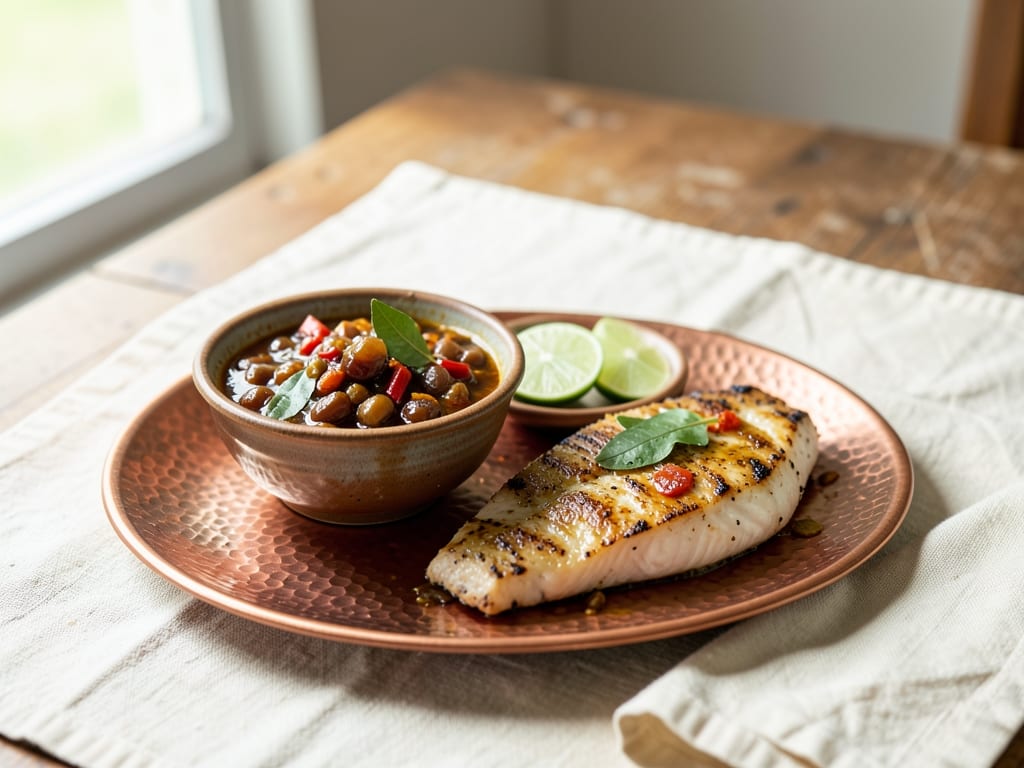
Indian Tamarind Fish Marinade with Curry Leaves and Turmeric
A tangy, earthy South Indian-style marinade that coats firm white fish in tamarind, turmeric, red chili and fragrant curry leaves. After just 30 minutes, the fish is pan-seared until crisp at the edges and juicy inside, and cooked to a safe 145°F (63°C).
- Prep
- 12 min
- Cook
- 9 min
- Wait
- 32 min
- Total
- 53 min
- Makes
- 4 servings (4 fillets, about 6 oz / 170 g each)
Steps
Before you start
- Use firm white fish such as cod, haddock, halibut, or snapper; delicate fish like sole will fall apart.
- Use seedless tamarind paste, not sweetened tamarind chutney. Concentrate is much stronger than paste, so see the substitutions.
- Do not marinate longer than 30 minutes (45 at most); the acid in tamarind turns the fish mushy and chalky.
- Thaw frozen fish fully in the fridge, then pat very dry.
- Have an instant-read thermometer ready: the fish is safely cooked when the thickest part reaches 145°F (63°C).
Dry the fish
- Pat the fish portions thoroughly dry with paper towels on all sides.
- Set them on a plate and sprinkle the salt evenly over both sides.
+ Show details− Hide details
Ready when: Surface feels tacky, not wet
Tip: Dry fish takes marinade better and sears instead of steaming.
Mix the marinade
- In a medium non-reactive bowl, stir together the tamarind paste, water, turmeric, chili powder, grated garlic, grated ginger, the chopped half of the curry leaves, and 1 tbsp (15 ml) of the oil.
- Mix until it forms a smooth, thick, spreadable paste about the texture of ketchup.
+ Show details− Hide details
Ready when: No lumps of tamarind remain and the paste is a uniform deep orange-red
Tip: Wear gloves or wash hands promptly; turmeric stains skin and countertops.
Coat the fish
- Add the fish to the bowl and turn each piece to coat all sides with a generous, even layer of paste.
- Tuck the whole curry leaves between and on top of the fillets.
+ Show details− Hide details
Ready when: Every surface is covered with paste
Tip: Handle gently so the fillets stay in whole pieces.
Marinate briefly
- Cover the bowl and refrigerate for 30 minutes.
- Do not exceed 45 minutes.
+ Show details− Hide details
Ready when: Flesh looks slightly opaque at the surface under the paste
Tip: Set a timer so you don't forget.
Heat the skillet
- About 5 minutes before the marinade time is up, set a 12-inch (30 cm) skillet over medium-high heat and add the remaining 2 tbsp (30 ml) oil.
- Heat until the oil shimmers and flows easily.
+ Show details− Hide details
Ready when: Oil shimmers and a bit of marinade sizzles on contact
Tip: Use non-stick or well-seasoned cast iron to keep the paste from sticking.
Sear first side
- Lift the fish from the bowl, leaving thick excess paste behind (keep a thin layer on each piece, along with the leaves).
- Lay the fillets in the pan, spaced apart.
- Cook without moving for 3 to 4 minutes.
+ Show details− Hide details
Ready when: Underside is deep brick-red with crisp edges and releases easily from the pan
Tip: Tamarind sugars brown fast; reduce to medium if the crust darkens to near black.
Flip and finish
- Slide a thin spatula under each fillet and flip carefully.
- Reduce heat to medium and cook 2 to 3 more minutes.
- Insert an instant-read thermometer into the thickest part of the fish; it must read at least 145°F (63°C).
+ Show details− Hide details
Ready when: Flesh is opaque throughout and flakes easily with a fork; thermometer reads 145°F (63°C)
Tip: If it reads below 145°F (63°C), cook another 30 to 60 seconds and check again.
Rest and serve
- Transfer the fish to a warm plate and rest for 2 minutes.
- Serve with lime wedges to squeeze over the top.
+ Show details− Hide details
Ready when: Fish is steaming gently and holds together
Good to know
Tips
- Keep the marinade time to 30 minutes; tamarind's acid firms and breaks down fish quickly.
- Scrape off thick clumps of paste before searing so it browns rather than burns.
- Thicker fillets can instead be baked at 425°F (220°C) for 10 to 12 minutes on a lined sheet pan, until the thickest part reaches 145°F (63°C).
- Serve with steamed rice, coconut chutney or a cucumber raita to balance the tang and heat.
Make ahead
Mix the marinade (without the fish) up to 3 days ahead and refrigerate in a sealed jar. Marinate the fish only on the day you cook it.
Storage & reheating
Cooked fish keeps in an airtight container in the fridge for up to 2 days. Reheat gently in a covered skillet over low heat, or in a 300°F (150°C) oven for 8 to 10 minutes, until hot throughout (165°F / 74°C). Do not leave at room temperature beyond 2 hours. Do not freeze raw fish in the marinade; unused marinade made without fish freezes up to 2 months.
Substitutions
- seedless tamarind paste → 1 tbsp (15 g) tamarind concentrate plus 2 tbsp (30 ml) water. Concentrate is much stronger than paste; dilute as stated.
- fresh curry leaves → 6 fresh basil leaves plus a pinch of lime zest. Flavor differs, but it adds a similar herbal brightness. Dried curry leaves are a weak match.
- Kashmiri red chili powder → 1 tsp cayenne plus 1 tsp sweet paprika. Gives similar color with more heat.
- coconut oil or neutral oil → ghee. Adds nutty richness; works well at medium-high heat.