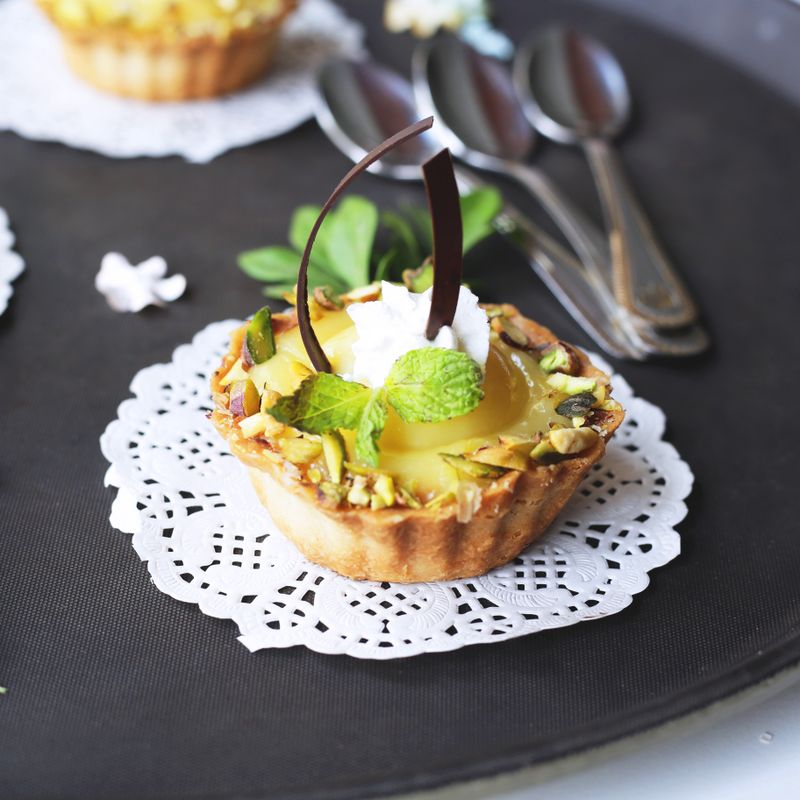
Iftar Spread Rose Water Custard Tart with Pistachio Crust
A luxurious Middle Eastern-inspired custard tart featuring a buttery pistachio crust and silky rose water-infused custard filling. The nutty pistachio base provides textural contrast to the delicate, perfumed custard center, finished with candied rose petals and chopped pistachios. This elegant dessert is perfect for Iftar celebrations or any occasion calling for refined Middle Eastern flavors.
- Prep
- 25 min
- Cook
- 40 min
- Wait
- 1 hr 30 min
- Total
- 2 hr 35 min
- Makes
- 1 tart (8 slices)
Steps
Before you start
- Chill all equipment and butter for the crust ahead of time
- Preheat oven to 350°F (175°C) before making the custard
- Remove eggs from refrigerator 15 minutes before use to avoid temperature shock when added to hot cream
- Have a bain-marie (water bath) ready with hot water
Make pistachio crust
- Combine ground pistachios, sugar, and salt in a large bowl.
- Add cold butter cubes and use a fork or your fingertips to work the butter into the dry mixture until it resembles coarse breadcrumbs with some pea-sized pieces of butter still visible.
- This should take 2–3 minutes.
- Add the room-temperature egg yolk and mix gently with a fork until the mixture just comes together into a shaggy dough.
- Do not overwork.
+ Show details− Hide details
Ready when: Dough just comes together; mixture looks like coarse breadcrumbs with some butter pieces still visible
Tip: Keep all ingredients cold to ensure a flaky, tender crust. Work quickly and don't overwork the dough, or the crust will be tough.
Press crust into tart pan
- Press the dough evenly into the bottom and up the sides of a 9-inch (23 cm) fluted tart pan with a removable bottom, using the heel of your hand or the bottom of a measuring cup.
- Make sure there are no thin spots or holes.
- Chill in the freezer for 15 minutes while you prepare the custard filling.
+ Show details− Hide details
Ready when: Dough is firm and holds its shape in the pan
Tip: Chill the crust thoroughly to prevent shrinkage during baking. If the dough is still warm when it goes in the oven, it will slump.
Preheat ovenOven 350°F / 175°C
- Preheat your oven to 350°F (175°C).
- After the crust has chilled for 15 minutes, line it with parchment paper and fill with pie weights or dried beans.
- Bake for 12–15 minutes, until the crust is light golden and set but not fully baked.
- Remove the parchment and weights and set aside.
+ Show details− Hide details
Ready when: Crust is light golden and feels firm but is still pale
Tip: Blind bake the crust to prevent a soggy bottom. Don't skip this step, or the finished tart will have a wet, mushy base.
Heat cream and milk
- While the crust bakes, combine the heavy cream and whole milk in a small saucepan.
- Split the vanilla bean lengthwise with a sharp knife and scrape the seeds directly into the cream mixture.
- Add the vanilla pod as well.
- Heat over medium heat, stirring occasionally, until the mixture is steaming and just beginning to form small bubbles around the edges, about 5–7 minutes.
- Do not boil.
- Remove from heat and let steep for 5 minutes, then remove the vanilla pod.
+ Show details− Hide details
Ready when: Mixture is steaming with small bubbles around the edges but not boiling
Tip: Do not boil the cream, or it may separate. A gentle heat and slight steeping time allows the vanilla flavor to infuse without curdling.
Whisk egg yolks and sugar
- In a separate bowl, whisk together the egg yolks and sugar until pale and thick, about 2–3 minutes.
- The mixture should fall in ribbons from the whisk.
- Sift the cornstarch over the egg mixture and whisk until completely combined and no lumps remain.
+ Show details− Hide details
Ready when: Mixture is pale, thick, and falls in ribbons from the whisk
Tip: Whisk the yolks and sugar thoroughly to incorporate air and ensure a smooth custard without lumps. The cornstarch prevents curdling and helps set the custard.
Temper egg yolks
- Slowly pour about 1/4 of the hot cream mixture into the egg yolk mixture while whisking constantly.
- This tempers the eggs and prevents them from scrambling.
- Once combined, pour the warmed egg mixture back into the remaining cream in the saucepan, whisking constantly.
+ Show details− Hide details
Ready when: All ingredients are combined into a smooth, pale mixture
Tip: Whisk constantly while adding the hot cream to the eggs to avoid scrambling them. Work slowly if you're nervous—it's better to take your time and create a smooth custard.
Cook custard
- Return the saucepan to medium heat and cook, whisking constantly, for 3–5 minutes.
- The custard will gradually thicken as you whisk.
- Continue until it reaches a gentle boil and coats the back of a spoon—when you run your finger along the back of the spoon, it should leave a clear trail.
- Remove from heat immediately.
+ Show details− Hide details
Ready when: Custard reaches a gentle boil and coats the back of a spoon with a visible trail when you run your finger along it
Tip: Watch carefully toward the end. Overcooking will break the custard or make it too thick. If it lumps, strain it through a fine sieve immediately.
Flavor custard with rose water
- Let the custard cool for 2 minutes off the heat, then whisk in the culinary rose water.
- Taste and adjust if desired.
- Be conservative with rose water—it can easily overpower the custard.
- You want a subtle floral note, not perfume.
+ Show details− Hide details
Ready when: Rose water is fully incorporated and no streaks remain
Tip: Rose water is potent. Start with the amount given, taste, and add only more if needed. Too much will make the custard taste like perfume, not food.
Fill tart with custard
- Pour the hot custard into the partially baked pistachio crust, spreading it evenly with a spatula.
- The custard should reach about 3/4 inch (2 cm) from the rim of the crust.
+ Show details− Hide details
Ready when: Custard is spread evenly and level
Tip: Pour the custard while it's still hot so it fills all the nooks and crannies of the crust and continues to set properly during baking.
Bake filled tartOven 350°F / 175°C
- Place the filled tart on a baking sheet (for easy handling) and set it on the middle rack of the oven, still at 350°F (175°C).
- Bake for 18–22 minutes.
- The custard should be set around the edges but still very slightly jiggly in the center when you gently shake the pan—it will continue to set as it cools.
- The surface may develop a light golden color, especially around the edges.
+ Show details− Hide details
Ready when: Edges of custard are set and light golden; center jiggles very slightly when you gently shake the pan
Tip: The custard will continue to set as it cools, so don't overbake it or it will be rubbery. A gentle jiggle in the center is exactly right.
Cool tart completely
- Remove the tart from the oven and let it rest on a wire rack at room temperature for 30 minutes.
- Then transfer it to the refrigerator to chill for at least 1 hour (up to 4 hours is fine).
- The tart is best served at room temperature or slightly chilled.
+ Show details− Hide details
Ready when: Tart is chilled through and custard is fully set
Tip: Don't skip the chilling time. The custard needs time to set properly, and the flavors develop as it cools.
Garnish and serve
- Carefully remove the tart from the tart pan by pushing up on the bottom or using a thin knife to loosen the sides first.
- Transfer to a serving plate.
- Just before serving, scatter the chopped pistachios over the top and arrange the candied rose petals (if using) in a decorative pattern.
- Slice with a sharp, hot knife, wiping the blade between cuts for clean edges.
+ Show details− Hide details
Ready when: Tart is plated and garnished
Tip: A hot knife gives the cleanest slices. Dip the blade in hot water and wipe it dry between cuts. Garnish just before serving so the pistachios stay crisp.
Good to know
Tips
- Rose water is intensely aromatic—use a high-quality culinary product from a specialty spice shop or reputable online source, not cosmetic-grade rose water. Start conservatively and taste as you go.
- For the silkiest custard, strain it through a fine sieve immediately after cooking, even if it looks smooth. Any tiny cooked egg bits will be caught, leaving you with pure velvet.
- If the filled tart cracks during baking, it's still delicious and a rustic charm—but avoid jostling the oven door while it bakes. The vibration can cause cracks.
- This tart is spectacular at Iftar because it can be prepared largely ahead of time. Make the crust and custard the day before, assemble and bake 2 hours before serving, then garnish just before serving to guests.
Make ahead
Prepare the pistachio crust dough up to 1 day ahead; wrap it tightly and refrigerate. Blind bake the crust up to 8 hours ahead and keep it in the tart pan. Make the custard filling up to 4 hours ahead; cover it with plastic wrap pressed directly onto the surface, chill, and reheat gently on the stovetop or in a warm water bath before filling the crust.
Storage & reheating
Room temperature: up to 4 hours (covered loosely). Refrigerator: up to 3 days in an airtight container. Freezer: up to 2 months (freeze the baked tart, unwrapped, then wrap tightly in plastic and foil). To reheat from frozen, thaw in the refrigerator overnight, then bring to room temperature for 30 minutes before serving, or serve chilled directly from the fridge.
Substitutions
- culinary rose water → 1 teaspoon orange blossom water plus 1 teaspoon freshly grated orange zest mixed into the custard. Orange blossom water offers a different but equally elegant Middle Eastern floral note. Add the zest for extra brightness.
- roasted unsalted pistachios → ½ cup ground pistachios mixed with ½ cup finely ground almonds. Reduces pistachio intensity and adds subtle nuttiness. Keep the total ground-nut amount to 1½ cups.
- heavy cream → 1¼ cups crème fraîche or Greek yogurt (whisked smooth). Creates a slightly tangier custard with a unique texture. Strain through cheesecloth if using Greek yogurt to remove excess whey.
- vanilla bean → ½ teaspoon vanilla extract, added after the cream cools. A practical swap if vanilla beans are unavailable. Add after cooking the cream mixture, not during heating, so the flavor doesn't dissipate.
More pies & tarts
See all →



Find more like this
- Meal
- Dessert
- Cuisine
- Middle Eastern
- Method
- Oven