Homemade Caffè Latte
A smooth, café-style latte made at home: a double shot of espresso topped with silky steamed whole milk and a thin cap of fine microfoam. Works with an espresso machine or a moka pot and a simple milk frother.
- Prep
- 3 min
- Cook
- 5 min
- Total
- 8 min
- Makes
- 1 latte (about 10 fl oz / 300 ml)
Steps
Before you start
- Use cold milk straight from the fridge; cold milk gives you more time to build silky foam before it gets too hot.
- Warm your mug by filling it with hot tap water while you prepare everything else, then empty it just before brewing.
- If using an espresso machine, let it fully heat up (usually 10–15 minutes) so the shot extracts properly.
- Use freshly ground, fine espresso-grade coffee for the best flavor.
Warm the mug
- Fill a 10–12 fl oz (300–350 ml) mug with hot tap water and let it sit while you work.
- Pour the milk into a cold steaming pitcher; fill it no more than one-third full (about 8 fl oz / 240 ml in a 12 fl oz pitcher) so the milk has room to expand.
+ Show details− Hide details
Ready when: Mug is warm to the touch.
Tip: A warm mug keeps the latte hot longer.
Grind and dose
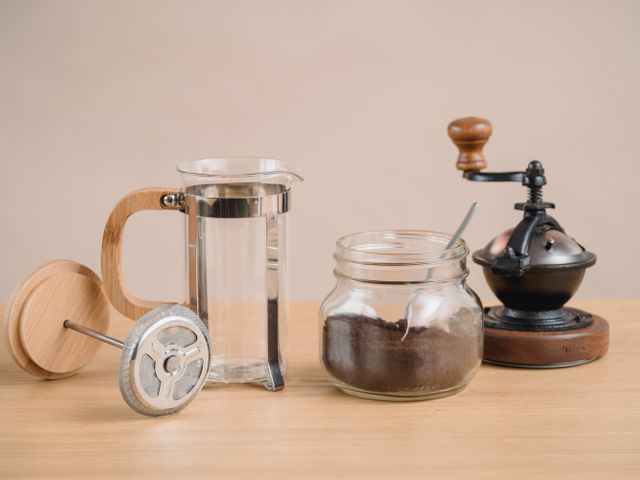
- Grind about 19 g of coffee fine, like table salt but slightly softer.
- Dose it into the portafilter, level it, and tamp firmly and evenly.
- Wipe any grounds from the rim.
+ Show details− Hide details
Ready when: Coffee bed is level and firmly compressed with no loose grounds on the rim.
Tip: No espresso machine? Brew a strong moka pot with about 2 fl oz (60 ml) of water-based coffee instead.
Pull the shot
- Empty the mug and place it under the spout (or put a small cup under it if you'll steam first).
- Start the shot and extract about 2 fl oz (40–60 ml) of espresso in 25–30 seconds.
- Stir in the sugar now if using.
+ Show details− Hide details
Ready when: Espresso flows like warm honey, finishing a golden-brown with a thin reddish-tan crema on top.
Tip: If the shot runs under 20 seconds, grind finer; if it takes over 35 seconds and tastes bitter, grind coarser.
Purge and position wand
- Point the steam wand into the drip tray and open it for 2 seconds to clear water.
- Submerge the wand tip just below the milk surface, slightly off-center, with the pitcher tilted a little.
+ Show details− Hide details
Ready when: Wand tip sits about ¼ inch (6 mm) below the milk surface.
Stretch the milk
- Turn the steam on fully.
- Lower the pitcher slightly so the tip skims the surface and makes a soft, paper-tearing hiss for 3–5 seconds, adding air.
- Then sink the tip deeper to spin the milk in a whirlpool.
+ Show details− Hide details
Ready when: Milk has grown in volume by about 20–30% and swirls glossy like wet paint.
Tip: Loud screeching means the tip is too shallow and making big bubbles; submerge it a touch more.
Heat to temperature
- Keep the milk spinning until the pitcher is hot to touch but you can still hold it for a second or two, 135–145°F (57–63°C).
- Turn off the steam before removing the wand, then wipe the wand with a damp cloth and purge it again.
+ Show details− Hide details
Ready when: Thermometer reads 135–145°F (57–63°C); never above 160°F (71°C), which scalds the milk.
Tip: Stop heating early rather than late; overheated milk tastes flat and cooked.
Polish the milk
- Tap the pitcher firmly on the counter two times to pop large bubbles, then swirl for 10–15 seconds until the milk looks smooth and shiny.
- Use it right away, before the foam separates.
+ Show details− Hide details
Ready when: Milk is uniformly glossy with no visible bubbles.
Tip: If it separates, swirl again briefly to re-combine.
Pour and serve
- Pour the espresso into the warmed mug if it isn't already there.
- Tilt the mug and pour the milk in a steady stream from a few inches up, then lower the pitcher close to the surface to let the foam float on top.
- Hold back the foam with a spoon if needed.
- Serve immediately.
+ Show details− Hide details
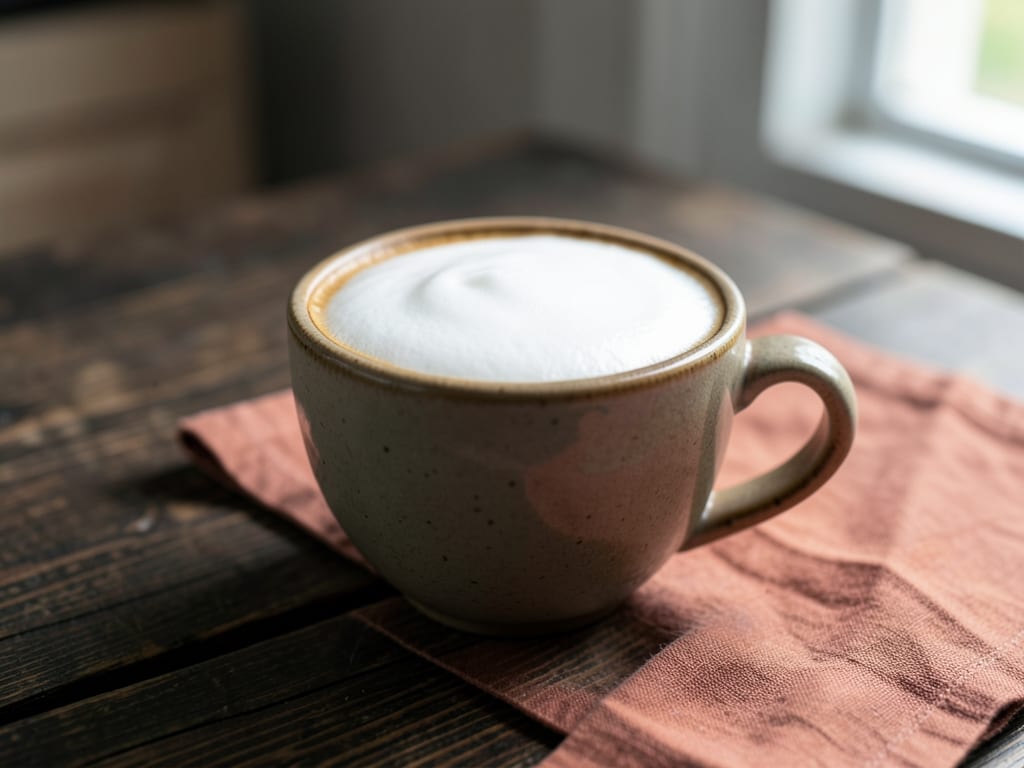
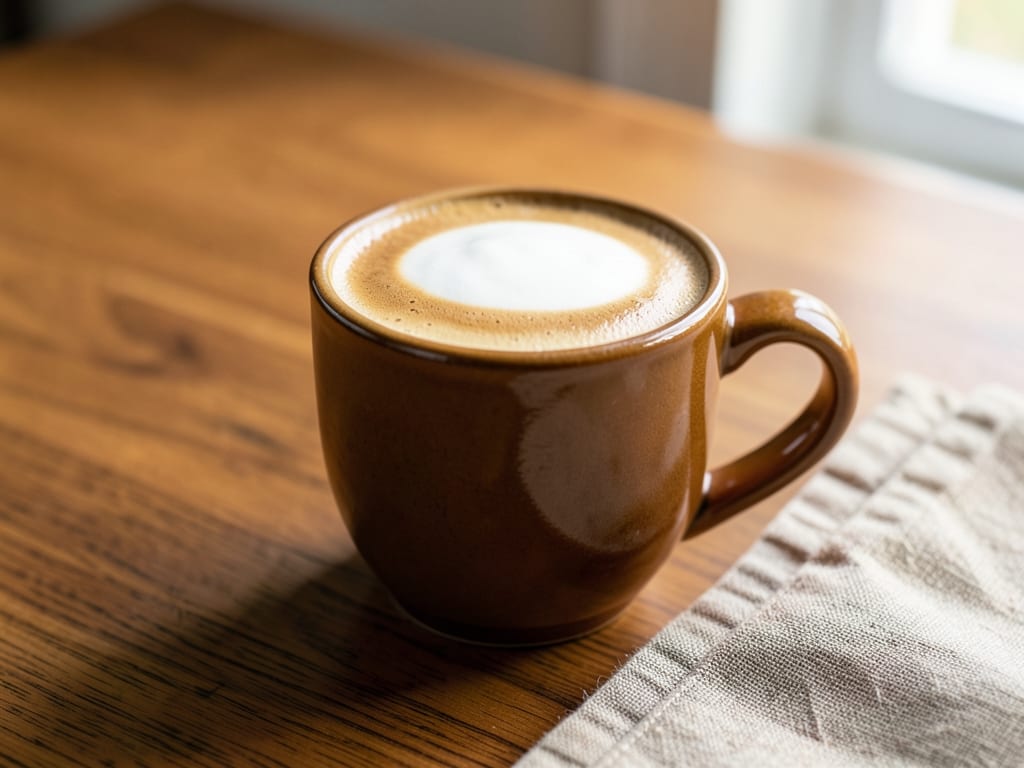
Ready when: Latte has a thin layer, about ¼–½ inch (6–12 mm), of white microfoam over a creamy tan body.
Good to know
Tips
- No steam wand: heat milk in a saucepan over medium-low to 140°F (60°C), then froth with a handheld frother or shake in a sealed jar for 30 seconds.
- A latte is milk-forward: about 1 part espresso to 4 parts milk, with a thin foam layer. For more foam, make a cappuccino by stretching the milk longer.
- Use fresh cold milk each time; re-steamed milk won't foam well.
- Clean the steam wand immediately after every use; dried milk clogs the holes.
Storage & reheating
Best consumed immediately. Leftover latte keeps covered in the fridge up to 24 hours, though the foam will collapse; reheat gently in a saucepan over low heat or in the microwave in 20-second bursts until steaming, and do not boil. Not suitable for freezing, though leftover espresso can be frozen in ice cube trays for up to 1 month.
Substitutions
- espresso or dark-roast coffee beans → 2 fl oz (60 ml) strong moka pot coffee or 2 Nespresso-style espresso capsules. Moka coffee is slightly less intense but works well with steamed milk.
- whole milk → barista-style oat milk. Foams well and gives a similar creamy body; avoid regular oat milk, which foams poorly.
- whole milk → 2% milk. Slightly lighter and foams well, though less creamy.
- granulated sugar or simple syrup → vanilla syrup or honey. Use 1–2 tsp, stirred into the hot espresso so it dissolves.