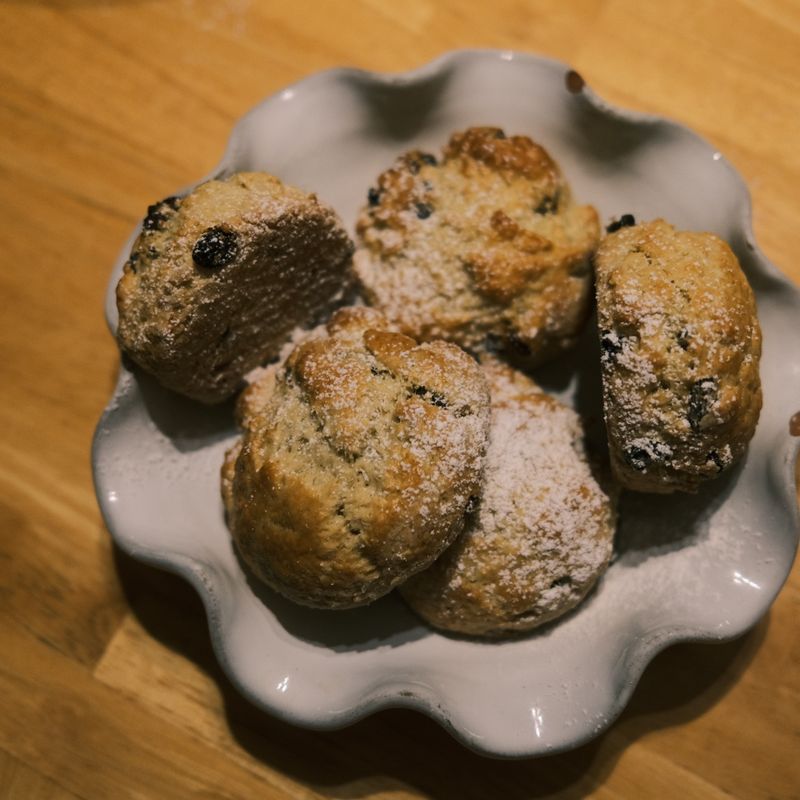
Herb and Feta Breakfast Scones
Tender, crumbly breakfast scones studded with tangy feta cheese and fresh Mediterranean herbs. These scones have a golden exterior and a moist, flaky crumb that comes from cold butter and minimal mixing. Perfect for breakfast with butter and jam, or served savory with cream cheese and smoked salmon.
Steps
Before you start
- Cut butter into ½-inch cubes and chill for at least 15 minutes
- Preheat oven to 400°F (200°C)
- Line a baking sheet with parchment paper
- Have all ingredients at the temperatures specified
Mix dry ingredients
- In a large bowl, whisk together 2 cups (250 g) flour, 2 tbsp (25 g) sugar, 2½ tsp (12 g) baking powder, ½ tsp (3 g) fine sea salt, and ¼ tsp (0.5 g) freshly ground black pepper.
- Break up any lumps with the back of a spoon so the mixture is evenly combined.
+ Show details− Hide details
Ready when: mixture is uniform and free of lumps
Tip: Sift the flour and baking powder if they are lumpy; this ensures even rising.
Cut in cold butter
- Add the 6 tbsp (85 g) cold butter cubes to the flour mixture.
- Using a pastry cutter, two forks, or your fingertips, work the butter into the flour until the mixture resembles coarse breadcrumbs with some pea-sized pieces of butter still visible.
- This should take 3–4 minutes.
- Work quickly and keep everything as cold as possible.
+ Show details− Hide details
Ready when: mixture resembles coarse breadcrumbs with pea-sized butter pieces visible
Tip: Warm hands will melt the butter; use fingertips and work quickly, or briefly chill your hands if needed.
Fold in cheese and herbs
- Gently fold 0.75 cup (110 g) crumbled feta cheese, 3 tbsp (9 g) finely chopped fresh dill, 2 tbsp (8 g) finely chopped fresh parsley, and 2 tbsp (6 g) finely chopped fresh chives (if using) into the flour mixture using a rubber spatula.
- Fold until just evenly distributed; do not overmix.
+ Show details− Hide details
Ready when: cheese and herbs are evenly distributed with no dry flour streaks
Tip: Fold gently to avoid crushing the feta and to prevent overdeveloping gluten, which toughens scones.
Create wet dough
- In a small bowl, whisk together 1 beaten egg and 0.75 cup (180 ml) cold buttermilk.
- Pour the wet mixture into the dry ingredients and fold together with a rubber spatula just until no dry flour remains.
- The dough will be shaggy and slightly sticky.
- Do not overwork it.
+ Show details− Hide details
Ready when: no dry flour visible and ingredients are just combined
Tip: Overmixing develops gluten and makes the scones tough. Stop as soon as you see no dry flour.
Shape the dough
- Turn the dough out onto a lightly floured work surface.
- Gently pat and shape it into a 7-inch (18 cm) round disc about ¾ inch (2 cm) thick.
- Do not knead or compress the dough.
- Using a sharp knife, cut the disc into 8 wedges, like cutting a pizza.
+ Show details− Hide details
Ready when: dough is shaped into 8 even wedges
Tip: Light handling preserves the flaky texture. If the dough warms up, chill it for 5 minutes before cutting.
Apply egg wash
- Place the 8 scone wedges on the prepared baking sheet, spacing them about 2 inches (5 cm) apart.
- In a small bowl, whisk together 1 beaten egg and 1 tbsp (15 ml) water.
- Brush the egg wash over the top of each scone until lightly coated.
- This creates a golden, glossy exterior.
+ Show details− Hide details
Ready when: all scones are evenly brushed with egg wash
Tip: Use a pastry brush or the back of a spoon; avoid letting egg wash drip down the sides, which can inhibit rising.
Bake until goldenOven 400°F / 205°C
- Bake in a preheated 400°F (200°C) oven for 16–18 minutes, until the scones are golden brown on top and a toothpick inserted into the center of one comes out clean or with just a few moist crumbs.
- The scones should feel firm and light when gently pressed.
+ Show details− Hide details
Ready when: golden brown tops, toothpick comes out clean, scones feel firm and light
Tip: Rotate the baking sheet halfway through if your oven has hot spots; do not open the oven before 15 minutes.
Cool before serving
- Remove the baking sheet from the oven and let the scones cool on the sheet for 5 minutes.
- Transfer them to a wire rack and cool for an additional 5 minutes before serving.
- They will continue to firm up as they cool.
+ Show details− Hide details
Ready when: scones are warm but firm, no longer steaming
Tip: Scones taste best served warm or at room temperature. Cooling them briefly allows the crumb to set without drying them out.
Good to know
Tips
- For the flakiest scones, everything except the buttermilk and egg should be as cold as possible. Chill your bowl and even your work surface in the fridge for 10 minutes before you start.
- Do not skip the folding motion when combining the wet and dry ingredients. A rubber spatula and gentle folding prevents overdeveloping gluten, which is the enemy of tender scones.
- If you prefer sweet scones, omit the black pepper, reduce the feta to ½ cup (75 g), and use just the dill and parsley. These still work beautifully.
- These scones are best served warm or at room temperature the same day they are baked. Freshly baked scones have the best texture and flavor.
Make ahead
Prepare the dry ingredient mixture (flour through black pepper) up to 1 day ahead; store in an airtight container at room temperature. On the day of serving, add the feta, herbs, and wet ingredients and proceed with shaping and baking. Unbaked scone wedges can be frozen on a baking sheet for up to 3 weeks; bake directly from frozen, adding 2–3 minutes to the baking time.
Storage & reheating
Store at room temperature in an airtight container or paper bag for up to 2 days. Reheat in a 300°F (150°C) oven for 5 minutes to restore warmth and texture. Scones can be frozen in an airtight container for up to 3 weeks; thaw at room temperature for 1 hour and reheat in a 300°F (150°C) oven for 8 minutes, or warm them wrapped in foil for 10 minutes.
Substitutions
- fresh dill → fresh mint, tarragon, or thyme. Use the same amount (3 tbsp or 9 g) for a different but equally fresh flavor profile.
- crumbled feta cheese → crumbled goat cheese or ricotta salata. Goat cheese adds tang; ricotta salata is milder. Both work well with the herbs.
- cold buttermilk → Greek yogurt thinned with milk (mix 0.5 cup yogurt with 0.25 cup milk). Creates a slightly richer crumb with the same tender texture.
- all-purpose flour → cake flour (increase to 2¼ cups / 260 g). Produces an even more tender, delicate scone; reduce baking powder to 2 tsp (10 g) to avoid over-rising.
More breakfast bakes
See all →

Find more like this
- Meal
- Breakfast
- Diet
- VegetarianHalal
- Method
- Oven
- Quick & Easy
- Easy