Harissa Cheddar Cornbread
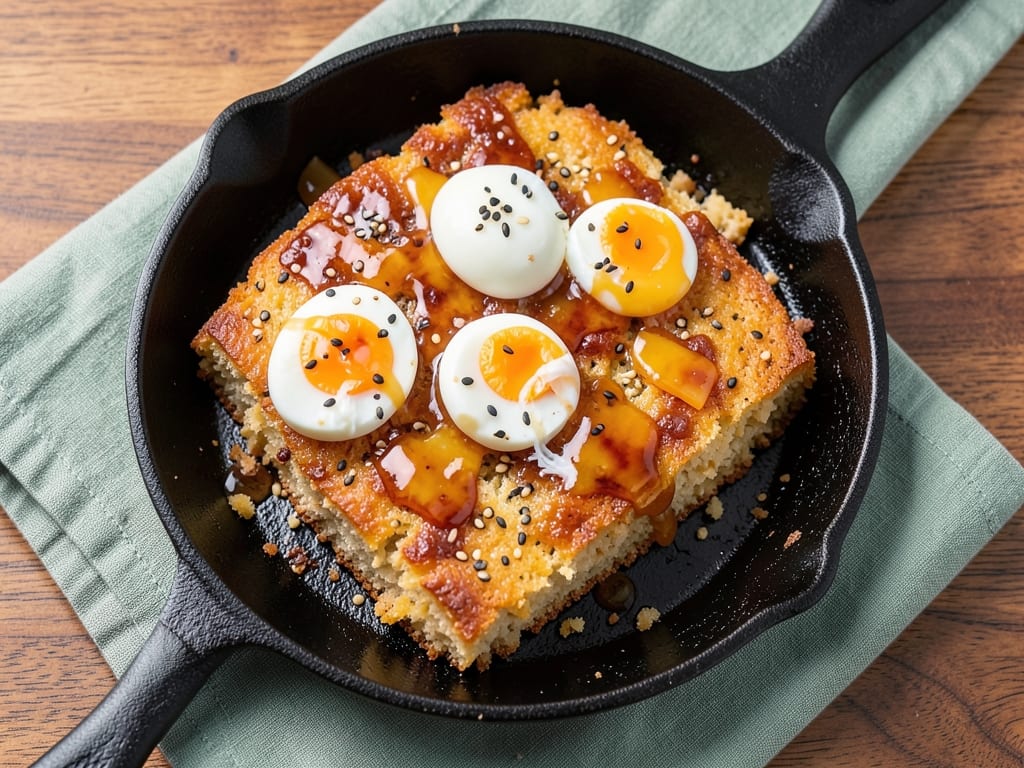
A rustic, spiced cornbread with the deep heat and complexity of harissa paste and the sharp tang of aged cheddar cheese. The cornmeal crumb stays tender and moist while the cheese melts throughout, creating pockets of savory richness. Perfect alongside chili, soup, or eaten warm with butter.
- Prep
- 10 min
- Cook
- 25 min
- Wait
- 10 min
- Total
- 45 min
- Makes
- 1 skillet cornbread (8 wedges)
Steps
Before you start
- Preheat your oven to 400°F (200°C) for at least 10 minutes
- Place a 10-inch (25 cm) cast-iron skillet or round cake pan in the oven to heat
- Have all ingredients at room temperature or cool for the best crumb
- Read through the instructions so you understand the hot-skillet technique
Mix dry ingredients
- In a medium bowl, whisk together the cornmeal, all-purpose flour, baking powder, and kosher salt.
- Set aside.
+ Show details− Hide details
Ready when: dry ingredients evenly combined with no lumps
Tip: Whisk the dry ingredients thoroughly to distribute the baking powder evenly, which ensures an even rise
Combine wet ingredients
- In a large mixing bowl, whisk together the buttermilk, eggs, and harissa paste until the harissa is fully dispersed and the mixture is a uniform pale orange with no streaks.
- The consistency should be smooth and pourable.
+ Show details− Hide details
Ready when: harissa is completely dissolved with no visible streaks or clumps
Tip: Mix the harissa thoroughly so it distributes evenly; any clumps will create hot pockets in the finished cornbread
Fold in dry and cheese
- Pour the dry ingredients into the wet ingredients and gently fold together using a wooden spoon or spatula.
- Stir just until barely combined—some lumps are okay.
- Fold in the shredded cheddar cheese until evenly distributed, then add the butter pieces.
+ Show details− Hide details
Ready when: dry ingredients just incorporated with visible lumps; cheese distributed throughout
Tip: Overmixing develops gluten and makes the cornbread tough and dense—stir just until you can't see dry flour
Pour into hot skilletOven 400°F / 205°C
- Carefully remove the preheated 10-inch (25 cm) cast-iron skillet from the oven.
- The skillet should be very hot.
- Pour the cornbread batter directly into the hot skillet and smooth the top with a spatula.
- If using honey, drizzle it lightly over the surface in a thin spiral.
+ Show details− Hide details
Ready when: batter covers the entire skillet bottom and begins to sizzle at the edges
Tip: The hot skillet creates a golden, crispy edge; use an oven mitt and work quickly so the skillet doesn't lose heat
Bake until goldenOven 400°F / 205°C
- Place the skillet in the 400°F (200°C) oven and bake for 20–25 minutes.
- The cornbread is done when the top is deep golden brown, a toothpick inserted in the center comes out clean or with just a few moist crumbs, and the internal temperature reaches 190°F (88°C).
+ Show details− Hide details
Ready when: top is deep golden, toothpick comes out clean or with few crumbs, internal temperature 190°F (88°C)
Tip: Don't open the oven door frequently—every peek drops the temperature and extends cooking time
Rest and cool
- Remove the skillet from the oven and let the cornbread rest in the pan for 10 minutes.
- This allows it to set and firm up slightly, making it easier to cut without crumbling.
+ Show details− Hide details
Ready when: cornbread has pulled slightly away from the skillet edges
Tip: Resist the urge to cut into it immediately—the interior is still very hot and fragile
Cut and serve
- Run a thin knife around the edge of the skillet, then cut the cornbread into 8 wedges, like a pizza.
- Serve warm, directly from the skillet or transferred to a serving plate, with butter on the side.
+ Show details− Hide details
Ready when: cornbread cuts cleanly into wedges
Tip: If the cornbread sticks, run the knife around the edge again; a bit of the crispy bottom is delicious
Good to know
Tips
- For extra spice and complexity, bloom a pinch of caraway seeds or cumin in a dry skillet before adding to the batter
- If your harissa paste is very thick, thin it slightly with 1 tablespoon of the buttermilk before whisking into the wet ingredients
- Cast iron is ideal—it distributes heat evenly and creates the best crispy edge—but a round cake pan works if that's what you have
- Serve with whipped butter mixed with a little extra harissa or a dollop of labneh (strained yogurt) for a Middle Eastern twist
Storage & reheating
Store at room temperature in an airtight container for up to 2 days. Wrap cooled wedges individually in foil or parchment for freezing up to 3 months. Reheat in a 350°F (175°C) oven for 10 minutes, covered with foil to prevent drying, or microwave a single wedge for 30–45 seconds.
Substitutions
- harissa paste (roasted red peppers, chiles, garlic, spices) → sambal oelek (red chili paste) or sriracha mixed with a pinch of smoked paprika. Use the same amount; sambal oelek and sriracha are slightly runnier, so the batter may be fractionally looser
- sharp cheddar cheese, aged 1 year or more → aged manchego, gruyère, or smoked gouda. Choose an aged cheese with similar sharpness; avoid mild cheddars, which will be lost in the strong harissa flavor
- buttermilk → 1 cup (240 ml) whole milk mixed with 1 tablespoon (15 ml) lemon juice or vinegar, left to sit 5 minutes. The acid activates the baking powder similarly to buttermilk
- yellow cornmeal → white or blue cornmeal in equal measure. Color will change but flavor and texture remain nearly identical; blue cornmeal adds a subtle nuttiness