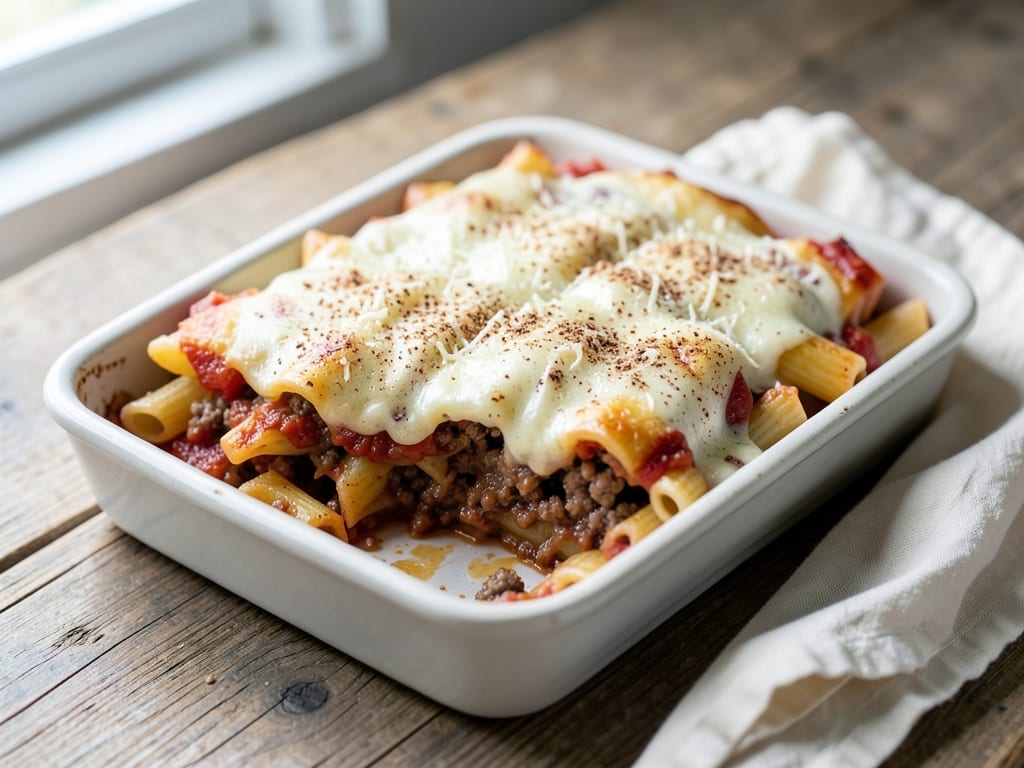
Greek Pastitsio with Béchamel
Thick bucatini, a cinnamon-scented tomato and beef sauce, and a nutmeg-kissed kefalotyri béchamel baked into a golden, sliceable Greek classic that holds clean squares when rested.
- Prep
- 40 min
- Cook
- 1 hr 40 min
- Wait
- 40 min
- Total
- 3 hr
- Makes
- 1 (9×13-inch) casserole, 12 squares
Steps
Before you start
- Grate all the kefalotyri first (about 150 g / 1½ cups total) and divide it into three portions: ½ cup for the pasta, ¾ cup for the béchamel, ¼ cup for the top.
- Set the eggs and egg yolks out at room temperature and warm the milk before you start the béchamel so the sauce stays smooth.
- Plan on about 3 hours: the sauce simmers while you boil the pasta and make the béchamel, and the finished pastitsio needs 30 minutes to rest before cutting.
- Position an oven rack in the center and preheat to 350°F (175°C) when you reach step 1.
- Have an instant-read thermometer ready: the ground beef must reach 160°F (71°C) in the skillet, and the finished casserole should read 160°F (71°C) in the center.
Prep the panOven 350°F / 175°C
- Set a rack in the center of the oven and heat to 350°F (175°C).
- Grease the bottom and sides of a 9×13-inch (23×33 cm) baking dish with the softened butter.
- Grate the kefalotyri and divide it into ½ cup, ¾ cup and ¼ cup portions.
- Fill the large pot with 5 quarts (4.7 L) of water and set it aside for later.
+ Show details− Hide details
Ready when: Dish is evenly coated in a thin layer of butter.
Tip: Grating cheese ahead keeps you from rushing while the béchamel is on the heat.
Soften the onion
- Heat the olive oil in a 12-inch (30 cm) deep skillet or Dutch oven over medium heat.
- Add the chopped onion and ¼ tsp of the sauce salt.
- Cook, stirring often, for 6 to 7 minutes.
- Add the garlic and cook 30 seconds more.
+ Show details− Hide details
Ready when: Onion is soft and translucent with no browning; garlic smells fragrant.
Tip: Keep the garlic from browning or it turns bitter in the long simmer.
Brown the beef
- Raise the heat to medium-high and add the ground beef.
- Break it into small crumbles with a wooden spoon and cook for 8 to 10 minutes, until it reaches a safe internal temperature of 160°F (71°C) when an instant-read thermometer is inserted into several crumbles.
- Season with the remaining salt (¾ tsp) and the pepper.
- Stir in the tomato paste and cook 2 minutes, stirring, so it darkens slightly.
+ Show details− Hide details
Ready when: Beef reads at least 160°F (71°C), no pink remains, liquid has mostly evaporated, and the tomato paste turns brick red.
Tip: Don't crowd or stir constantly at first; letting the meat sit briefly helps it brown rather than steam.
Simmer the sauce
- Pour in the red wine and scrape up the browned bits.
- Simmer 2 minutes until nearly evaporated.
- Add the crushed tomatoes, cinnamon stick, ground cinnamon, allspice, bay leaves and oregano.
- Bring to a bubble, reduce the heat to low, partially cover and simmer 25 minutes, stirring every 8 minutes or so.
- Remove the bay leaves and cinnamon stick, then stir in the parsley.
+ Show details− Hide details
Ready when: Sauce is thick and spoonable; a spoon dragged across the bottom leaves a clear trail that doesn't fill in right away.
Tip: A watery sauce makes a soggy pastitsio, so keep simmering a few more minutes if it looks loose.
Boil the bucatini
- While the sauce simmers, bring the pot of water to a rolling boil over high heat and add the salt.
- Break the bucatini in half if you like shorter pieces, or leave whole.
- Cook for 2 minutes less than the package directions (usually 8 to 9 minutes) so it stays firm.
- Drain well and return to the pot.
+ Show details− Hide details
Ready when: Pasta is flexible but still has a firm, chalky-white center when bitten.
Tip: The pasta finishes cooking in the oven, so don't cook it fully now.
Dress the pasta
- Toss the hot pasta with the melted butter and let it cool for 10 minutes, tossing once or twice.
- When it's warm, not hot, stir in the beaten eggs and ½ cup of kefalotyri until every strand is coated.
+ Show details− Hide details
Ready when: Strands look glossy and evenly coated with no visible streaks of egg.
Tip: Add the eggs only once the pasta is just warm to the touch.
Make the béchamel
- In a heavy 3-quart (3 L) saucepan, melt the butter over medium heat.
- Whisk in the flour and cook 2 minutes, whisking constantly, without letting it color.
- Add the warm milk in 4 additions, whisking until smooth after each.
- Cook, whisking, for 8 to 10 minutes.
- Remove from the heat, stir in the salt and nutmeg, and cool 5 minutes.
- Whisk about ½ cup of the sauce into the yolks, then whisk that back into the pan along with ¾ cup of kefalotyri.
+ Show details− Hide details
Ready when: Sauce is thick like pudding and coats the back of a spoon; a finger swipe leaves a clean line.
Tip: Cool the sauce slightly before adding the yolks, otherwise they curdle.
Layer the casserole
- Press half of the pasta into the dish, packing it into an even layer (arrange strands in the same direction for neat slices).
- Spoon over all of the meat sauce and spread it evenly.
- Cover with the remaining pasta, again pressing down firmly.
- Pour the béchamel on top and spread it to the edges with a spatula.
- Sprinkle with the ¼ cup of kefalotyri.
+ Show details− Hide details
Ready when: Layers are level and the béchamel forms a smooth, even blanket.
Tip: Pressing the pasta firmly is what keeps the squares from falling apart.
Bake until goldenOven 350°F / 175°C
- Bake on the center rack at 350°F (175°C) for 45 to 50 minutes.
- If the top isn't golden at the end, broil on high for 1 to 2 minutes, watching closely.
+ Show details− Hide details
Ready when: Top is deep golden with brown patches, edges bubble, and the center reads 160°F (71°C).
Tip: Place a baking sheet on the rack below to catch any drips.
Rest, then slice
- Let the pastitsio rest on a rack for 30 minutes.
- Run a knife around the edge and cut into 12 squares with a sharp knife, wiping the blade between cuts.
- Lift out with a spatula.
+ Show details− Hide details
Ready when: Béchamel no longer jiggles when the pan is nudged and a knife cuts cleanly to the bottom.
Tip: Cutting too early makes the layers slide apart.
Good to know
Tips
- Undercook the pasta and pack it firmly; both help the squares stay neat.
- Whisk the béchamel constantly and use warm milk to avoid lumps; if any form, pass it through a fine strainer.
- Don't skip the 30-minute rest. It is the difference between clean squares and a sloppy slice.
- Use a pan at least 2½ inches deep so the béchamel doesn't bubble over.
Make ahead
Make the meat sauce up to 3 days ahead and refrigerate. You can also assemble the whole pastitsio (through step 8), cover tightly and refrigerate up to 24 hours. Bake straight from the fridge, adding 15 to 20 minutes, covering loosely with foil for the first 30 minutes. Confirm the center reads 160°F (71°C) before resting.
Storage & reheating
Room temperature: up to 2 hours. Refrigerator: covered, up to 4 days. Freezer: wrap individual squares tightly and freeze up to 2 months; thaw overnight in the fridge. Reheat squares, covered with foil, at 325°F (165°C) for 20 to 25 minutes until hot in the center (165°F / 74°C), or microwave a single square 2 to 3 minutes until hot in the center.
Substitutions
- kefalotyri cheese → pecorino romano or Parmigiano-Reggiano. Use the same weight in all three places; both are slightly saltier, so reduce the béchamel salt to ½ tsp.
- bucatini → ziti or penne rigate. Same weight and same undercooking; shorter shapes are easier to cut into squares.
- dry red wine → beef broth. Use ½ cup (120 ml) and add 1 tsp red wine vinegar for brightness.
- ground beef, 85% lean → ground lamb or half beef and half lamb. Lamb gives a more traditional, richer flavor; cook to 160°F (71°C) and drain excess fat after browning.