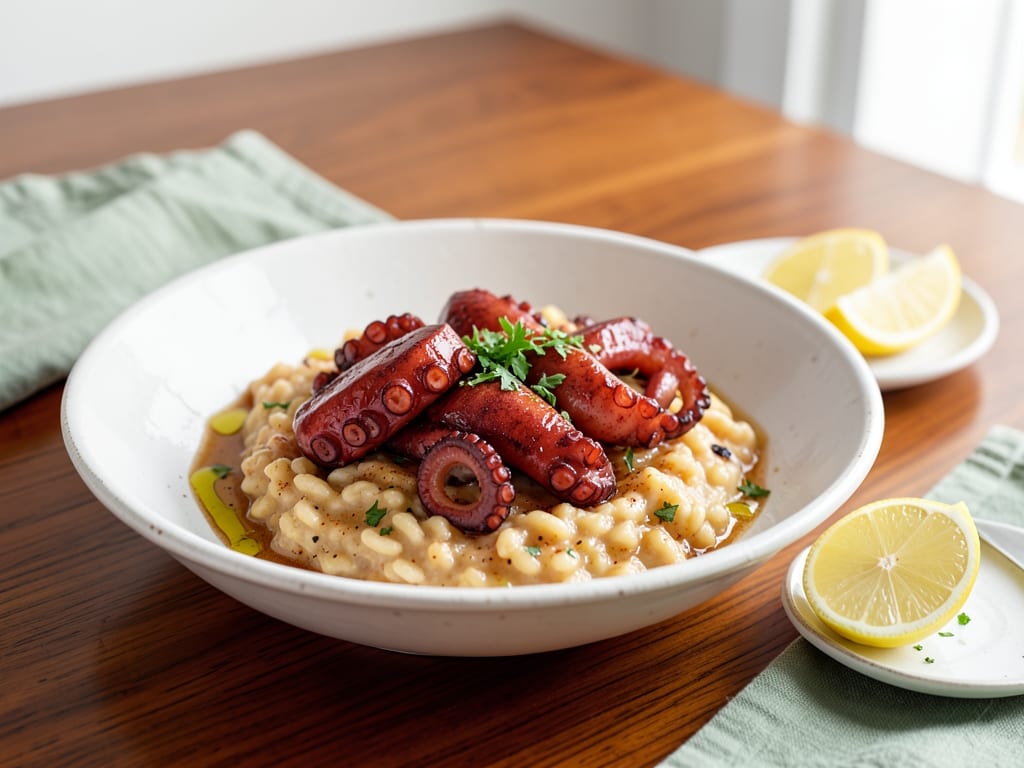
Greek Octopus and Smoked Paprika Risotto
Tender red-wine-braised octopus is folded into creamy arborio risotto that is built on the rich braising liquid and perfumed with smoked paprika, garlic and lemon. A Greek-inspired seafood dinner with a slow, hands-off stovetop braise and a short, attentive stir.
- Prep
- 35 min
- Cook
- 2 hr 10 min
- Wait
- 10 min
- Total
- 2 hr 55 min
- Makes
- 4 generous main-course servings (about 1½ cups / 350 g each)
Steps
Before you start
- If your octopus is frozen, thaw it in the fridge for 24 hours. Frozen-then-thawed octopus is already tenderized by ice crystals, so no pounding is needed.
- Read the timing: the braise takes about 1 hour 15 minutes on the stovetop and is mostly unattended. Start the risotto only once the octopus is tender.
- Keep the strained braising liquid and the stock hot in a saucepan on a back burner while you make the risotto. Cold liquid stalls the rice and makes it gluey.
- Have everything chopped and measured before starting the risotto, because you will be stirring almost continuously for about 20 minutes.
Set up the braise
- Rinse the octopus well under cold running water.
- Place it in a 5–6 quart (5–6 L) heavy pot with 1 cup (240 ml) red wine, 3 cups (720 ml) water, the onion wedges, 2 smashed garlic cloves, bay leaves and peppercorns.
- Do not add salt now; the braising liquid is reduced later and would become too salty.
- Set over high heat and bring to a gentle boil.
+ Show details− Hide details
Ready when: Liquid reaches a gentle boil with small bubbles around the edges.
Tip: The octopus will be only partly submerged; it releases liquid as it cooks, so don't add more water.
Braise until tender
- Reduce the heat to low so the liquid barely trembles, cover with the lid slightly ajar, and cook for 70–80 minutes.
- Flip the octopus once halfway through.
+ Show details− Hide details
Ready when: A paring knife slides into the thickest part of a tentacle near the head with little resistance, like piercing a cooked potato.
Tip: A hard boil makes octopus rubbery. Keep it at a bare simmer.
Rest, strain and cut
- Lift the octopus onto a cutting board and let it rest 10 minutes.
- Strain the braising liquid through a fine-mesh strainer into a 3-quart saucepan, discarding the solids.
- Measure it: you need about 1½ cups (360 ml); if you have more, boil it down; if less, top up with water.
- Add the 3 cups (720 ml) stock and keep it at a bare simmer over low heat.
- Cut the tentacles from the head and slice the tentacles and head into ¾-inch (2 cm) pieces.
+ Show details− Hide details
Ready when: Combined liquid is steaming hot and totals about 4½ cups (1.1 L).
Tip: Taste the liquid. If it is very salty, replace some with hot water.
Sear the octopus
- Pat the octopus pieces dry.
- Heat 1 tbsp (15 ml) olive oil in the 12-inch (30 cm) deep skillet over medium-high heat until shimmering.
- Add the octopus pieces in one layer (work in two batches if crowded) and sear 2–3 minutes, turning once.
- Transfer to a plate and wipe out the skillet.
+ Show details− Hide details
Ready when: Edges are deep reddish-brown and the surface looks dry, not wet.
Tip: Dry pieces sear instead of steam.
Soften the aromatics
- Return the skillet to medium heat and add 3 tbsp (45 ml) olive oil and the diced onion with a pinch of salt.
- Cook, stirring often, for 6–8 minutes until soft and translucent but not browned.
- Stir in the garlic, smoked paprika and tomato paste and cook 1 minute, stirring constantly.
+ Show details− Hide details
Ready when: Onion is translucent and the paste smells sweet and darkens to brick red.
Tip: Paprika burns quickly and turns bitter; lower the heat if it sticks.
Toast the rice
- Add the arborio rice and stir for 2 minutes so each grain is coated in oil and the edges turn translucent while the centers stay white.
- Pour in ½ cup (120 ml) red wine and stir until it is almost fully absorbed, about 1–2 minutes.
+ Show details− Hide details
Ready when: Rice grains have translucent edges with a white dot in the center; the pan is nearly dry of wine.
Add liquid gradually
- Add the hot liquid about ¾ cup (180 ml) at a time, stirring frequently and keeping the risotto at a lively simmer.
- Wait until the rice has absorbed most of the liquid and a spoon dragged across the bottom leaves a brief trail before adding the next ladle.
- Continue for 18–22 minutes total.
+ Show details− Hide details
Ready when: Rice is tender with a slight firm bite in the center (al dente) and the risotto is loose and creamy. Taste a grain after 17 minutes.
Tip: You may not need all the liquid, or you may need a splash of hot water. It should flow slowly when you tilt the pan.
Fold in the octopus
- When the rice is nearly done, stir in the seared octopus and cook 1–2 minutes to heat through.
- Remove the pan from the heat.
+ Show details− Hide details
Ready when: Octopus is hot throughout and evenly distributed.
Tip: Don't cook the octopus further or it can toughen.
Mantecare and season
- Off the heat, vigorously stir in the cold butter and half the lemon zest until glossy and creamy.
- Season with salt and black pepper to taste, adding salt a pinch at a time since the stock and braising liquid are already seasoned.
- Cover and rest 2 minutes.
+ Show details− Hide details
Ready when: Risotto looks glossy and slowly spreads when spooned onto a plate (all'onda, 'wavy').
Tip: If it is too thick, loosen with a splash of hot water.
Serve
- Spoon the risotto into warmed shallow bowls.
- Top with the remaining lemon zest and the chopped parsley, and serve at once with lemon wedges.
+ Show details− Hide details
Tip: Serve immediately; risotto keeps absorbing liquid and thickens as it sits.
Good to know
Tips
- Don't rinse the arborio: the surface starch is what makes the risotto creamy.
- Keep the liquid hot at all times so the rice cooks evenly and the creamy texture builds.
- Taste for salt only at the end; the braising liquid and stock concentrate as they cook down.
- A wide pan gives more evaporation and a faster, more even risotto than a deep narrow pot.
Make ahead
Braise the octopus up to 2 days ahead: cool it in its strained liquid, refrigerate in a covered container, then cut, sear and make the risotto as directed. Reheat the liquid before using it.
Storage & reheating
Best eaten fresh. Refrigerate leftovers in an airtight container up to 2 days. Reheat gently in a skillet over low heat with a splash of stock or water, stirring until hot and loose. Not recommended to freeze the finished risotto, as the rice turns mushy. The braised, unsauced octopus can be frozen in its liquid for up to 2 months.
Substitutions
- whole octopus, cleaned (beak and eyes removed) → pre-cooked octopus tentacles (about 1 lb / 450 g). Skip the braise, but still simmer 3 cups water with the wine and aromatics for 15 minutes to make a flavorful base; sear as directed.
- arborio rice → carnaroli or vialone nano rice. Same quantity; carnaroli is more forgiving and stays firm.
- dry red wine → dry white wine. Gives a lighter color and brighter flavor.
- unsalted butter → extra-virgin olive oil. Use 2 tbsp (30 ml) for a dairy-free, more Greek finish.