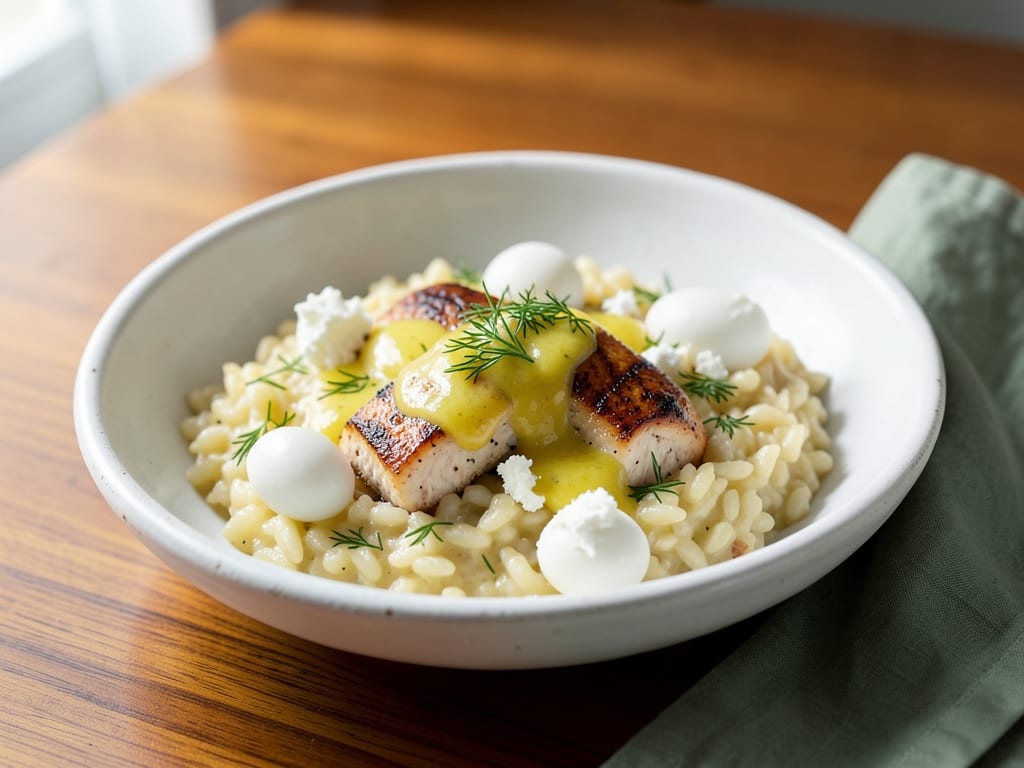
Greek Lemon Chicken Avgolemono Risotto
Creamy arborio risotto with seared chicken, finished with a tempered egg-and-lemon avgolemono and plenty of fresh dill. It has all the bright, silky comfort of Greek avgolemono soup, and the only cream is the rice's own starch.
- Prep
- 20 min
- Cook
- 42 min
- Wait
- 7 min
- Total
- 1 hr 9 min
- Makes
- About 6 cups (4 generous main-course servings)
Steps
Before you start
- This is an all-stovetop recipe. No oven is needed.
- Take the eggs out of the fridge 30 minutes ahead. Room-temperature eggs are less likely to scramble when tempered.
- Juice and zest the lemons first (zest before juicing). You need 1 tablespoon zest and ¼ cup (60 ml) juice.
- Use low-sodium broth so you can control the salt. The finished dish is not meant to be soupy.
- Have everything measured and chopped before you start. Once the rice goes in, you stir almost constantly for about 20 minutes.
Heat the broth
- Pour the 5 cups (1.2 L) chicken broth into a medium saucepan and bring to a bare simmer over medium-low heat.
- Keep it hot, with the lid ajar, for the whole recipe.
- Cold broth stalls the rice and makes it gummy.
+ Show details− Hide details
Ready when: Small bubbles break the surface and steam rises, but the broth isn't at a rolling boil.
Tip: Hot broth also makes the egg tempering safer later.
Sear the chicken
- Season both sides of the thighs with ½ tsp salt and ¼ tsp pepper.
- Heat 1 tbsp olive oil in the wide heavy pot over medium-high heat until it shimmers.
- Add the thighs in a single layer and sear without moving them for 5–6 minutes, until deep golden.
- Flip and cook 5–6 minutes more.
+ Show details− Hide details
Ready when: The thickest part reads 175°F (80°C) on an instant-read thermometer (minimum safe is 165°F / 74°C), and the juices run clear.
Tip: Leave the browned bits in the pot. They flavor the risotto.
Rest and slice chicken
- Move the chicken to a cutting board and let it rest for 5 minutes.
- Slice it against the grain into ½-inch (1 cm) strips, then cut the strips into bite-size pieces.
- Set aside with any juices.
+ Show details− Hide details
Ready when: The slices are moist and juicy with no pink.
Tip: Reduce the heat to medium while you slice so the browned bits in the pot don't burn.
Soften the onion
- Keep the heat at medium.
- Add the butter and 1 tbsp olive oil to the same pot.
- When the butter foams, add the onion and a pinch of salt.
- Cook, stirring and scraping up the browned bits, for 5–6 minutes.
- Stir in the garlic and cook 30 seconds.
+ Show details− Hide details
Ready when: The onion is soft and translucent with no browning, and the garlic smells fragrant.
Tip: Don't brown the garlic. It turns bitter.
Toast the rice
- Add the arborio rice and stir constantly for 2 minutes, until every grain is coated in fat and the edges look translucent with a white dot in the center.
+ Show details− Hide details
Ready when: The rice smells slightly nutty and makes a faint clicking sound against the pot.
Add the wine
- Pour in the white wine and stir until it is almost fully absorbed, about 2 minutes, and the sharp alcohol smell has cooked off.
+ Show details− Hide details
Ready when: Only a thin film of wine remains and the rice looks glossy.
Add broth gradually
- Add 1 ladleful (about ¾ cup / 180 ml) of hot broth and stir often.
- When the liquid is mostly absorbed and a spoon dragged across the bottom leaves a trail, add another ladleful.
- Keep the heat at a lively simmer and repeat for 20–22 minutes.
- Use about 4 cups (950 ml) in total and keep the last 1 cup (240 ml) hot in the saucepan.
+ Show details− Hide details
Ready when: The rice is creamy and loose, and a grain bitten in half is tender with a tiny firm core (al dente).
Tip: If the rice is still hard after 4 cups, add a few more splashes of hot broth. Remove the pot from the heat before adding the eggs.
Prepare avgolemono
- While the last ladle of broth is absorbing, whisk the eggs in a medium bowl until smooth, then whisk in the lemon juice.
- Slowly drizzle in 1 cup (240 ml) of the reserved hot broth while whisking constantly, a spoonful at a time at first.
- This warms the eggs gently so they don't scramble.
+ Show details− Hide details
Ready when: The mixture is smooth, pale yellow and warm to the touch with no cooked egg bits.
Tip: Pour slowly and keep whisking. Fast pouring can curdle the eggs.
Finish the risotto
- Take the pot off the heat completely.
- Pour in the avgolemono and stir vigorously for 1 minute.
- Fold in the sliced chicken and its juices, the lemon zest and chopped dill.
- Season with salt to taste.
- Don't return the pot to the heat or the eggs may curdle.
+ Show details− Hide details
Ready when: The risotto is glossy, creamy and flows slowly when you tilt the pot. The sauce reads about 160°F (71°C) if checked.
Tip: If it's too thick, stir in a splash of hot broth. Off the heat, the egg won't scramble.
Serve
- Spoon the risotto into warm shallow bowls.
- Top with the crumbled feta, if using, a few dill sprigs and extra lemon zest if you like.
- Serve right away, as it thickens as it cools.
+ Show details− Hide details
Ready when: The risotto is hot, creamy and slightly loose.
Tip: Warm the bowls briefly under hot tap water and dry them to keep the risotto from firming up.
Good to know
Tips
- Zest the lemons before juicing them. A juiced lemon is nearly impossible to zest.
- Use a wide pot so the rice cooks in a thin layer and releases starch evenly.
- Add the egg mixture only off the heat. Temper slowly and stir constantly.
- Taste before adding the final salt. Broth, feta and the sear all add salt.
Make ahead
The chicken can be seared, sliced and refrigerated up to 1 day ahead. Chop the onion and garlic, and juice and zest the lemons, up to 1 day ahead. Cook and serve the risotto fresh, because the rice and egg sauce are best right after cooking.
Storage & reheating
Room temperature: no more than 2 hours. Fridge: airtight container up to 3 days. Freezer: not recommended, because the egg sauce can separate and the rice turns mushy. To reheat, put it in a pot over low heat with a few tablespoons of broth or water, stirring gently, until hot (165°F / 74°C). Don't let it boil.
Substitutions
- boneless, skinless chicken thighs → boneless, skinless chicken breasts. Cook 5–6 minutes per side to 165°F (74°C). Don't overcook, because breasts dry out faster.
- dry white wine → additional chicken broth plus 1 tbsp lemon juice. Use ½ cup (120 ml) broth for a non-alcoholic version.
- arborio rice → carnaroli or vialone nano rice. Use the same weight. Carnaroli is a little more forgiving.
- fresh dill → fresh flat-leaf parsley and a little fresh mint. Use the same total amount. The flavor is less classic but still bright.