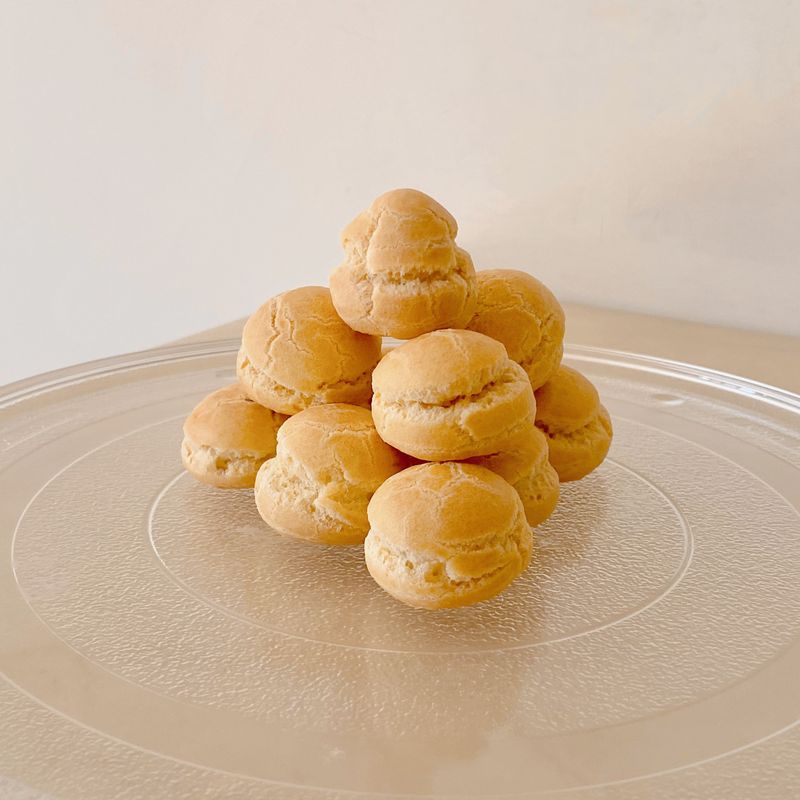
Greek Honey Puffs with Mastic
Airy choux pastry puffs infused with aromatic mastic gum, crispy on the outside and hollow within. They're dipped in warm honey syrup and topped with crushed walnuts and a whisper of cinnamon. Serve while warm with a dollop of whipped cream for an authentic Greek treat that's lighter than it looks.
- Prep
- 25 min
- Cook
- 40 min
- Wait
- 15 min
- Total
- 1 hr 20 min
- Makes
- 24 puffs (about 6 servings)
Steps
Before you start
- Preheat oven to 400°F (200°C) and line two large baking sheets with parchment paper
- Have all choux dough ingredients at room temperature (water, butter, flour)
- Crush mastic gum crystals into a fine powder (use a mortar and pestle with 1 tablespoon sugar to help break them down)
- Prepare a piping bag fitted with a ½-inch (12 mm) plain round tip
Make the choux dough
- In a large saucepan, combine the water, butter cubes, salt, and sugar.
- Heat over medium heat, stirring occasionally, until the butter melts and the mixture comes to a gentle boil.
- The liquid should steam slightly but not vigorously boil.
- Once the butter is fully melted, remove from heat.
- Sift the flour over the mixture and stir vigorously with a wooden spoon until completely combined and smooth, about 1 minute.
- The dough will be thick and pull away from the sides of the pan.
+ Show details− Hide details
Ready when: Dough is smooth, thick, and pulls away from pan sides
Tip: Remove from heat immediately after mixing the flour—returning to heat will make the dough greasy and cause collapsed puffs.
Cool and add eggs
- Let the dough cool in the pan for 2–3 minutes, stirring occasionally to release steam.
- It should still be warm but not scorching hot.
- Add the eggs one at a time, beating vigorously with a wooden spoon after each addition until fully incorporated and the mixture is smooth before adding the next egg.
- The dough will look curdled after the first egg but will come together.
- After all four eggs are incorporated, the dough should be shiny, smooth, and fall in ribbons from the spoon.
+ Show details− Hide details
Ready when: Dough is shiny, smooth, and falls in ribbons from spoon
Tip: Cold eggs added to hot dough scramble; lukewarm dough accepts them smoothly. If dough seems too warm, stir for 30 seconds more before adding the first egg.
Fold in mastic
- Sprinkle the powdered mastic mixture over the dough and fold it in gently with a spatula until evenly distributed and no white streaks remain.
- Do not overmix or the dough will deflate.
- The mastic will give the puffs their distinctive, delicate anise-like flavor.
+ Show details− Hide details
Ready when: Mastic is evenly dispersed throughout dough with no white specks
Tip: Overmixing mastic-infused dough causes it to break down and lose air, resulting in denser puffs. Fold gently and stop as soon as it's combined.
Pipe the puffs
- Transfer the dough to the piping bag fitted with the ½-inch round tip.
- Pipe mounds about ¾ inch (2 cm) tall and 1 inch (2.5 cm) in diameter onto the prepared baking sheets, spacing them about 2 inches (5 cm) apart.
- You should have about 24 puffs, split between the two sheets.
- If the dough is too thick to pipe smoothly, stir it very gently to soften it slightly, but do not overwork.
+ Show details− Hide details
Ready when: All dough is piped into mounds on baking sheets
Tip: Keep puffs uniform in size so they bake evenly. If you don't have a piping bag, drop small spoonfuls (about ¾ teaspoon each) onto the sheets.
Bake the puffsOven 400°F / 205°C
- Bake at 400°F (200°C) for 30–35 minutes, until the puffs are puffed up, golden brown on all sides, and feel hollow and crispy when touched gently.
- Do not open the oven door before 25 minutes or the puffs may collapse.
- They should double in size and be a uniform tan-to-golden color.
- The larger ones may take closer to 35 minutes.
+ Show details− Hide details
Ready when: Puffs are golden brown, feel hollow and crispy, and have roughly doubled in height
Tip: If puffs are browning too fast, lower heat to 375°F (190°C) and bake a few minutes longer. Underbaked puffs will collapse as they cool.
Cool the puffs
- Remove the puffs from the oven and place the baking sheets on cooling racks.
- Let them cool for 5–10 minutes at room temperature.
- They will firm up and become crispier as they cool.
- Once they're cool enough to handle but still warm, they're ready to dip.
+ Show details− Hide details
Ready when: Puffs are firm enough to handle but still warm to the touch
Tip: Do not let puffs cool completely before dipping, or the crispy shell will resist the honey and not absorb it well.
Prepare the honey syrupOven 170°F / 75°C
- While the puffs bake, prepare the syrup.
- In a small saucepan, combine the honey and water.
- Add the cinnamon stick pieces, cloves, and lemon zest.
- Bring to a gentle simmer over medium heat, stirring occasionally, and simmer for 5 minutes without boiling vigorously.
- The syrup should be fragrant and warm but not thick.
- Remove from heat and let it cool slightly (to around 160–170°F / 70–75°C on a thermometer), so it's warm enough to soak the puffs but not hot enough to burn them.
+ Show details− Hide details
Ready when: Syrup is fragrant, warm, and spices have infused it with flavor
Tip: Do not boil the honey vigorously or you'll crystallize it; a gentle simmer is all you need. The syrup should smell of honey, cinnamon, and lemon.
Dip and coat the puffs
- Strain the warm honey syrup through a fine-mesh sieve into a shallow bowl, discarding the cinnamon and cloves.
- Working quickly while the puffs are still warm, dip each puff into the honey syrup, turning it gently with a fork or small tongs to coat all sides.
- Let excess syrup drip back into the bowl, then place the dipped puff on a serving plate or platter.
- The puffs will soak up some syrup and remain pleasantly moist inside.
+ Show details− Hide details
Ready when: All puffs are evenly coated in warm honey syrup and glistening
Tip: Dip quickly while both puffs and syrup are still warm, or the shell will become too firm to absorb the honey. If syrup cools, rewarm it gently over low heat.
Finish and serve
- While the honey is still sticky on the puffs, sprinkle the chopped walnuts and ground cinnamon generously over them.
- Work quickly so the toppings stick to the warm honey.
- Arrange the finished puffs on a serving platter.
- Serve warm or at room temperature.
- If you're whipping the cream, do so just before serving—whip the cold heavy cream with powdered sugar until soft peaks form, and serve a dollop alongside or nested inside the puffs if desired.
+ Show details− Hide details
Ready when: Puffs are coated, topped, and arranged on platter
Tip: Assemble the puffs in a single layer on a platter rather than stacking, so the honey-coated bottoms don't get crushed and soggy.
Good to know
Tips
- For the most authentic flavor, buy mastic gum crystals from a specialty market, Greek grocery, or online—it's worth the effort. Real mastic tastes floral and slightly piney, not synthetic. Crushing it with a little sugar helps it incorporate evenly into the dough and prevents clumping.
- Choux dough is temperature-sensitive: too-hot dough scrambles the eggs, too-cool dough won't absorb them smoothly. A 2–3 minute rest after cooking the water–butter–flour mixture is ideal. If you're nervous, briefly stir the hot dough on the turned-off heat to cool it, then begin adding eggs.
- The key to crispy puffs is a full bake at proper oven temperature. Underbaked or cooled puffs won't crisp; if your oven runs cold, rotate the pans halfway through baking and increase the temperature by 10–15°F.
- Timing is everything when dipping: warm puffs and warm (not hot) honey mean the puffs soak up flavor without becoming mushy. Room-temperature puffs and syrup won't work—the shell resists and the result is only surface sticky, not evenly honey-soaked.
Make ahead
Bake the puffs up to 1 day ahead and store them in an airtight container at room temperature. Re-crisp them in a 300°F (150°C) oven for 5 minutes before dipping and serving. The honey syrup can be made up to 2 days ahead and stored in an airtight container; reheat gently before dipping.
Storage & reheating
Unfilled puffs: Store in an airtight container at room temperature for up to 2 days; re-crisp in a 300°F (150°C) oven for 5 minutes before serving. Honey-coated puffs: Best eaten the day of, but will keep in an airtight container at room temperature for 1 day (they soften slightly). With cream filling: Assemble just before serving and eat within 2 hours. Do not freeze once coated with honey. Freeze unbaked puffs (piped on a tray) for up to 1 month; bake directly from frozen, adding 5 extra minutes to baking time.
Substitutions
- mastic gum crystals → 1 teaspoon anise extract or ground anise seed (omit sugar folding step). Mastic has a unique flavor, but anise provides a vaguely similar aromatic note. Use less if using extract, as it is potent. The puffs will taste more like Italian bignè than Greek, but will still be delicious.
- walnuts → chopped pistachios or unsalted roasted almonds. Both are traditional in Greek pastries. Pistachios add color and a slightly different flavor. Use the same amount.
- heavy cream → Greek yogurt (strained overnight) mixed with a little honey. A lighter, tangy alternative to whipped cream that is also authentically Greek. The yogurt should be thick (like crème fraîche) before mixing with honey.
- cinnamon stick → a pinch of mastic powder or one 2-inch strip of orange zest. If making the syrup without the aromatic cinnamon stick, use a tiny bit of mastic or orange zest to maintain flavor depth. Cloves alone make the syrup taste medicinal.
More no-bake desserts
See all →


Find more like this
- Meal
- Dessert
- Cuisine
- Greek
- Diet
- VegetarianHalal
- Method
- Oven