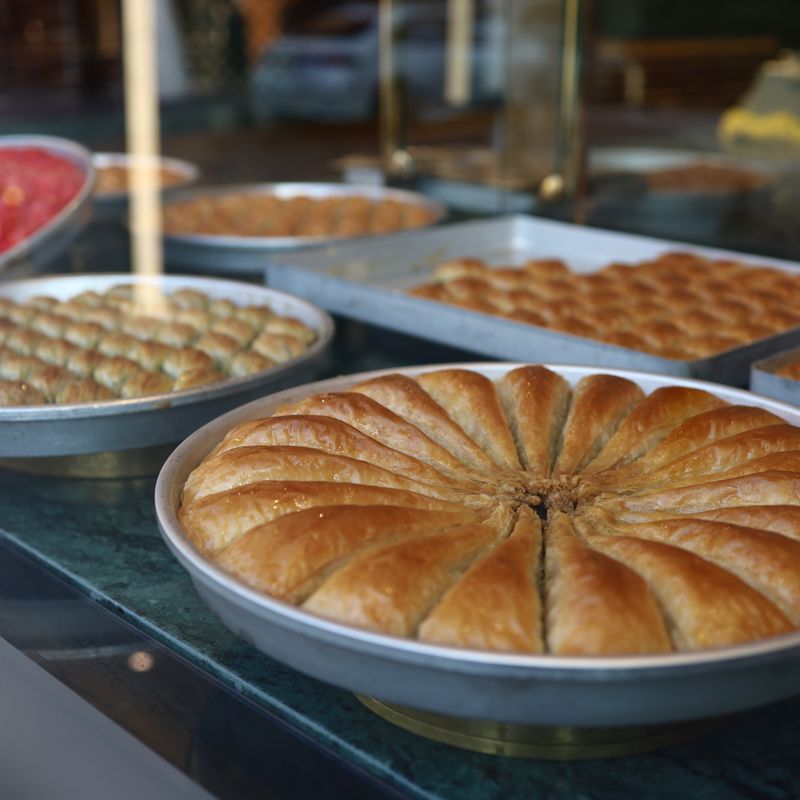
Grappa-Infused Date and Chestnut Baklava
Delicate phyllo layers hide a luxurious filling of roasted chestnuts and Medjool dates, then baked until golden and soaked in a warm grappa-honey syrup infused with cinnamon and star anise. The result is crispy, nutty, and elegantly boozy—a modern take on baklava that bridges Mediterranean and Middle Eastern flavors. Each piece shatters with a golden crunch and yields to a rich, sticky center.
Steps
Before you start
- Preheat oven to 350°F (175°C) 15 minutes before baking
- Have all phyllo sheets at room temperature for 1 hour so they don't crack
- Melt the butter for brushing and keep it warm
- Make the syrup first so it cools while the baklava bakes
Make the grappa-honey syrup
- In a small saucepan, combine honey, water, grappa, cinnamon stick (if using one from the star anise batch), and the 2 star anise pods.
- Bring to a gentle simmer over medium heat and cook for 8–10 minutes, stirring occasionally, until fragrant and slightly thickened.
- Remove from heat, stir in lemon zest if using, and let cool completely on the counter.
- The syrup will thicken as it cools.
+ Show details− Hide details
Ready when: Syrup is fragrant, slightly thicker than honey, and coats a spoon lightly
Tip: Make this first so it's cool and ready to pour over hot baklava immediately after baking—warm syrup penetrates the crispy layers better.
Prepare the filling
- In a large bowl, combine the chopped chestnuts, finely chopped dates, ground cinnamon, ground cardamom, and sea salt.
- Toss together until the dates are evenly distributed throughout the nut mixture.
- If the dates clump together, use your fingers to separate them gently.
+ Show details− Hide details
Ready when: Filling is evenly mixed with no visible pockets of dates or nuts
Tip: Keep the filling at room temperature; cold fillings can tear delicate phyllo as you layer.
Brush pan and start layeringOven 350°F / 175°C
- Preheat oven to 350°F (175°C).
- Lightly brush the bottom of a 9×13-inch baking pan with melted butter.
- Lay down one phyllo sheet and brush very lightly with butter.
- Repeat until you have 6 phyllo layers, each brushed with a thin coating of butter.
- Work quickly—phyllo dries fast—and cover unused sheets with a barely damp kitchen towel.
+ Show details− Hide details
Ready when: Pan has 6 thin, golden-brushed phyllo layers stacked evenly
Tip: Use just a whisper of butter on each layer—too much makes baklava greasy; too little makes it tough. A pastry brush holds the right amount naturally.
Add filling layer
- Spread half of the filling (about 1.25 cups / 200 g) evenly over the phyllo stack, leaving a ½-inch (1 cm) border on all sides.
- The border prevents filling from seeping out the edges.
+ Show details− Hide details
Ready when: Filling is spread in an even layer with clear borders
Tip: Don't over-stuff; excess filling will seep out during baking and make the phyllo soggy at the edges.
Add middle phyllo layers
- Layer 4 more phyllo sheets on top of the filling, brushing each one lightly with melted butter.
- This creates the middle section of the baklava.
- Work quickly and keep unused phyllo covered.
+ Show details− Hide details
Ready when: 4 more phyllo layers are stacked and lightly buttered above the filling
Add remaining filling
- Spread the remaining filling (about 1.25 cups / 200 g) evenly over the middle phyllo layers, again leaving a ½-inch border.
+ Show details− Hide details
Ready when: Second layer of filling is spread evenly with clear borders
Top and finish layering
- Layer the final 6 phyllo sheets on top, brushing each lightly with butter.
- Work deliberately but without rushing—tears can be patched with a small piece of phyllo and a dab of butter.
+ Show details− Hide details
Ready when: Top phyllo layer is smooth and evenly buttered; 6 layers total cover the filling
Tip: The top layers protect the filling from drying out. Make sure the final sheet is well-brushed so the top bakes golden.
Cut the baklava
- Using a sharp knife, score the top layers into 24 pieces (4 rows × 6 columns, making diagonal cuts for traditional diamond shapes, or straight cuts for rectangles).
- Cut down through the top phyllo and into the filling so the syrup can seep in during baking, but do not cut all the way through to the bottom of the pan.
+ Show details− Hide details
Ready when: 24 evenly cut pieces are visible on top; cuts penetrate halfway down the pan
Tip: A sharp knife makes clean cuts; a dull knife drags phyllo. Cut in one smooth stroke per line, don't saw back and forth.
Bake until goldenOven 350°F / 175°C
- Place the pan in the preheated 350°F (175°C) oven and bake for 32–35 minutes until the top is deep golden brown and crispy to the touch.
- The phyllo will puff slightly and the edges may turn darker than the center—this is fine and adds flavor.
- If the top is browning too fast after 25 minutes, loosely tent with foil.
+ Show details− Hide details
Ready when: Top is deep golden brown; phyllo feels crispy when you touch an edge (carefully); pan edges show bubbling butter
Tip: Don't open the oven door in the first 20 minutes—warm air escaping can make the phyllo soggy. A crack in the door at the end is fine to check color.
Soak with syrup immediately
- Remove the baklava from the oven and immediately, while it is still hot, pour the cooled grappa-honey syrup slowly and evenly over the entire surface.
- The hot phyllo will absorb the syrup as it soaks in—you'll hear a pleasant crackling sound.
- Let the baklava sit in the pan for 10 minutes, then pour any remaining syrup around the edges and into the cut seams.
+ Show details− Hide details
Ready when: Syrup is absorbed into the phyllo; pieces glisten with syrup and are starting to set as they cool
Tip: Hot baklava + cool syrup = perfect absorption. If you wait until the baklava is completely cold, the syrup won't penetrate as well. Pour generously—this baklava should be moist and sticky, not dry.
Cool completely and finish
- Allow the baklava to cool in the pan at room temperature for at least 30 minutes before serving.
- Once cooled, the syrup will set and the pieces will hold together cleanly when you cut through them again at the score lines.
- Garnish with finely chopped pistachios if desired.
- Store in an airtight container.
+ Show details− Hide details
Ready when: Baklava is cool to the touch; syrup is set but pieces are still moist inside
Tip: You can serve at room temperature or gently warm in a 250°F (120°C) oven for 5 minutes if you want the interior soft and the syrup fluid again—many prefer baklava this way.
Good to know
Tips
- Phyllo dough is fragile but forgiving. If a sheet tears, patch it immediately with a scrap of phyllo and a small dab of butter. Small tears won't affect the final result, but patching prevents the syrup from leaking out and creating soggy spots.
- The grappa is not optional for flavor—it adds a peppery warmth that balances the sweetness of the honey and dates. If you truly cannot use alcohol, substitute an equal amount of pomegranate juice or strong brewed tea for a more savory syrup.
- Roasted chestnuts (vacuum-packed, jarred, or frozen) are readily available in the fall and winter. Roast raw chestnuts yourself only if you enjoy the task; they require scoring, boiling, and peeling. Store-bought roasted are just as delicious and save time.
- Baklava is best eaten within 24–48 hours of baking, when the phyllo is crispiest. After 3 days, it's still delicious but slightly softer. If you need it to last longer, freeze individual pieces; thawing at room temperature and reheating gently restores crispness.
Make ahead
Baklava can be made up to 3 days ahead. After it cools completely, store it in an airtight container at room temperature. The flavors meld and deepen on day 2. Do not refrigerate, as this hardens the phyllo. You can also freeze unbaked, layered baklava (before cutting) for up to 1 month; bake directly from frozen, adding 5–7 minutes to the baking time, then soak with syrup as directed.
Storage & reheating
Room temperature in an airtight container: 3 days. The phyllo stays crispy and the interior remains moist thanks to the syrup. Do not refrigerate—cold temperatures make phyllo tough and rubbery. Freezer: wrap individual pieces tightly in plastic wrap and foil; freeze up to 2 months. Thaw at room temperature for 1–2 hours before serving. To reheat, place thawed pieces on a baking sheet in a 250°F (120°C) oven for 8–10 minutes until warm and slightly crispy.
Substitutions
- grappa or brandy → cognac, armagnac, or brandy. Use the same amount. These spirits are slightly smoother than grappa but deliver a similarly warming, boozy note. Avoid cheap brandy, which can taste harsh.
- roasted chestnuts, unsalted → roasted hazelnuts or a mix of roasted almonds and walnuts. Use the same weight. Hazelnuts are closest in flavor (rich, slightly sweet); almonds and walnuts are more neutral and less buttery, so add a pinch of vanilla extract to the filling for depth.
- Medjool dates, pitted → Deglet Noor dates or dried figs. Deglet Noors are less sweet and more textured; use the same weight. Figs add tanginess; chop them finely and use 1 cup (150 g) to account for less sweetness.
- raw honey → maple syrup or agave nectar. Use the same volume. Maple adds earthy depth; agave is neutral. Both may make the syrup slightly thinner, so reduce water to ¼ cup and cook an extra 2 minutes to thicken.
More middle eastern sweets
See all →


Find more like this
- Meal
- Dessert
- Cuisine
- Middle Eastern
- Main ingredient
- Dates
- Diet
- Vegetarian
- Method
- Oven