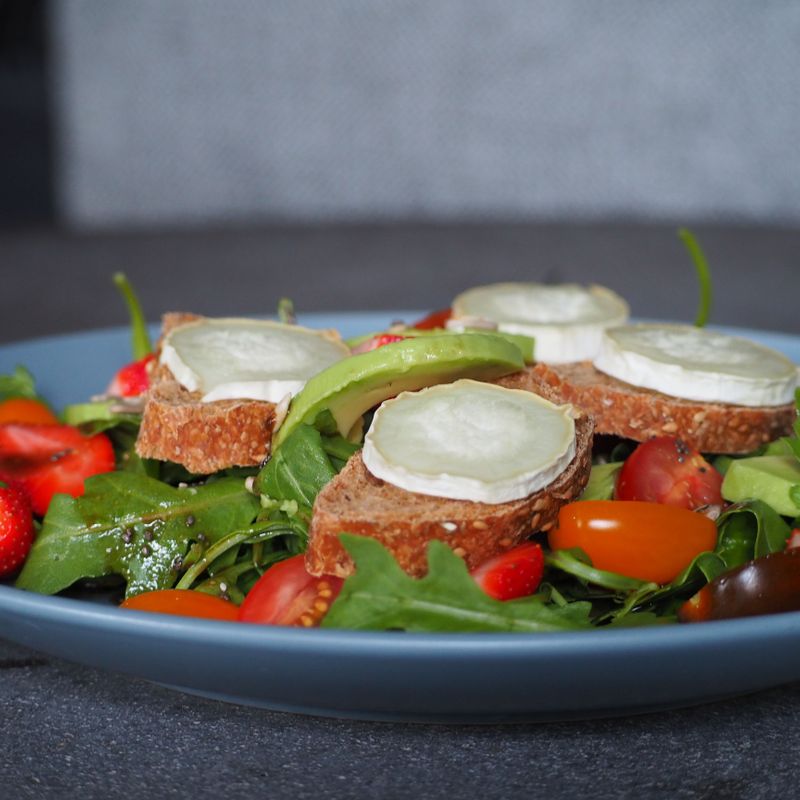
French Warm Goat Cheese Salad with Toasted Bread and Greens
A classic French-inspired salad featuring warm, slightly melted goat cheese rounds on crispy toasted bread, nestled on a bed of tender greens and dressed with a fragrant thyme vinaigrette. The contrast of warm cheese against cool, peppery greens makes this an elegant starter or light lunch.
- Prep
- 15 min
- Cook
- 10 min
- Wait
- 5 min
- Total
- 30 min
- Makes
- 4 servings (1 salad per person)
Steps
Before you start
- Remove goat cheese from the refrigerator 15 minutes before cooking so it slices cleanly
- Preheat your oven to 400°F (200°C)
- Have all greens washed and dried in advance
- Make the vinaigrette while the bread toasts
Make the vinaigrette
- In a small bowl, whisk together the minced shallot, red wine vinegar, and Dijon mustard.
- Let sit for 1 minute to allow the shallot to soften slightly.
- While whisking constantly, slowly drizzle in the 6 tablespoons of olive oil until the vinaigrette is emulsified and creamy.
- Stir in the fresh thyme leaves.
- Season with a pinch of salt and a few grinds of black pepper.
- Taste and adjust the seasoning as needed.
+ Show details− Hide details
Ready when: Vinaigrette is smooth, creamy, and well-combined
Tip: Whisking in the oil slowly creates an emulsion that won't separate as quickly. If your vinaigrette breaks, start with a fresh egg yolk in a clean bowl and slowly whisk in the broken vinaigrette to re-emulsify.
Toast the breadOven 400°F / 205°C
- Brush both sides of the baguette slices lightly with the 1.5 tablespoons of olive oil.
- Place them on a baking sheet in a single layer.
- Toast in a 400°F (200°C) oven for about 4–5 minutes, until golden brown and crispy.
- Remove from the oven.
+ Show details− Hide details
Ready when: Bread is golden brown and crispy throughout, not soft in the center
Tip: Watch the bread closely in the last minute—oven temperatures vary, and bread can go from golden to burnt quickly.
Arrange goat cheese on breadOven 425°F / 220°C
- Remove the baking sheet from the oven and increase the temperature to 425°F (220°C).
- Place one slice of goat cheese on top of each warm piece of toasted bread, centering it slightly.
- Return the baking sheet to the oven for 3–4 minutes, just until the cheese softens and begins to show slight browning on the edges—it should still hold its shape but be warm and slightly creamy.
+ Show details− Hide details
Ready when: Cheese is warm, slightly softened, and beginning to brown lightly at the edges while still holding its shape
Tip: Don't over-bake or the cheese will collapse completely and lose its pleasant texture. You want it warm and creamy on the inside, not melted flat.
Dress the greens
- While the goat cheese is warming, place the 5 cups of mixed greens in a large bowl.
- Drizzle with about two-thirds of the vinaigrette (roughly 3–4 tablespoons) and gently toss with your hands until the greens are lightly and evenly coated.
- The greens should glisten but not be drenched.
+ Show details− Hide details
Ready when: Greens are evenly coated and glistening, but not wet or wilted
Tip: Dress the greens just before serving so they stay crisp and don't become limp. If you dress them too early, they'll wilt.
Plate and serve
- Divide the dressed greens among four salad plates or shallow bowls, creating a loose bed of greens.
- Top each portion with one piece of warm goat cheese toast, placing it in the center or slightly off to one side.
- Drizzle the remaining vinaigrette around the plate.
- Finish with a tiny pinch of fleur de sel if desired.
- Serve immediately while the cheese is still warm.
+ Show details− Hide details
Ready when: Salad is plated and ready to eat
Tip: Plate this salad quickly after warming the cheese so the contrast between warm cheese and cool greens is pronounced. This temperature contrast is what makes the dish special.
Good to know
Tips
- For the most elegant presentation, let your goat cheese round warm in the oven until the edges are just beginning to turn golden, which adds visual appeal and a hint of caramelization.
- If your greens are still wet after washing, dry them thoroughly in a salad spinner or with paper towels—excess water will dilute the vinaigrette.
- The key to this salad is the contrast of temperatures: warm, soft cheese against cool, crisp greens. Serve it immediately so this contrast is maximized.
- Make a quick pan drizzle by warming the remaining vinaigrette gently on the stovetop before plating if you prefer a more cohesive sauce, but be careful not to break the emulsion with too much heat.
Make ahead
The vinaigrette can be made up to 4 hours ahead and kept at room temperature. The bread can be toasted up to 2 hours ahead and stored in an airtight container. Assemble and serve the salad fresh—the greens should not be dressed more than 5 minutes before plating.
Storage & reheating
This salad is best served immediately. If you have leftover dressed greens, store them in an airtight container in the refrigerator for up to 1 day, though they will soften. Store leftover vinaigrette in a covered jar in the refrigerator for up to 5 days; whisk or shake to re-emulsify before use. Leftover toasted bread can be stored in an airtight container at room temperature for up to 2 days and reheated gently in a 350°F (175°C) oven for 2 minutes.
Substitutions
- fresh thyme leaves → ½ teaspoon dried thyme or ½ teaspoon finely chopped fresh tarragon. Dried thyme is more concentrated, so use half the amount. Tarragon offers a subtle anise flavor that works beautifully with goat cheese.
- red wine vinegar → sherry vinegar or white wine vinegar. Sherry vinegar is slightly sweeter and very French; white wine vinegar is more delicate. Both work well; use the same amount.
- mixed salad greens (arugula, frisée, and butter lettuce blend) → arugula, frisée, or butter lettuce alone, or a mix of spinach and arugula. Avoid iceberg lettuce, which is too mild and bland for this vinaigrette. Peppery greens like arugula complement the warm cheese especially well.
- fresh goat cheese (chèvre) → fresh chèvre, warm cheese from the cow (such as Valencay), or even fresh mozzarella. Goat cheese is traditional and tangy; mozzarella will be milder and creamier. Avoid aged or very firm cheeses.