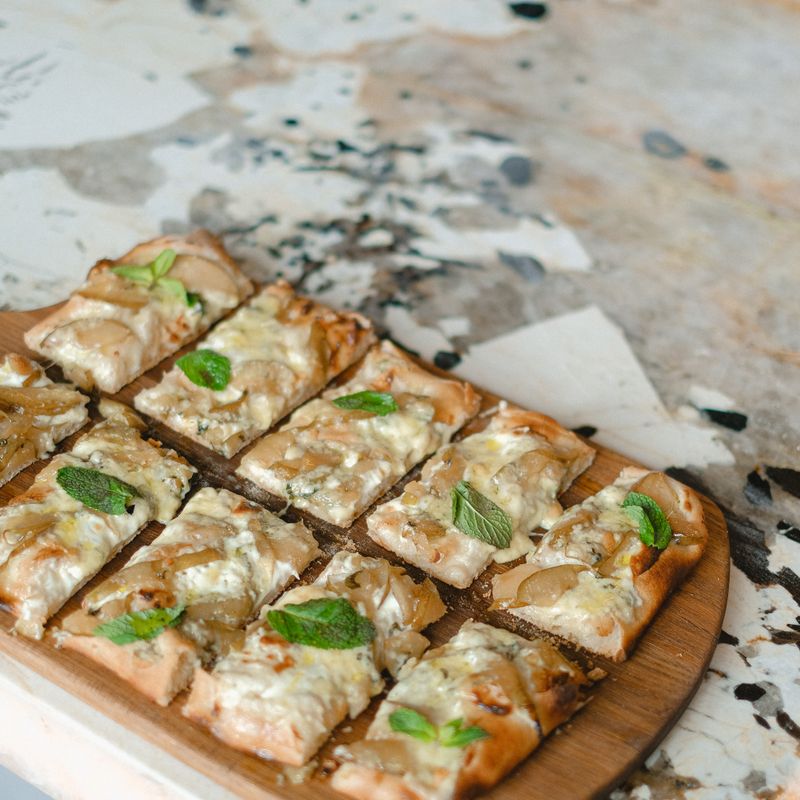
French Goat Cheese and Hazelnut Pizza
A sophisticated oven-baked pizza inspired by French flavors, featuring creamy goat cheese, toasted hazelnuts, deeply caramelized onions, and fresh thyme on a crispy wood-fired-style crust. The sweet, umami-rich onions balance the tangy cheese and earthy nuts for an elegant yet approachable dinner.
- Prep
- 25 min
- Cook
- 35 min
- Wait
- 1 hr 15 min
- Total
- 2 hr 15 min
- Makes
- 2 personal pizzas (8–10 inches each)
Steps
Before you start
- Caramelize the onions first (they take 45 minutes); they can cool while dough rises
- Place a pizza stone or steel on the lowest oven rack and preheat to 500°F (260°C) for at least 30 minutes
- Have all toppings prepped and at room temperature before shaping dough
Caramelize the onions
- Heat 2.5 tbsp (37 ml) of olive oil in a large saucepan over medium-high heat.
- Add the minced shallot and sauté for 1 minute until fragrant.
- Add the sliced yellow onions and 1 tbsp (5 g) of fresh thyme.
- Stir frequently, cooking for 8–10 minutes until the onions begin to turn golden and release their moisture.
- Lower the heat to medium-low and continue stirring occasionally—do not stir constantly, as this slows caramelization.
- After 30–35 minutes total, the onions will turn deep amber and smell sweet and jammy.
- Stir in the balsamic vinegar (this adds depth) and cook for 1 more minute.
- Transfer to a small bowl and set aside to cool.
- The onions will keep warm and continue concentrating in flavor.
+ Show details− Hide details
Ready when: Onions are deep amber, translucent, and smell intensely sweet
Tip: Don't stir too frequently—occasional stirring allows onions to brown properly. Lower heat if they begin to blacken.
Mix the dough
- In a stand mixer fitted with the dough hook (or a large bowl), combine 1.5 cups (195 g) of bread flour, 0.5 tsp (3 g) of instant yeast, and 0.75 tsp (4 g) of kosher salt.
- Add 0.75 cup (180 ml) of lukewarm water (about 80°F/27°C) and 1 tbsp (15 ml) of olive oil.
- Mix on low speed for 8–10 minutes until the dough is smooth and slightly elastic.
- If mixing by hand, knead for 10–12 minutes until no large flour streaks remain and the dough is cohesive.
+ Show details− Hide details
Ready when: Dough is smooth, slightly elastic, and no dry flour remains
Tip: Water temperature matters—too hot kills yeast; too cold slows rising. Use a kitchen thermometer if unsure.
First rise
- Lightly oil a medium bowl, place the dough in it, and cover with a damp kitchen towel or plastic wrap.
- Let it rest at room temperature (68–72°F/20–22°C) for about 60 minutes.
- The dough should increase in volume by roughly 50–75%, looking puffy and soft.
+ Show details− Hide details
Ready when: Dough is visibly puffy and springs back slowly when poked
Tip: Avoid placing the dough in a draft or very warm spot. A consistent temperature ensures even rising.
Preheat oven and stoneOven 500°F / 260°C
- Place a pizza stone or steel on the lowest oven rack.
- Preheat the oven to 500°F (260°C) for at least 30 minutes.
- A thoroughly heated stone is essential for a crispy, well-browned crust.
+ Show details− Hide details
Ready when: Oven reaches 500°F and stone is very hot
Tip: Use an oven thermometer to verify actual temperature; oven dials can be off by 25–50°F.
Shape the pizzas
- Turn the risen dough onto a lightly floured work surface.
- Divide it in half.
- With floured hands, gently stretch one half into a 8–10 inch disk, about ¼ inch thick.
- Work from the center outward, being careful not to tear the dough.
- If it springs back, let it rest for 2 minutes and try again.
- Transfer the shaped dough to a piece of parchment paper on a pizza peel or flat baking sheet.
- Repeat with the second half.
+ Show details− Hide details
Ready when: Dough is stretched into a thin, even disk
Tip: Parchment paper prevents sticking and can go directly onto the hot stone.
Top the first pizza
- Spread half of the caramelized onions (about 3–4 tbsp, or 60 g) over the first pizza crust, leaving a ½-inch border.
- Scatter half of the goat cheese pieces (2.5 oz / 70 g) evenly over the onions.
- Sprinkle with half of the chopped hazelnuts (¼ cup / 27 g) and half of the grated Gruyère (1 oz / 27 g).
- Season lightly with fleur de sel and freshly ground black pepper.
+ Show details− Hide details
Ready when: Toppings are evenly distributed
Tip: Don't overload the pizza or the crust will become soggy. Goat cheese will melt and soften during baking.
Bake the first pizzaOven 500°F / 260°C
- Carefully slide the parchment and pizza onto the preheated stone.
- Bake at 500°F (260°C) for 10–13 minutes until the crust is golden brown, the cheese has melted, and the hazelnuts smell toasted.
- The edges of the crust should be darker than the center.
+ Show details− Hide details
Ready when: Crust is golden brown, cheese has melted, and edges are slightly charred
Tip: Watch closely after minute 10—ovens vary. The bottom should sound hollow if you tap it with a utensil.
Rest and finish the first pizza
- Remove the pizza from the oven and slide it onto a cutting board with the parchment still attached.
- Drizzle with ¼ tbsp (3.5 ml) of finishing olive oil.
- Sprinkle with a few fresh thyme leaves (about ½ tbsp or 1 g).
- Let it rest for 2 minutes so the cheese sets slightly.
- Cut into slices and serve warm.
+ Show details− Hide details
Ready when: Pizza has cooled enough to slice without melted cheese running
Tip: A fresh thyme sprinkle after baking adds brightness; avoid adding it before baking or the leaves will burn.
Top and bake the second pizzaOven 500°F / 260°C
- Repeat steps 6–8 with the second pizza using the remaining caramelized onions, goat cheese, hazelnuts, Gruyère, sea salt, and black pepper.
- While the second pizza bakes, the first can be plated and served.
+ Show details− Hide details
Ready when: Crust is golden brown and cheese is melted
Tip: If the oven temperature has dropped, add 30 seconds to baking time. Reheating the stone by opening the oven can cool it briefly.
Good to know
Tips
- For a darker, more caramelized crust, brush the dough edges with a light egg wash (1 beaten egg whisked with 1 tbsp water) before topping.
- If you don't have a pizza stone, a preheated cast-iron skillet or thick baking sheet works well—just reduce the oven temperature to 475°F (245°C) to prevent burning the bottom.
- The key to crispy pizza at home is a very hot oven and a preheated stone. Don't skip preheating for at least 30 minutes.
- Taste the caramelized onions as you go; they should be sweet and savory with no harsh tang. If they're catching and burning, lower the heat immediately.
Make ahead
The dough can be made up to 8 hours ahead: after the first rise, gently punch it down, wrap it tightly in plastic wrap, and refrigerate. Remove it from the fridge 30 minutes before shaping. The caramelized onions can be made up to 3 days ahead and stored in an airtight container in the refrigerator; rewarm gently on the stove over medium-low heat before topping the pizzas.
Storage & reheating
Leftover pizza keeps in an airtight container in the refrigerator for up to 2 days. Reheat in a 350°F (175°C) oven for 8–10 minutes to restore crispness, or eat cold. Unbaked dough will keep refrigerated for up to 8 hours; do not freeze.
Substitutions
- roasted hazelnuts → roasted walnuts or toasted pine nuts. Walnuts add earthiness; pine nuts are more delicate. Use the same amount.
- fresh chèvre (soft goat cheese) → ricotta salata or crumbled feta. Ricotta salata is tangy and firm; feta is saltier. Reduce added salt if using feta.
- Gruyère cheese → Emmental or aged Comté. These French cheeses melt similarly and add nutty flavor. Use the same amount.
- balsamic vinegar → red wine vinegar or sherry vinegar. These are sharper; use only ½ tbsp (7 ml) to avoid overpowering the onions.
More pizza
See all →


Find more like this
- Meal
- Dinner
- Cuisine
- French
- Main ingredient
- Cheese
- Diet
- HalalSugar-Free