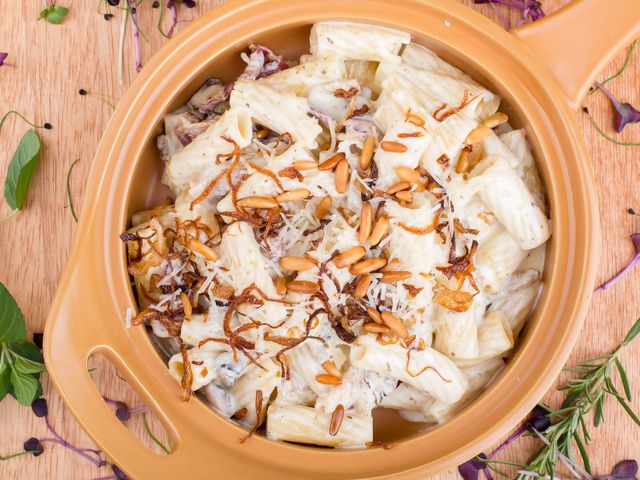
French Baked Pappardelle with Duck Confit and Cherry Gastrique
Wide ribbon pappardelle noodles layered with tender shredded duck confit, béchamel sauce, and a vibrant sweet-tart cherry gastrique, then baked until golden and bubbling. The duck's richness is balanced by the bright acidity of the cherry reduction and Gruyère cheese crust. A sophisticated French-inspired baked pasta that feels both comforting and refined.
- Prep
- 25 min
- Cook
- 45 min
- Wait
- 15 min
- Total
- 1 hr 25 min
- Makes
- 4 generous servings (one 9×13-inch baking dish)
Steps
Before you start
- Preheat oven to 375°F (190°C)
- Have duck confit at room temperature or warm
- Measure and set out all ingredients before beginning (mise en place)
- Use fresh or thawed pappardelle; if using dried, cook 1 minute less than package directions so it finishes cooking in the oven
Make the cherry gastrique
- In a medium saucepan over medium-high heat, combine the red wine vinegar, sugar, minced shallot, and thyme sprigs.
- Bring to a simmer and stir occasionally until reduced by half and syrupy, about 5–6 minutes.
- Add the cherries and continue cooking for 3–4 minutes until they begin to soften and release their juices.
- The mixture should be glossy and reduced to about ¾ cup (180 ml).
- Remove from heat, discard thyme sprigs, and set aside to cool slightly.
+ Show details− Hide details
Ready when: Gastrique is reduced by half, syrupy, and cherries have softened and released their juices
Tip: Do not let the gastrique burn; if it darkens too much, the acid will become acrid. The mixture will continue to thicken as it cools.
Cook the pappardelle
- Bring a large pot of generously salted water to a boil.
- Add the pappardelle and cook for 1 minute less than the package directions (the pasta will finish cooking in the oven).
- Drain in a colander, drizzle lightly with a little of the reserved duck fat so the strands don't stick, and set aside.
+ Show details− Hide details
Ready when: Pasta is just under al dente, with a slight firmness at the center when bitten
Tip: Under-cooking by 1 minute is critical—the pasta finishes cooking in the oven and will become mushy if cooked fully on the stovetop.
Build the béchamel sauce
- In a medium saucepan, melt the butter and reserved duck fat together over medium heat.
- Once foaming, whisk in the flour and cook for 1–2 minutes, stirring constantly, until it turns light golden and smells toasty—this is your roux.
- Gradually whisk in the warm milk and stock, stirring continuously to avoid lumps.
- Continue cooking for 5–7 minutes, stirring often, until the sauce thickens enough to coat the back of a spoon.
- Whisk in the Dijon mustard, a pinch of fresh nutmeg, and season with salt and pepper to taste.
- The sauce should be thick and creamy but still pourable.
+ Show details− Hide details
Ready when: Sauce coats the back of a spoon and there are no lumps; it flows but doesn't run off immediately
Tip: Warm the milk and stock before adding to prevent lumps. Whisk constantly and don't rush—patience here ensures a silky sauce.
Assemble the baking dish
- Lightly coat a 9×13-inch (23×33 cm) baking dish with a thin layer of the béchamel sauce.
- Spread half of the cooked pappardelle evenly over the sauce.
- Scatter half of the shredded duck confit over the pasta.
- Spoon half of the remaining béchamel over the duck layer.
- Add the rest of the pappardelle, then the remaining duck confit, and finish with the final layer of béchamel sauce.
- Spread the sauce evenly so it reaches all corners.
- Sprinkle the entire surface with three-quarters of the grated Gruyère (save the remainder for the topping), then drizzle the cherry gastrique in a gentle pattern across the top.
- Finish with the reserved Gruyère.
+ Show details− Hide details
Ready when: Layering is even and complete; the surface is ready for baking
Tip: Use a béchamel-coated baking dish to prevent the bottom pasta from sticking. Don't overwork the layers—gentle spreading keeps the pasta strands intact.
Bake until golden and bubblingOven 375°F / 190°C
- Place the baking dish in a preheated 375°F (190°C) oven on the middle rack.
- Bake for 35–40 minutes, until the cheese topping is golden brown and the edges are bubbling vigorously.
- If the cheese is browning too quickly before the interior is hot, loosely tent with foil for the last 10 minutes, then remove to finish browning.
- The internal temperature should reach 165°F (74°C) when measured in the center with an instant-read thermometer.
+ Show details− Hide details
Ready when: Cheese topping is golden brown, edges bubble vigorously, and internal temperature is 165°F (74°C)
Tip: Tent with foil if the cheese browns too fast—you want the inside hot before the top burns. The baking time can vary with oven type, so check at 35 minutes.
Rest and serve
- Remove from the oven and let the dish rest for 5–7 minutes on the counter.
- This allows the sauce to set slightly so the pasta doesn't slide around on the plate.
- Garnish with fresh chopped parsley if desired, and serve directly from the baking dish or divide into portions with a large spoon.
+ Show details− Hide details
Ready when: Pasta is very tender, sauce is set but still creamy, and cheese is golden
Tip: Resting is essential—it prevents a soupy dish and allows the layers to hold together when plated.
Good to know
Tips
- Duck confit is key to this dish's success. If you cannot find it at a specialty shop or online, make it 2–3 days ahead by braising duck legs slowly in rendered fat until the meat is fork-tender, then cool and store in the fat. Homemade confit tastes superior to most store-bought versions.
- The bright cherry gastrique is what elevates this dish—it cuts through the richness of the duck and cream sauce. Taste it before layering; if it's too acidic, whisk in a teaspoon of butter to round out the flavor.
- Use freshly grated Gruyère if possible; pre-shredded cheese contains anti-caking agents that prevent smooth melting and browning.
- This is a rich dish, but the portion size is generous. Serve with a simple green salad dressed with vinaigrette and a glass of dry Burgundy or Pinot Noir to balance the richness.
Make ahead
Duck confit can be made 2–3 days ahead and refrigerated, or purchased ready-made. The cherry gastrique can be made up to 4 hours ahead and kept at room temperature. The assembled, unbaked dish can sit in the refrigerator up to 2 hours before baking; add 5–10 minutes to bake time if baking from cold.
Storage & reheating
Refrigerate leftovers in an airtight container for up to 3 days. To reheat, cover with foil and warm in a 325°F (163°C) oven for 15–20 minutes until heated through. Do not microwave, as the sauce may separate. This dish does not freeze well due to the pasta's texture after thawing.
Substitutions
- fresh or frozen pitted cherries → Frozen pitted cherries (no thaw needed) or canned cherries in syrup, drained. Adjust sugar in the gastrique down by 1 tablespoon if using canned cherries, which are already sweet. Frozen cherries give the same result as fresh.
- Gruyère cheese, finely grated → Emmental, Comté, or aged Cheddar. Use a hard cheese that melts smoothly and has good flavor depth. Avoid soft cheeses like mozzarella, which won't brown properly.
- duck confit (purchased or homemade) → Shredded confit pork shoulder or chicken confit. Pork or chicken confit will work, though the dish loses its richness; increase the sauce by 2–3 tablespoons for moisture. Duck is traditional and preferred.
- red wine vinegar → Sherry vinegar or balsamic vinegar. Sherry vinegar gives a milder, slightly sweeter gastrique; balsamic creates a deeper, more complex flavor. Reduce balsamic by ¼ cup (60 ml) as it's thicker.