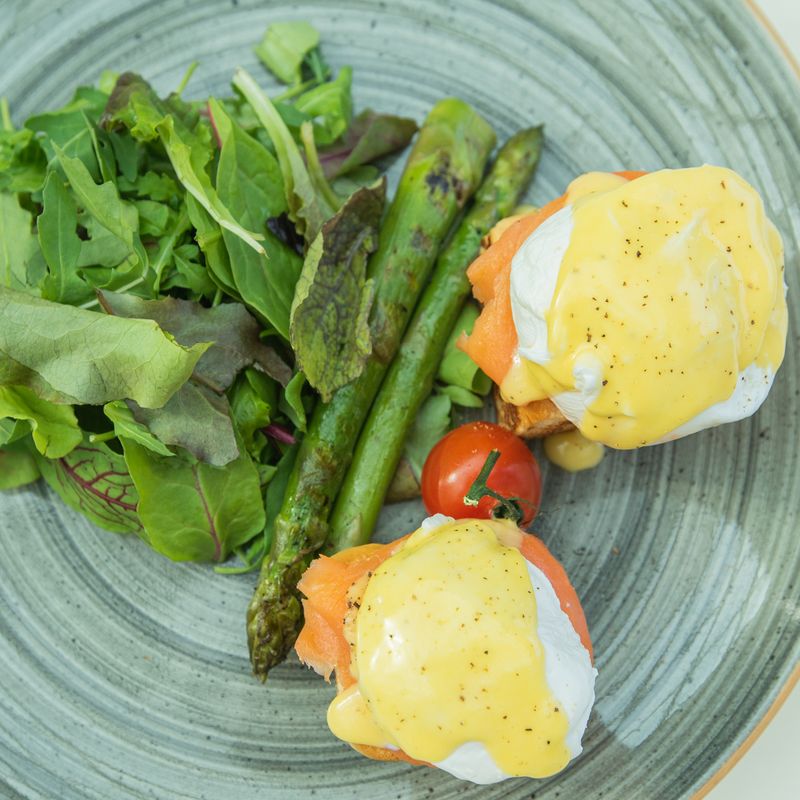
French Asparagus Hollandaise Rice
A elegant French side dish that pairs fluffy white rice with tender asparagus spears and a silky warm hollandaise sauce infused with fresh lemon. The hollandaise—made with egg yolks, butter, and lemon juice—coats the rice and asparagus in a rich, velvety richness. Perfect alongside roasted chicken, poached fish, or as a vegetarian main when topped with a soft-poached egg.
Steps
Before you start
- Have all ingredients at room temperature before starting, especially egg yolks and butter, so the hollandaise emulsifies properly
- Trim asparagus and measure rice before you begin cooking
- Read through the hollandaise technique—it requires patience and gentle heat to avoid scrambling the eggs
Cook the rice
- In a medium saucepan, bring 2¾ cups (650 ml) water and 1 teaspoon (6 g) kosher salt to a boil over high heat.
- Add 1½ cups (300 g) long-grain white rice, stir once, then reduce heat to low and cover tightly with a lid.
- Simmer for 18 minutes without lifting the lid.
+ Show details− Hide details
Ready when: Water is fully absorbed and rice grains are tender when tested with a fork
Tip: Do not lift the lid during cooking—this allows steam to escape and rice won't cook evenly
Rest the rice
- Remove the rice from heat and let it rest, covered, for 5 minutes.
- This allows any remaining moisture to distribute evenly.
+ Show details− Hide details
Ready when: Rice is fluffy and steam has mostly dissipated when you peek under the lid
Blanch the asparagus
- While the rice rests, bring a large pot of salted water to a rolling boil.
- Add 1 pound (450 g) asparagus pieces (cut into 2-inch lengths, woody ends trimmed beforehand).
- Boil for 4–5 minutes until the spears are bright green and tender-crisp when pierced with a fork.
- Drain in a colander and set aside.
+ Show details− Hide details
Ready when: Asparagus is bright green, tender when pierced, but still holds its shape
Tip: Don't overcook—asparagus should remain slightly firm so it doesn't turn mushy when coated in warm hollandaise
Start the hollandaise base
- While asparagus cooks, set a heatproof bowl over a small pot of gently simmering water (the bowl should not touch the water—this is a double boiler).
- Add 3 room-temperature egg yolks to the bowl and whisk constantly for 2–3 minutes until they become pale and slightly thickened.
- Add 2 tablespoons (30 ml) fresh lemon juice and whisk for 30 seconds more.
+ Show details− Hide details
Ready when: Yolks are pale, thick, and ribbon-like when the whisk is lifted; mixture reaches 160°F (71°C) for food safety
Tip: Keep the water below a boil—if it boils too vigorously, the eggs can scramble. Whisk constantly to avoid lumps
Whisk in the butter
- Reduce heat under the simmering water to low.
- Working very slowly, add cold butter one piece at a time (about 1 tablespoon at a time), whisking continuously after each addition until completely incorporated before adding the next.
- This should take 8–10 minutes total.
- The sauce will gradually emulsify and thicken into a silky consistency.
+ Show details− Hide details
Ready when: Hollandaise is pale, glossy, thick enough to coat the back of a spoon, and reaches 160°F (71°C)
Tip: Adding butter slowly and whisking constantly is key—rushing or stopping the whisking breaks the emulsion. If it breaks and becomes grainy, remove it from heat and whisk in a teaspoon of cold water or cream to bring it back together
Season the hollandaise
- Remove the bowl from the heat and whisk in kosher salt and a pinch of cayenne pepper to taste.
- Taste and adjust lemon juice if needed for brightness.
+ Show details− Hide details
Ready when: Hollandaise is well-seasoned with balanced lemon brightness and a subtle heat
Tip: The sauce must remain above 160°F (71°C) for food safety but below 180°F (82°C) or it will break; keep it warm in the double boiler until serving
Combine and serve
- Fluff the cooked rice with a fork and divide evenly among four serving bowls or plates.
- Arrange the warm asparagus spears on top of the rice.
- Spoon the warm hollandaise sauce generously over the asparagus and rice, allowing some to pool around the plate.
- Serve immediately.
+ Show details− Hide details
Tip: Hollandaise is best served immediately after making—if it cools too much, it will solidify. Keep it warm in the double boiler and pour just before serving
Good to know
Tips
- Hollandaise is an emulsion of egg yolks and butter—the key to success is patience and slow, steady whisking. Rushing the process or using cold butter that won't incorporate smoothly will cause the sauce to break
- For a foolproof double boiler, simply set a heatproof bowl snugly over a pot of simmering water; the bowl should not touch the water. This indirect heat prevents scrambling the eggs
- If your hollandaise breaks and becomes grainy or separates, don't discard it—start with a fresh egg yolk in a clean bowl, whisk it briefly, then very slowly whisk in the broken sauce to reconstitute it
- Make sure all ingredients, especially egg yolks and butter, are at proper temperatures: yolks at room temperature, butter cold and cut into pieces. This helps the emulsion form smoothly
Make ahead
You can cook the rice and blanch the asparagus up to 4 hours ahead and store them separately in the refrigerator. Reheat the rice gently in a covered saucepan over low heat with a splash of water, and warm the asparagus in boiling salted water for 1–2 minutes. Make the hollandaise fresh just before serving—it cannot be made ahead without risking separation.
Storage & reheating
This dish is best served fresh. Leftover cooked rice and asparagus can be refrigerated together for up to 2 days; store the hollandaise separately (if any remains) for up to 1 day. Do not freeze hollandaise. To reheat, warm the rice and asparagus together gently in a saucepan over low heat with a splash of water, stirring occasionally. Prepare fresh hollandaise for serving.
Substitutions
- long-grain white rice → Basmati or jasmine rice. Use the same quantity. Basmati rice will have a more delicate flavor and jasmine will add a subtle fragrance; both work beautifully with the hollandaise
- fresh asparagus spears, medium thickness → Fresh broccoli florets or green beans, cut into 2-inch pieces. Use the same quantity and blanch for 4–5 minutes until tender-crisp; the dish will still be delicious with a slightly different character
- fresh lemon juice → White wine vinegar or fresh tarragon vinegar. Use 1½ tablespoons (22 ml) to start, then taste and adjust; vinegar will give a slightly sharper edge than lemon but is very French
- unsalted butter → Clarified butter (ghee). Use the same quantity; clarified butter makes a lighter, less rich hollandaise that is slightly more stable
More rice bowls
See all →



Find more like this
- Meal
- Dinner
- Cuisine
- French
- Main ingredient
- Rice
- Method
- Stovetop
- Quick & Easy
- 5 Ingredients or Less