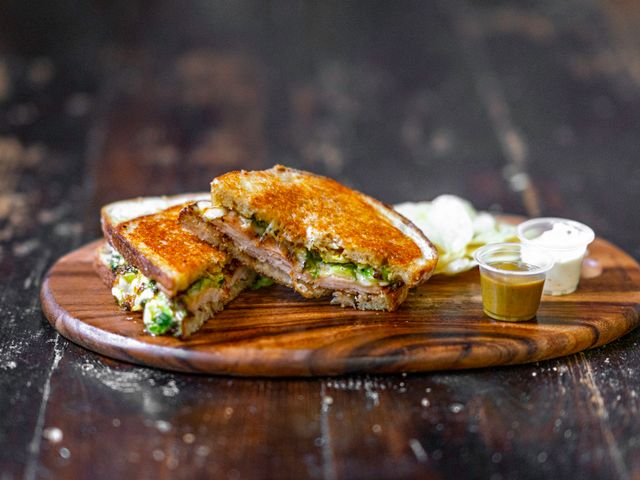
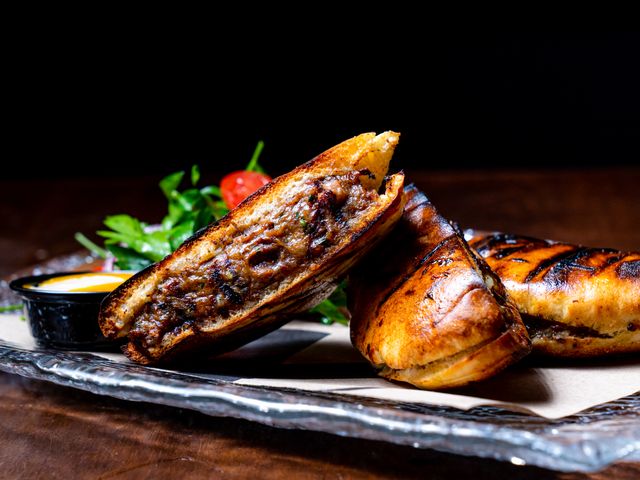
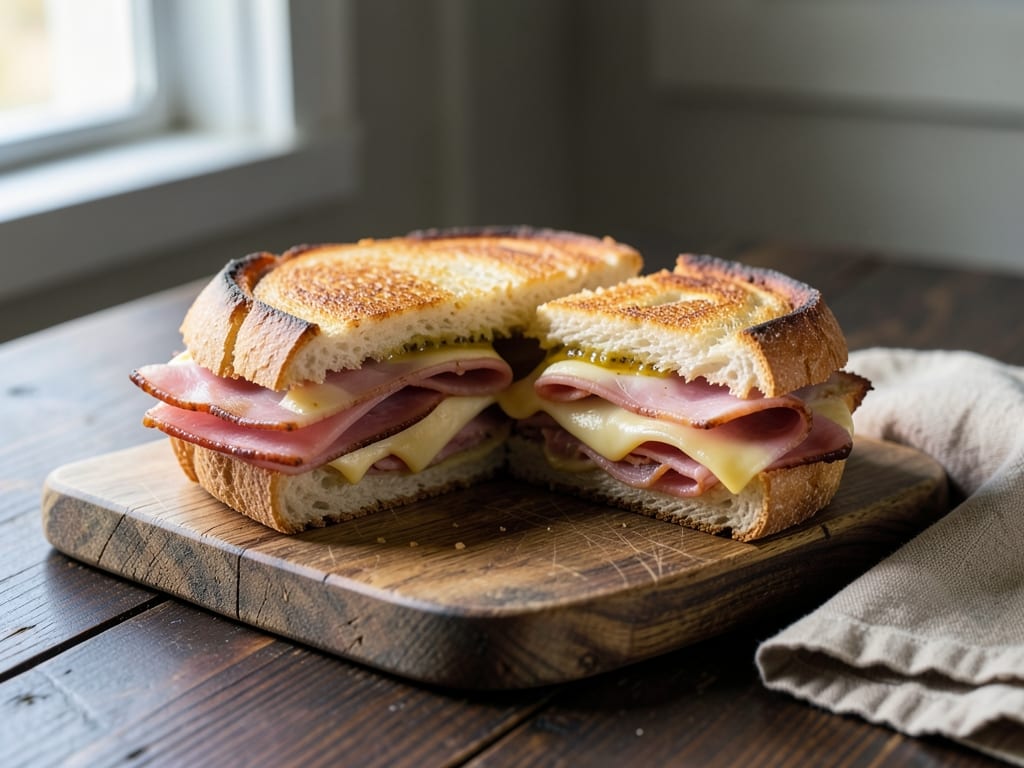
French Andouille Sausage and Gruyère Panini
A sophisticated panini built on crusty sourdough with smoky andouille sausage, nutty Gruyère cheese, sweet caramelized onions, and whole grain mustard. The panini press creates a golden, crisp exterior while melting the cheese into the warm sausage and onions. Classic French bistro flavors in a hand-held sandwich.
Steps
Before you start
- Preheat your panini press for 5 minutes
- Slice the andouille sausage into thin rounds (about ⅛ inch) and set aside
- Have all ingredients assembled and within reach
Warm the caramelized onions
- If using store-bought caramelized onions or homemade ones that have been refrigerated, gently warm them in a small skillet over medium-low heat for 2–3 minutes, stirring occasionally, until warmed through.
- This ensures they will not cool down the hot sausage.
- Set aside.
+ Show details− Hide details
Ready when: Onions are heated through and fragrant
Tip: Cold onions will cool the cheese and sausage; warming them ensures even melting.
Cook the andouille sausage
- In a large skillet over medium-high heat, arrange the sliced andouille rounds in a single layer.
- Cook for 2–3 minutes per side until the edges are lightly browned and the sausage is warmed through.
- The sausage should release its oils and develop a slight crust.
- Transfer to a plate and keep warm.
+ Show details− Hide details
Ready when: Sausage slices are lightly browned on the edges and warm throughout, internal temperature reaches 160°F (71°C)
Tip: Do not crowd the pan; cook in batches if necessary to avoid steaming the sausage.
Assemble the first sandwich
- Open the first sourdough sandwich.
- Spread ½ tablespoon (7.5 ml) of whole grain mustard on the bottom half and ½ tablespoon (7.5 ml) on the top half.
- On the bottom half, layer approximately 2 oz (57 g) of Gruyère cheese, then half of the warm andouille sausage slices, then half of the warm caramelized onions.
- Top with the remaining cheese (about 1 oz / 28 g), then close with the top half of bread.
+ Show details− Hide details
Ready when: Sandwich is stacked and closed
Tip: Place cheese on both sides of the filling so it encases the sausage and onions when melted.
Assemble the second sandwich
- Repeat the assembly process with the second sourdough piece, using the remaining mustard, cheese, sausage, and onions in equal proportions.
+ Show details− Hide details
Ready when: Second sandwich is stacked and closed
Butter the sandwich exterior
- Lightly brush or spread about ½ tablespoon (7 g) of softened butter on the outside of the top and bottom of the first sandwich.
- Repeat with the second sandwich.
- The butter creates the golden crust when pressed.
+ Show details− Hide details
Ready when: Both sides of sandwich are evenly coated with a thin layer of butter
Tip: Use a light hand; too much butter will make the bread greasy rather than crisp.
Press the first panini
- Place the first sandwich on the preheated panini press.
- Close the lid and press gently—do not force it shut, as this will compress the bread too much.
- Press for 3–4 minutes until the bread is golden brown and the cheese has melted.
- Open the press carefully (the sandwich will be hot) and transfer to a cutting board.
+ Show details− Hide details
Ready when: Bread is golden brown and crispy; cheese is completely melted
Tip: If your press has adjustable heat, use medium to avoid burning the bread before the cheese melts.
Press the second panini
- Repeat the pressing process with the second sandwich: place it on the preheated panini press, close gently, and press for 3–4 minutes until golden and the cheese is melted.
- Transfer to the cutting board with the first panini.
+ Show details− Hide details
Ready when: Bread is golden brown and crispy; cheese is completely melted
Rest and serve
- Let each panini rest on the cutting board for 1–2 minutes.
- This allows the cheese to set slightly and prevents it from oozing out when you cut.
- Optionally, season with a pinch of freshly ground black pepper.
- Serve immediately while the bread is still warm and crispy.
+ Show details− Hide details
Ready when: Panini is cool enough to handle but still warm inside
Tip: Resting prevents the filling from dripping out when you bite or cut into the sandwich.
Good to know
Tips
- Homemade caramelized onions are worth the effort: slice 1 large onion, cook over medium-low heat with 1 tablespoon butter for 20–25 minutes, stirring occasionally, until deep golden and sweet. Make a batch ahead and freeze in portions.
- The panini press is essential for this recipe; a skillet and flat weight can substitute, but the results won't be as evenly golden. If using a skillet, flip once halfway through and press with a lid weighted down with a cast-iron pan or heavy cookbook.
- For a vegetarian version, omit the sausage and add roasted red peppers, sautéed mushrooms, or crispy fried onions to maintain texture and richness.
- Serve with a simple green salad dressed in vinaigrette, or alongside a bowl of French onion soup for an elegant lunch.
Make ahead
Caramelized onions can be made up to 3 days ahead and stored in the refrigerator. Andouille sausage can be sliced and cooked up to 2 hours ahead; reheat gently in a skillet before assembling. Do not assemble the sandwich more than 30 minutes before pressing, as the bread will absorb moisture from the fillings.
Storage & reheating
Best enjoyed fresh immediately after pressing. Leftover panini can be wrapped in foil and stored in the refrigerator for up to 1 day. Reheat in a 350°F (175°C) oven for 8–10 minutes wrapped in foil, or unwrapped on a panini press at medium heat for 2–3 minutes. Do not microwave, as this will make the bread soggy.
Substitutions
- smoked andouille sausage → smoked kielbasa or Spanish chorizo. Both offer similar smoky, spiced flavors. Use the same weight and slice the same way.
- Gruyère cheese → aged Cheddar or Emmental cheese. Cheddar adds tang; Emmental melts very smoothly. Use the same weight.
- Dijon whole grain mustard → Creole mustard or spicy brown mustard. For a spicier panini. Use the same amount.
- rustic sourdough bread → crusty ciabatta or focaccia rolls. Any sturdy, crusty bread works well. Ensure pieces are thick enough not to compress too much when pressed.