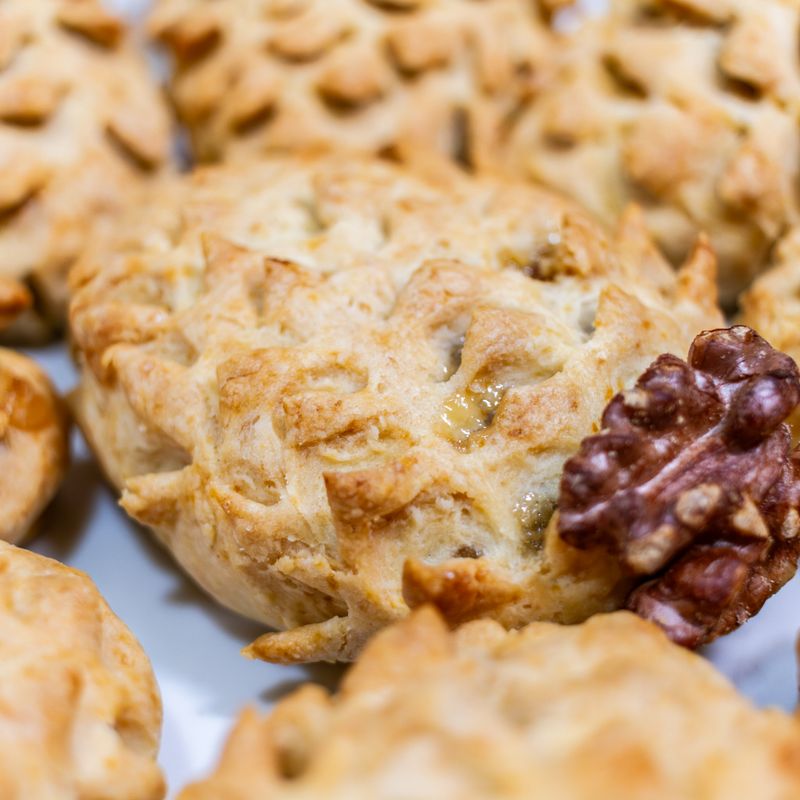
Flaky Wife Cake with Winter Melon Filling
Crisp, shatteringly flaky layers of lard pastry wrap a chewy, lightly sweet winter melon filling flecked with toasted sesame. This is the classic Cantonese-style lao po bing, baked until golden and best eaten the same day.
- Prep
- 1 hr 25 min
- Cook
- 27 min
- Wait
- 1 hr 5 min
- Total
- 2 hr 57 min
- Makes
- 12 pastries (about 2½ inches / 6 cm wide, 70 g each)
Steps
Before you start
- Buy thick, spoonable winter melon paste (the jam-like kind sold in jars or cans at Asian markets); if it looks loose or wet, the filling step will firm it up.
- Lard should be soft but not melted (like spreadable butter, about 68°F / 20°C). If it's rock hard, leave it out for 30–45 minutes.
- The dough needs two rests (30 and 15 minutes), so read the timing and plan about 3 hours start to finish.
- Line a large baking sheet with parchment paper. Preheat the oven only when you reach the shaping step (step 8).
Toast rice flour and sesame
- Set a small dry skillet over medium-low heat.
- Add the glutinous rice flour and stir constantly for 3–4 minutes until it smells nutty and looks very faintly tan.
- Tip it onto a plate.
- In the same skillet, toast the filling sesame seeds for 2 minutes, shaking the pan, until light golden and fragrant.
- Tip onto a second plate and let both cool completely.
+ Show details− Hide details
Ready when: Flour smells nutty and is faintly tan; sesame is light golden.
Tip: Keep stirring and use low heat. Scorched rice flour tastes bitter and can't be rescued.
Mix the filling
- In a medium bowl, stir the winter melon paste with the cooled toasted rice flour and sesame seeds until evenly combined.
- The mixture should hold a shape like soft cookie dough and not stick to a clean finger.
- If it's still sticky, stir in 1 more tablespoon (8 g) of toasted rice flour.
- Cover and refrigerate while you make the dough.
+ Show details− Hide details
Ready when: Filling holds a ball shape and doesn't stick to a clean fingertip.
Tip: A firm filling is the key to a neat seal. Runny filling leaks out during baking.
Knead the water dough
- In a medium bowl, whisk the all-purpose flour, powdered sugar and salt.
- Add the 2½ tbsp (32 g) lard and the warm water.
- Mix with your hand or a spatula into a shaggy dough, then knead on a clean counter for 6–8 minutes until smooth, soft and slightly elastic like an earlobe.
- Shape into a ball, cover with plastic wrap and rest at room temperature for 30 minutes.
- Put the filling in the fridge during this time.
+ Show details− Hide details
Ready when: Dough is smooth, soft and springs back slowly when poked.
Tip: If the dough feels stiff, wet your hands lightly rather than adding more water to the bowl.
Make the oil dough
- While the water dough rests, put the cake flour and the 4 tbsp (50 g) lard in a small bowl.
- Rub and press together with a spatula or your fingertips for about 2 minutes until it forms a smooth, soft, pale paste with no dry flour streaks.
- It should feel like soft play dough.
- Cover until needed.
+ Show details− Hide details
Ready when: Smooth paste with no dry flour; holds together when pressed.
Tip: If your kitchen is hot and the paste is greasy and slack, refrigerate it for 10 minutes.
Divide both doughs
- Divide the water dough into 12 equal pieces of about 21 g each, and the oil dough into 12 pieces of about 12 g each.
- Roll each piece into a ball.
- Keep all balls covered with plastic wrap or a damp towel so they don't form a skin.
+ Show details− Hide details
Ready when: 24 smooth balls: 12 larger (water dough) and 12 smaller (oil dough).
Tip: Weigh the pieces. Even sizes give even layers and even baking.
Wrap, roll and rest
- Flatten one water-dough ball into a 3-inch (8 cm) disc, thinner at the edges.
- Place one oil-dough ball in the center, pull the edges up around it, and pinch the seam tightly closed.
- Press flat, then roll into an oval about 5 inches (13 cm) long.
- Roll it up from the short end like a tiny jelly roll, turn it 90 degrees, press flat, roll into a second oval and roll up again into a short cylinder.
- Repeat with the rest.
- Place seam-side down on the counter, cover, and rest 15 minutes.
+ Show details− Hide details
Ready when: Each cylinder is smooth with no oil leaking through the surface.
Tip: Use only a light dusting of flour for rolling; too much flour makes the layers dry and stops them from sealing.
Portion the filling
- Weigh the chilled filling into 12 portions of about 37 g each and roll each into a smooth ball.
- Keep them covered while you work on the dough.
+ Show details− Hide details
Ready when: 12 smooth balls with no cracks.
Fill and shapeOven 350°F / 175°C
- Preheat the oven now to 350°F (175°C) with a rack in the center.
- Stand a rested cylinder on one of its cut ends and press it down into a disc.
- Roll it out to a 3½-inch (9 cm) circle, keeping the swirl on the outside.
- Put a filling ball in the center, bring the edges up and pinch firmly to seal, twisting off any excess.
- Turn seam-side down and gently flatten with your palm to a disc about 2½ inches (6 cm) wide and ¾ inch (2 cm) thick.
- Set on the lined baking sheet 1½ inches (4 cm) apart.
+ Show details− Hide details
Ready when: Smooth domed discs with swirl visible on top and no filling showing.
Tip: A tiny hole in the seal will leak filling in the oven. Pinch any gaps closed and keep the seam underneath.
Glaze and topOven 350°F / 175°C
- Whisk the egg yolk with the 1 tbsp water.
- Brush a thin coat over the top of each pastry, avoiding drips onto the parchment.
- Sprinkle each with about ½ tsp raw sesame seeds.
- Using a paring knife, make two or three small slits in the top of each, just through the dough, or prick with a fork, to let steam escape.
+ Show details− Hide details
Ready when: Tops are evenly glossy and speckled with sesame.
Tip: Brush gently and don't let egg pool at the base, which glues the layers and stops them from rising.
Bake until goldenOven 350°F / 175°C
- Bake at 350°F (175°C) for 25–28 minutes, rotating the pan front to back after 15 minutes, until the pastries are deep golden on top and light golden on the sides and bottoms, and the layers have puffed slightly.
+ Show details− Hide details
Ready when: Deep golden brown tops, lightly golden edges, crisp when tapped.
Tip: If the tops brown too fast before the sides color, tent loosely with foil for the last 8 minutes.
Cool to crisp
- Transfer the pastries to a wire rack with a spatula.
- Cool for at least 20 minutes before serving; the filling is molten at first and the layers crisp as they cool.
+ Show details− Hide details
Ready when: Pastry feels dry and crisp, and is just warm to the touch.
Tip: Don't stack or cover them while warm, or steam will soften the layers.
Good to know
Tips
- Weigh the dough and filling pieces; consistent sizes ensure uniform layers and baking.
- Work in a cool kitchen. If the lard softens and the dough feels greasy or sticky, chill the shaped pieces for 10 minutes.
- Keep the seam tightly pinched and facing down so the filling can't leak.
- For stronger sesame flavor, add black sesame seeds to the topping alongside the white.
Make ahead
Make the filling up to 3 days ahead and keep it covered in the fridge. Unbaked, shaped pastries (before the egg wash) can be refrigerated on the tray, covered, for up to 12 hours, or frozen solid on the tray then bagged for 1 month. Glaze and bake from frozen at 350°F (175°C), adding 6–8 minutes.
Storage & reheating
Best the day they're baked. Keep in an airtight container at room temperature for up to 2 days, or refrigerate for up to 5 days. Freeze baked pastries for up to 1 month. Re-crisp in a 325°F (160°C) oven for 8–10 minutes (12–15 from frozen); don't microwave.
Substitutions
- lard → Vegetable shortening (same weight), or cold unsalted butter for a more buttery, slightly less flaky result. Lard gives the most authentic flaky, tender crust. Use the same weight in both doughs; butter makes the oil dough softer, so chill it 10 minutes.
- cake flour → All-purpose flour (100 g). The oil-dough layers will be slightly less tender, but still flaky.
- winter melon paste → Sweet lotus seed paste or red bean paste (400 g). Not winter melon, but it uses the same weight and technique. Skip the extra rice flour if the paste is already firm.
- glutinous rice flour → Toasted all-purpose flour (30 g). Toast longer, about 5 minutes, until it smells nutty. The filling will be less chewy.