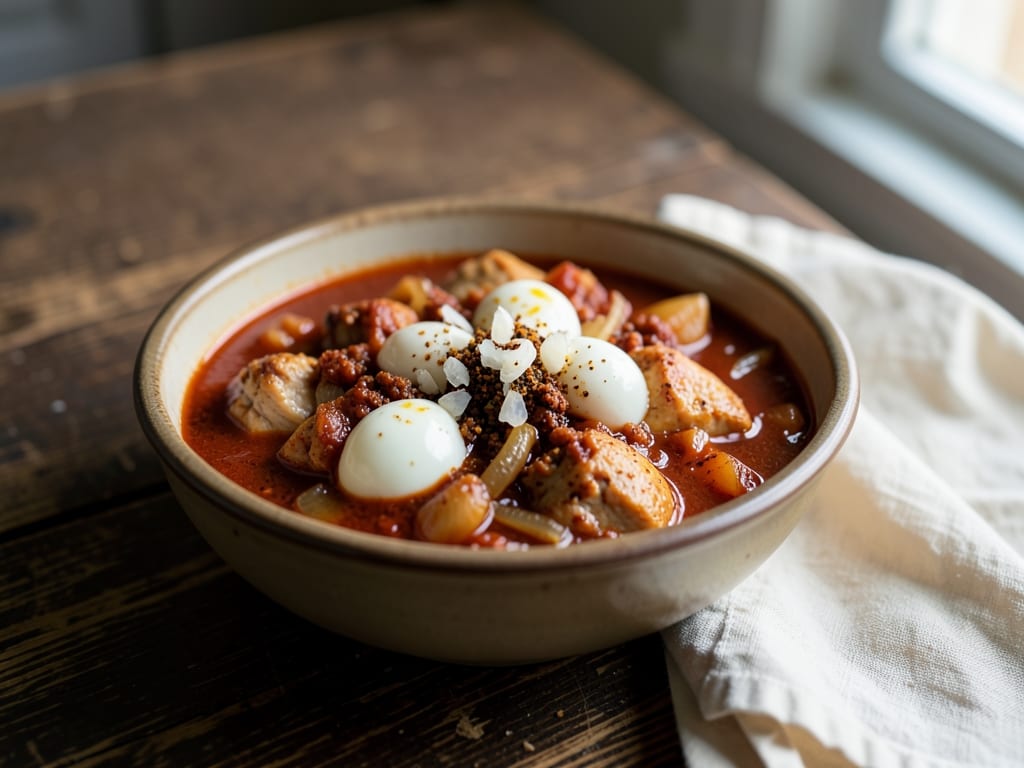
Ethiopian-Style Doro Wat (Spiced Chicken and Egg Stew)
A deep, brick-red stew inspired by Ethiopian doro wat: a mountain of onions cooked down slowly, enriched with spiced clarified butter and berbere, then simmered with tender chicken and soft hard-boiled eggs. Serve with injera or rice.
- Prep
- 35 min
- Cook
- 1 hr 55 min
- Wait
- 56 min
- Total
- 3 hr 26 min
- Makes
- About 6 cups (6 servings)
Steps
Before you start
- Marinate the chicken in lemon juice and salt for at least 30 minutes; this step is built into the timing. This recipe is made entirely on the stovetop, so no oven is needed.
- Berbere brands vary a lot in heat and salt. Start with 3 tbsp for milder or 4 tbsp for medium heat, and add more (up to 5 tbsp total) at the end.
- Chop the onions finely (about ¼ inch / 6 mm) so they melt into the sauce. A food processor, pulsed, works well.
- No niter kibbeh? See substitutions for a quick stand-in.
Marinate the chicken
- Place the chicken in a large bowl.
- Add the lemon juice and 1 tsp kosher salt and turn to coat, rubbing into the meat.
- Cover and refrigerate for 30 minutes.
+ Show details− Hide details
Ready when: Chicken surface looks slightly paler and feels a bit tacky
Tip: Don't go over 2 hours; the acid can make the meat mushy.
Chop aromatics
- Finely chop the onions to about ¼-inch (6 mm) pieces.
- Grate the garlic and ginger and set them aside together.
+ Show details− Hide details
Ready when: Onions are in uniform small pieces
Tip: Pulse onions in a food processor in batches, stopping before they turn to liquid.
Boil the eggs
- Place the eggs in a medium saucepan, cover with 1 inch (2.5 cm) of cold water and bring to a boil over high heat.
- Cover, remove from heat and let stand 11 minutes.
- Drain, cool in ice water for 5 minutes, then peel.
- Gently prick each egg 4–5 times with a toothpick so the sauce can flavor them.
+ Show details− Hide details
Ready when: Yolks are fully set and pale yellow with no gray ring
Tip: Peel under cool running water to prevent tearing the whites.
Dry-cook the onions
- Put the onions and 1 tsp kosher salt in the dry heavy pot over medium heat.
- Cook, stirring every minute or two, for 20 minutes, until the onions have released their liquid, reduced by about half and look soft and translucent.
- Do not let them brown.
+ Show details− Hide details
Ready when: Onions are soft, translucent, and the pot has little standing liquid
Tip: If they begin to stick or brown, lower the heat and add 1 tbsp water.
Add butter and aromatics
- Stir in the niter kibbeh, garlic and ginger.
- Cook, stirring often, for 5 minutes until the garlic and ginger smell fragrant and the onions look glossy.
+ Show details− Hide details
Ready when: Fragrant and glossy, with no raw garlic smell
Bloom berbere
- Stir in 4 tbsp berbere (3 for milder) and the tomato paste.
- Cook over medium-low heat, stirring constantly, for 10 minutes.
- The mixture will thicken into a deep red-brown paste and the oil will begin to separate at the edges.
- Splash in 1–2 tbsp water if it sticks.
+ Show details− Hide details
Ready when: Paste is dark brick red, thick, with red oil pooling at the edges
Tip: Scorched berbere turns bitter, so keep the heat low and keep stirring.
Build the sauce
- Pour in the wine, scraping up any browned bits, and simmer for 2 minutes.
- Add 1½ cups (360 ml) stock and stir well.
- Bring to a gentle boil.
+ Show details− Hide details
Ready when: Sauce is smooth and bubbling gently
Simmer the chicken
- Add the marinated chicken with any juices, turning to coat in the sauce.
- Reduce the heat to low, cover with the lid slightly ajar, and simmer for 45 minutes, stirring and turning the chicken every 15 minutes.
- Add a splash of the extra stock if the sauce becomes too thick to coat a spoon loosely.
+ Show details− Hide details
Ready when: Chicken is very tender and reaches 175°F (80°C) in the thickest part, near the bone
Tip: Keep the simmer lazy; hard boiling toughens the meat.
Add the eggs
- Nestle the peeled eggs into the sauce and spoon sauce over them.
- Simmer uncovered on low for 15 minutes, turning the eggs once, until the sauce is thick, glossy and clings to the chicken, and the eggs are stained reddish-brown.
+ Show details− Hide details
Ready when: Sauce coats a spoon thickly; a trail remains when you drag a spoon across the bottom
Tip: Stir gently so the eggs don't break.
Season and rest
- Taste and add salt, a pinch more berbere, or a squeeze of lemon if needed.
- Turn off the heat and let the stew rest, covered, for 10 minutes.
- Serve hot with injera, flatbread or rice, with an egg and 1–2 pieces of chicken per person.
+ Show details− Hide details
Ready when: Balanced: rich, spicy, slightly tangy
Tip: Doro wat tastes even better the next day.
Good to know
Tips
- Cooking the onions dry first builds the sweet, thick base that defines doro wat. Don't rush it or brown them.
- Bone-in, skinless pieces give body to the sauce while letting it absorb the spice.
- If the sauce is too thin at the end, simmer uncovered a few more minutes; if too thick, loosen with stock.
- Wear gloves or wash hands well after handling berbere and chopped onions.
Make ahead
Make the whole stew up to 3 days ahead; the flavor improves overnight. Cool and refrigerate, then reheat gently with a splash of water or stock.
Storage & reheating
Room temperature: no more than 2 hours. Fridge: airtight container up to 4 days. Freezer: up to 3 months (the eggs turn rubbery, so freeze without them if you can). Reheat gently on the stove over low heat, adding a splash of water or stock, until steaming hot (165°F / 74°C).
Substitutions
- niter kibbeh (spiced clarified butter) → ghee or unsalted butter plus ¼ tsp each ground cardamom, turmeric and fenugreek, and a pinch of cinnamon. Gets close to the spiced flavor; cook 1 extra minute to bloom the spices.
- berbere spice blend → 2 tbsp sweet paprika, 1 tbsp cayenne, ½ tsp each ground ginger, cardamom, cumin and black pepper, and a pinch of cloves. Homemade approximation; adjust cayenne for heat.
- dry white wine or water → water or additional chicken stock. Traditional versions often use tej (honey wine) or water.
- bone-in, skinless chicken drumsticks and thighs → all bone-in thighs. Rich and forgiving, so it is hard to overcook.
More stews
See all →
Find more like this
- Meal
- Dinner
- Cuisine
- Ethiopian
- Main ingredient
- Chicken ThighsEggs
- Method
- Stovetop