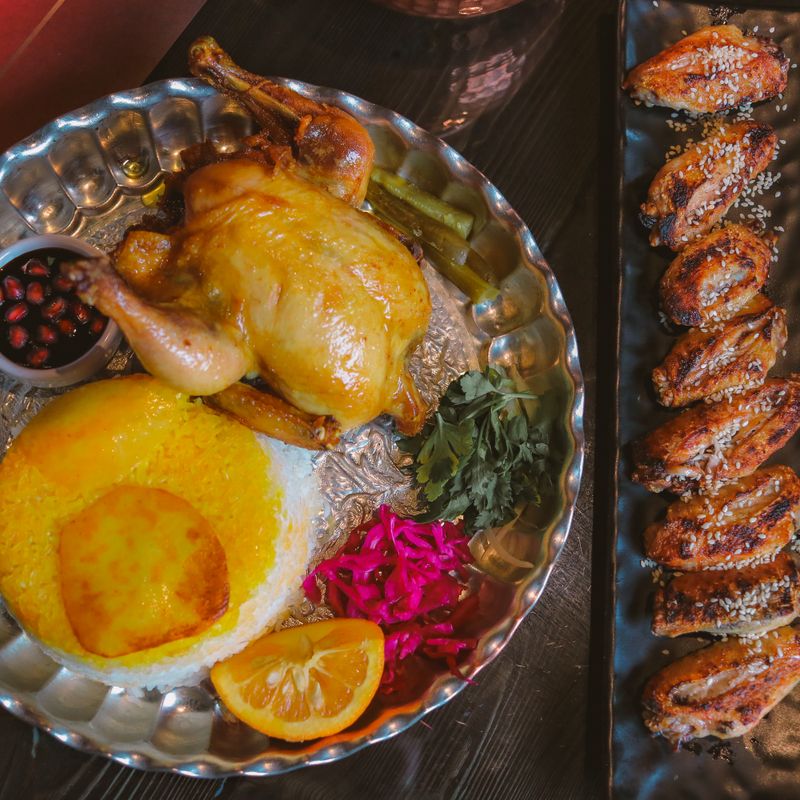
Eid Feast Roasted Chicken and Saffron Manakish
A celebratory Middle Eastern feast featuring a aromatic spiced roasted chicken served alongside saffron-scented manakish flatbread topped with toasted almonds and herbs. The chicken is rubbed with warm spices and lemon, while the manakish dough is enriched with saffron and topped with a fragrant almond and herb mixture. Perfect for Eid gatherings and special occasions.
- Prep
- 30 min
- Cook
- 1 hr 30 min
- Wait
- 1 hr 30 min
- Total
- 3 hr 30 min
- Makes
- 1 whole chicken (serves 4), 4 large manakish pieces
Steps
Before you start
- Remove the chicken from the refrigerator 30 minutes before cooking to bring it to room temperature
- Preheat your oven to 425°F (220°C) 15 minutes before roasting the chicken
- Bloom the saffron threads in hot water while you prepare the dough
- Gather all spices for the chicken rub and measure them out
Prepare the spice rub
- In a small bowl, combine the ground cumin, ground coriander, smoked paprika, ground ginger, ground cinnamon, kosher salt, and freshly ground black pepper.
- Stir until evenly mixed.
- Add the lemon zest and crushed garlic cloves, stirring to create a paste-like mixture.
- Drizzle in the 3 tablespoons of olive oil and mix well until all spices are moistened.
+ Show details− Hide details
Ready when: Spices are evenly moistened and fragrant
Tip: Toast whole spices in a dry pan for 1 minute before grinding to deepen their flavors, if you prefer—it's optional but elevates the dish.
Season and roast the chickenOven 375°F / 190°C
- Pat the whole chicken dry with paper towels.
- Rub the spice mixture generously all over the chicken—under the skin on the breasts and thighs, inside the cavity, and on the wings and legs.
- Squeeze the lemon juice over the bird.
- Place the chicken breast-side up in a 12-inch cast iron or roasting pan.
- Roast in a 425°F (220°C) oven for 15 minutes to set the skin, then reduce the heat to 375°F (190°C) and roast for 50–60 minutes longer, until the juices run clear when you pierce the thigh joint and an instant-read thermometer inserted into the thickest part of the thigh reads 165°F (74°C).
- The skin should be deep golden brown.
- Transfer to a cutting board and rest for 10 minutes before carving.
+ Show details− Hide details
Ready when: Thigh temperature reaches 165°F (74°C), juices run clear, skin is deep golden brown
Tip: Do not skip the 10-minute rest—it allows juices to redistribute, keeping the meat tender and moist.
Bloom the saffron
- While the chicken roasts, place the saffron threads in a small heatproof bowl and pour 3 tablespoons of hot water over them.
- Let steep for 10 minutes until the water becomes a deep golden color and the threads soften.
- Set aside—you will add this to the dough.
+ Show details− Hide details
Ready when: Water is deep golden and threads are softened
Tip: Use hot—not boiling—water so the saffron's delicate flavor is not damaged by excessive heat.
Mix the manakish dough
- In a stand mixer fitted with the dough hook, combine the all-purpose flour, instant yeast, kosher salt, and granulated sugar.
- Add the warm water (105–110°F / 40–43°C), the saffron bloom (threads and liquid), and the 2 tablespoons of olive oil.
- Mix on medium speed for 8–10 minutes until a smooth, elastic dough forms.
- The dough should be soft and slightly tacky but not sticky.
- If using a bowl and hand-kneading, knead for 10–12 minutes on a lightly floured surface until smooth and elastic.
+ Show details− Hide details
Ready when: Dough is smooth, elastic, slightly tacky, and pulls away from the bowl sides
Tip: If the dough is too dry, add water 1 teaspoon at a time. If too wet, add flour by the tablespoon.
First rise of dough
- Transfer the dough to a lightly oiled large bowl, turning it to coat.
- Cover with a damp kitchen towel or plastic wrap.
- Let rise in a warm, draft-free spot for 45–50 minutes until roughly doubled in size.
- The dough should spring back slowly when poked gently with a floured finger.
+ Show details− Hide details
Ready when: Dough has risen noticeably and springs back slowly when poked
Tip: Place the bowl in a warm spot—near (not on) a sunny window, or inside an oven with the light on.
Prepare the topping
- While the dough rises, toast the sliced almonds in a dry skillet over medium heat for 3–4 minutes, stirring frequently, until fragrant and lightly golden.
- Transfer to a bowl and let cool.
- Add the dried sumac, finely chopped fresh parsley, and salt.
- Drizzle with the 2 tablespoons of olive oil and toss gently.
- Taste and adjust salt if needed.
- Set aside until ready to top the manakish.
+ Show details− Hide details
Ready when: Almonds are fragrant and lightly golden brown
Tip: Keep your eyes on the almonds—they can go from golden to burnt quickly.
Shape and second rise
- Lightly flour a work surface.
- Punch down the risen dough and divide it into 4 equal pieces.
- Roll or stretch each piece into a long oval or rectangle approximately 10×6 inches (25×15 cm) and about ¼ inch (6 mm) thick.
- Place each on a parchment-lined 10×14-inch baking sheet, leaving room for them to expand slightly.
- Cover loosely with a damp towel and let rise for 20–25 minutes until puffy and light to the touch.
+ Show details− Hide details
Ready when: Dough pieces are puffy and spring back slowly when lightly pressed
Tip: If your kitchen is very cool, place the baking sheets inside the oven with just the light on.
Top the manakish and bakeOven 400°F / 205°C
- Preheat the oven to 400°F (200°C).
- Once the dough pieces have risen, dimple the surface of each oval gently with your fingertips to create slight wells (this is characteristic of manakish).
- Scatter the almond-sumac topping evenly over each piece.
- Bake for 12–15 minutes on the middle oven rack until the edges are golden brown and the topping is fragrant.
- The manakish should sound slightly hollow when tapped on the bottom.
- Remove from the oven and let cool on a wire rack for 5 minutes before serving.
+ Show details− Hide details
Ready when: Edges are golden brown, topping is fragrant, bottom sounds slightly hollow when tapped
Tip: Do not overbake—manakish dries out quickly. Remove as soon as the edges turn golden.
Serve the feast
- Carve the rested chicken and arrange on a serving platter.
- Serve the warm manakish alongside, cut into quarters or halves.
- Drizzle any pan juices from the roasted chicken over the meat.
- Offer fresh herbs, lemon wedges, and additional sumac on the side for guests to customize their plates.
+ Show details− Hide details
Tip: Manakish is best served warm but is also delicious at room temperature, making it ideal for a buffet-style feast.
Good to know
Tips
- For a truly special presentation, serve the manakish slightly warm on a wooden board alongside the carved chicken, allowing guests to tear pieces and enjoy them with the meat.
- If you don't have a stand mixer, hand-kneading the dough is entirely feasible and takes only 10–12 minutes. The rhythm is meditative and perfect for celebration day preparations.
- The saffron gives the manakish dough a subtle golden hue and delicate flavor—do not skip this step, as it ties the dish to the celebration theme.
- Make the almond-sumac topping your own: add a pinch of za'atar, a small crumbling of feta cheese, or a scatter of pomegranate seeds for extra festive color and flavor variation.
Make ahead
The dough can be made up to 8 hours ahead, covered, and refrigerated. Let it come to room temperature (about 30 minutes) before shaping. The spice rub for the chicken can be prepared up to 1 day in advance and stored in an airtight container. The almond-sumac topping can be assembled 2 hours ahead, covered, and kept at room temperature.
Storage & reheating
Leftover chicken keeps in an airtight container in the refrigerator for up to 3 days; reheat gently in a 325°F (160°C) oven for 15–20 minutes. Leftover manakish keeps at room temperature in an airtight container for 1 day, or refrigerated for up to 2 days. Reheat wrapped in foil at 300°F (150°C) for 10 minutes. Both freeze well separately for up to 1 month; thaw overnight in the refrigerator before reheating.
Substitutions
- saffron threads → 1 teaspoon of turmeric plus a pinch of ground cardamom. Turmeric provides color and earthy warmth, though it lacks saffron's subtle floral notes. Add a tiny pinch of cardamom to approximate the complexity.
- dried sumac → finely grated zest of 1 lemon plus a pinch of salt. Lemon zest provides tartness and brightness. Mix well with the salt to ensure even distribution.
- sliced almonds → pine nuts or roughly chopped pistachios. Both offer a similar buttery richness and are traditional in the region. Pistachios add a subtle earthiness.
- fresh flat-leaf parsley, finely chopped → fresh mint or a mixture of mint and cilantro. Mint or cilantro offers a fresher, more herbaceous flavor and is equally authentic in Middle Eastern flatbreads.
More manakish
See all →



Find more like this
- Meal
- Dinner
- Cuisine
- Middle Eastern
- Main ingredient
- LemonsWhole Chicken
- Diet
- Dairy-FreeHalal
- Occasion
- EidFamily Gatherings