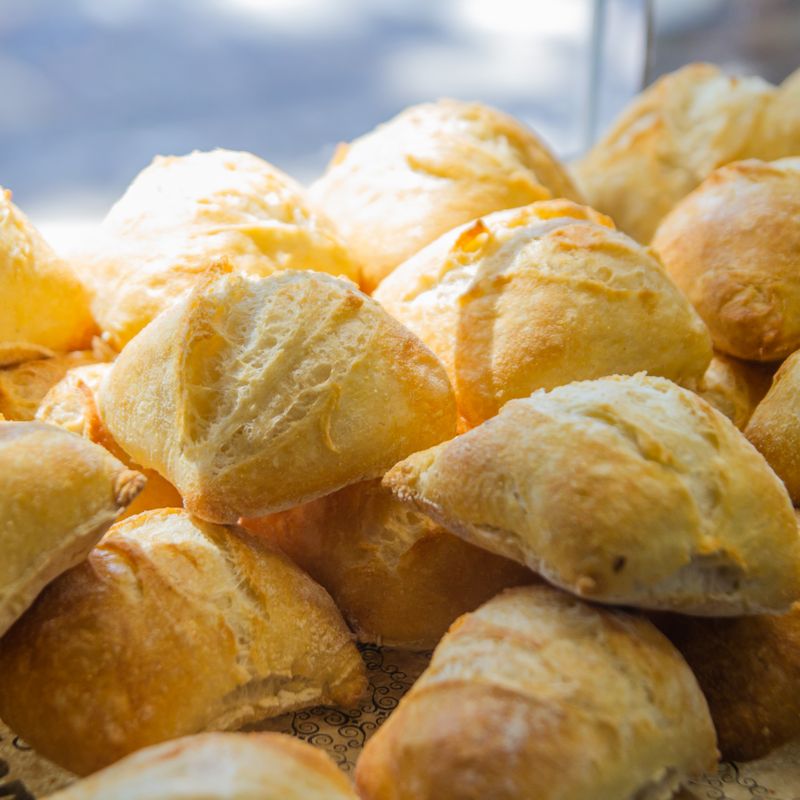
Egyptian Eish Baladi Rolls
Soft, nutty whole wheat rolls inspired by Egypt's everyday eish baladi. Each one is rolled in wheat bran and baked in a very hot oven so it puffs, browns and forms a chewy crust with a tender inside. They're perfect for scooping up ful, dipping in dukkah or stuffing with falafel.
- Prep
- 38 min
- Cook
- 13 min
- Wait
- 2 hr
- Total
- 2 hr 51 min
- Makes
- 8 rolls, about 4 inches (10 cm) wide
Steps
Before you start
- Plan on about 3 hours from start to finish, most of it hands-off rising time.
- Use instant (rapid-rise) yeast. If you only have active dry yeast, use the same amount and give it the full 10 minutes to foam in step 1.
- Put a heavy baking sheet or baking steel on the lowest oven rack before you preheat. The hot surface helps the rolls puff.
- The dough should feel soft and slightly tacky. Whole wheat flour and bran absorb water slowly, so don't add extra flour while kneading.
Foam the yeast
- Pour the 1¼ cups (300 ml) warm water into a large mixing bowl.
- Whisk in the instant yeast and sugar.
- Let it sit for 5 minutes.
+ Show details− Hide details
Ready when: The surface looks creamy and foamy, with small bubbles across the top and a yeasty smell.
Tip: If nothing foams after 10 minutes, the yeast is dead or the water was too hot or cold. Start again with fresh yeast.
Mix the dough
- Add the whole wheat flour, ½ cup (30 g) bran and salt to the yeast water.
- Stir with a wooden spoon or your hand for about 2 minutes, until no dry flour remains and you have a shaggy, sticky dough.
+ Show details− Hide details
Ready when: No dry flour is left and the dough forms a rough, sticky mass.
Tip: Add the salt on top of the flour, not directly onto the yeast water, so it doesn't slow the yeast.
Knead until elastic
- Turn the dough onto a lightly wet (not floured) counter.
- Knead for 8 to 10 minutes, pushing it away with the heel of your hand, folding it back and turning it a quarter turn.
- Wet your hands if it sticks.
- You can also knead for 6 to 8 minutes in a stand mixer with a dough hook on medium-low.
+ Show details− Hide details
Ready when: The dough is soft, slightly tacky and springs back slowly when you poke it. It forms a smooth, cohesive ball even though it feels a little rough from the bran.
Tip: Resist adding extra flour. Too much makes the rolls dense and dry.
First rise
- Grease a clean large bowl with the oil.
- Add the dough and turn it once to coat.
- Cover with a towel or plastic wrap.
- Leave it in a warm spot, 75–80°F (24–27°C), for 60 minutes.
+ Show details− Hide details
Ready when: The dough is nearly doubled in size and a floured finger poke leaves a dent that fills back in slowly.
Tip: In a cool kitchen, set the bowl in the oven with only the light on. It may need up to 90 minutes.
Divide and shape
- Turn the risen dough onto an unfloured counter.
- Divide it into 8 equal pieces, about 95 g each, using a scale if you have one.
- Shape each piece into a tight ball.
- Cup your hand over the dough and roll it in small circles on the counter until the surface is smooth and taut.
+ Show details− Hide details
Ready when: Each ball is smooth and tight on top, with the seam pinched closed underneath.
Tip: Keep unshaped pieces covered so they don't form a dry skin.
Coat, flatten and proofOven 475°F / 245°C
- Line a sheet of parchment on a large board or the back of a baking sheet.
- Press the top and bottom of each ball into the plate of bran so both sides are well coated.
- Set the balls on the parchment about 2 inches (5 cm) apart.
- Flatten each ball gently with your palm to a disc about 3½ inches (9 cm) wide and ¾ inch (2 cm) thick.
- Cover loosely with a towel and let rise for 40 minutes.
- At the 10-minute mark, put your baking sheet or steel on the lowest rack and preheat the oven to 475°F (245°C) so it is very hot by baking time.
+ Show details− Hide details
Ready when: The discs look visibly puffy and about 1½ times thicker, and a gentle poke springs back slowly.
Tip: Don't over-proof. Overly puffy rolls will deflate when you move them.
Bake hotOven 475°F / 245°C
- Carefully slide the parchment with the rolls onto the hot baking sheet or steel.
- Bake on the lowest rack at 475°F (245°C) for 12 to 14 minutes.
- The rolls will puff and the bran will toast.
+ Show details− Hide details
Ready when: The rolls are puffed and deep golden brown, with darker toasted spots. They sound hollow when you tap the bottom, and the internal temperature is about 200°F (93°C).
Tip: Don't open the oven in the first 8 minutes, or the rolls may not puff. If the bottoms brown faster than the tops, move the sheet up one rack for the last 3 minutes.
Cool and soften
- Move the rolls to a wire rack.
- Let them cool for 15 minutes so the crumb sets.
- For softer crusts, cover them with a clean towel while they cool.
- Serve warm.
+ Show details− Hide details
Ready when: The rolls are warm rather than hot, and the crust has softened slightly under the towel.
Tip: Cutting into them too soon makes the crumb gummy.
Good to know
Tips
- Weigh the flour and water. Whole wheat flour varies a lot by cup, and the 75% hydration is what keeps these soft.
- The very hot baking surface gives the rolls oven spring and the characteristic puff.
- For pocket-style bread, roll the discs thinner, about ¼ inch (6 mm), proof briefly and bake right away on the hot steel.
- Brush the rolls lightly with water before the bran coating if the bran doesn't stick well.
Make ahead
"After kneading, you can refrigerate the dough in the oiled, covered bowl for up to 24 hours. Let it sit at room temperature for 45 minutes, then shape, coat and proof as written, allowing 45 to 60 minutes for the final rise."
Storage & reheating
"Room temperature: keep in a bag or airtight container for up to 2 days. Freezer: wrap tightly and freeze for up to 3 months. Reheat: warm at 350°F (175°C) for 5 to 8 minutes, from frozen for 10 to 12 minutes, or toast cut sides in a dry skillet."
Substitutions
- instant yeast → Active dry yeast, same amount. Let it foam fully in the warm water, about 10 minutes, before adding the flour.
- wheat bran → Extra whole wheat flour, 30 g. The rolls will be a little less rustic and nutty. Coating still works with bran, or use coarse cornmeal.
- granulated sugar → Honey, ¼ tsp. Gives the yeast a little food. Dissolve it fully in the water.
- olive oil or neutral oil → Any neutral oil, such as sunflower. The oil is only for greasing the bowl, so any oil works.