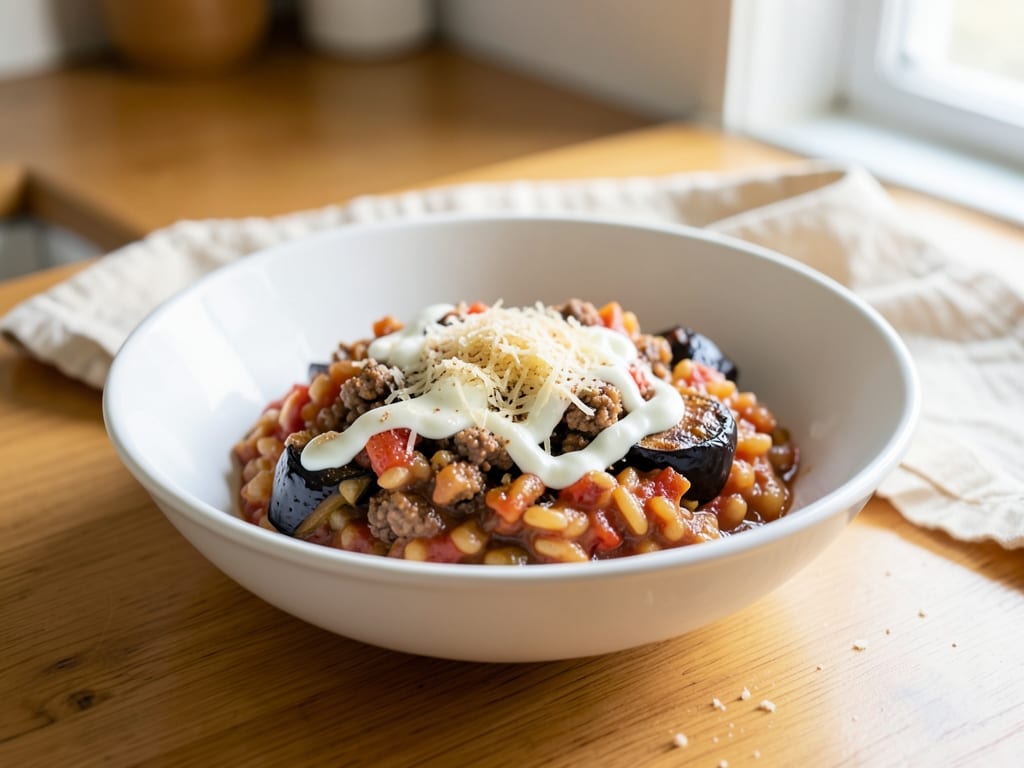
Eggplant Moussaka Risotto
All the flavors of Greek moussaka in a creamy stovetop risotto: seared eggplant, cinnamon-spiced beef and tomato, finished with a nutmeg-scented Parmesan and Greek yogurt swirl that stands in for béchamel.
- Prep
- 25 min
- Cook
- 55 min
- Wait
- 33 min
- Total
- 1 hr 53 min
- Makes
- 4 generous main-course servings (about 2 cups / 450 g each)
Steps
Before you start
- Salting the eggplant needs 30 minutes, so start there; the rest of the prep happens while it drains.
- Heat the broth in a saucepan and keep it at a bare simmer the whole time; cold broth slows the rice and makes it gummy.
- Measure and chop everything before you start the risotto, because once the rice goes in you need to stir almost constantly.
- Use a wide, heavy 12-inch (30 cm) deep skillet or a 4-quart (3.8 L) heavy-bottomed pot so the rice cooks in an even layer. This recipe is entirely stovetop; no oven is needed.
Salt the eggplant
- Toss the eggplant cubes with 1 tsp kosher salt in a colander set over a bowl or the sink.
- Let them drain for 30 minutes, then press firmly between clean kitchen towels or paper towels to remove as much liquid as possible.
+ Show details− Hide details
Ready when: Cubes look slightly shrunken and the towel comes away damp
Tip: Do not skip the pressing; wet eggplant will not brown and soaks up too much oil.
Heat the broth
- Pour the broth into a medium saucepan and bring to a bare simmer over medium-low heat.
- Keep it hot, with the ladle nearby, for the whole recipe.
+ Show details− Hide details
Ready when: Small bubbles break at the edges, with a little steam
Tip: Boiling hard reduces the broth and makes the risotto salty.
Sear the eggplant
- Heat 3 tbsp olive oil in the 12-inch skillet or heavy-bottomed pot over medium-high heat until it shimmers.
- Add the eggplant in a single layer (work in two batches if crowded) and cook, stirring every minute or so, for 7 to 8 minutes.
- Transfer to a plate.
+ Show details− Hide details
Ready when: Cubes are deep golden brown on most sides and tender when pressed with a spoon
Tip: Leave the browned bits in the pot; they flavor the sauce.
Brown the beef
- In the same pot over medium-high heat, add the ground beef and break it into small crumbles.
- Cook 5 minutes, undisturbed for the first 2 minutes, until browned and the liquid has evaporated.
- If there is more than 2 tbsp fat, spoon off the excess.
+ Show details− Hide details
Ready when: Beef is browned with no pink remaining and the pan sizzles rather than bubbles
Build the sauce base
- Reduce heat to medium.
- Add the onion and ½ tsp salt and cook, stirring, for 4 minutes until soft.
- Stir in the garlic, tomato paste, cinnamon, oregano and allspice and cook 1 to 2 minutes.
- Pour in the crushed tomatoes and simmer 5 minutes until thickened and jammy.
+ Show details− Hide details
Ready when: Tomato paste darkens to brick red and the sauce leaves a trail when you drag a spoon across the pan
Tip: Stir constantly once the spices go in so the cinnamon does not scorch.
Toast the rice
- Add the arborio rice to the pot and stir for 2 minutes so each grain is coated in the sauce and the edges turn translucent.
+ Show details− Hide details
Ready when: Grain edges look translucent with a small white dot in the center
Deglaze with wine
- Pour in the red wine and add the bay leaf.
- Stir until the wine is almost completely absorbed, about 2 minutes, scraping up any browned bits from the bottom.
+ Show details− Hide details
Ready when: No pool of liquid remains and the wine smell is no longer sharp
Add broth gradually
- Add 1 cup (240 ml) hot broth and stir often, keeping a steady gentle bubble.
- When the rice is nearly dry and a spoon drawn across the bottom leaves a clear trail, add another ladleful (about ¾ cup / 180 ml).
- Repeat for 22 to 25 minutes, until about 4½ cups of broth have been used.
+ Show details− Hide details
Ready when: Rice is creamy and loose but the grains are tender with a slight bite in the center when tasted
Tip: If the rice sticks or the liquid vanishes quickly, lower the heat slightly.
Fold in eggplant
- Stir the seared eggplant back into the risotto with the remaining ½ cup broth.
- Cook 2 minutes, then remove the bay leaf.
- The risotto should flow slowly when you tilt the pot; add a splash of water if it looks thick.
+ Show details− Hide details
Ready when: Risotto spreads into a loose, creamy pool rather than holding a mound
Finish and rest
- Remove the pot from the heat.
- Vigorously stir in the butter, Parmesan, nutmeg and a few grinds of pepper for 1 minute.
- Gently swirl in the yogurt just until marbled.
- Cover and rest 3 minutes, then taste and adjust salt.
+ Show details− Hide details
Ready when: Glossy, creamy, with white yogurt ribbons visible
Tip: Add the yogurt off the heat or it can curdle.
Serve
- Spoon into warm shallow bowls and sprinkle with parsley and extra Parmesan.
- Serve immediately, since risotto thickens as it sits.
Good to know
Tips
- Use a wide pot: a shallow layer of rice cooks more evenly and the broth absorbs predictably.
- Taste the rice at 18 minutes; stop adding broth when the center is just tender with a slight bite.
- Go light on the cinnamon and allspice at first; they should be a warm background note, not dominate.
- Grate the Parmesan fresh; pre-grated cheese can make the risotto grainy.
Make ahead
Salt and press the eggplant, then sear it up to 1 day ahead and refrigerate. The meat sauce through the sauce-base step can be made 2 days ahead; reheat before adding the rice. Risotto itself is best made fresh.
Storage & reheating
Room temperature: up to 1 hour. Fridge: airtight container up to 3 days. Freezer: up to 2 months (texture softens). Reheat in a skillet over medium-low heat with a splash of broth or water, stirring until hot and creamy, to 165°F (74°C).
Substitutions
- ground beef (85% lean) → ground lamb. Closer to traditional moussaka; cook to 160°F (71°C).
- dry red wine → extra broth plus 1 tsp red wine vinegar. Replaces the acidity without alcohol.
- full-fat Greek yogurt → mascarpone or crème fraîche. Richer and less tangy; stir in the same way off the heat.