Curried Pumpkin and Coconut Soup
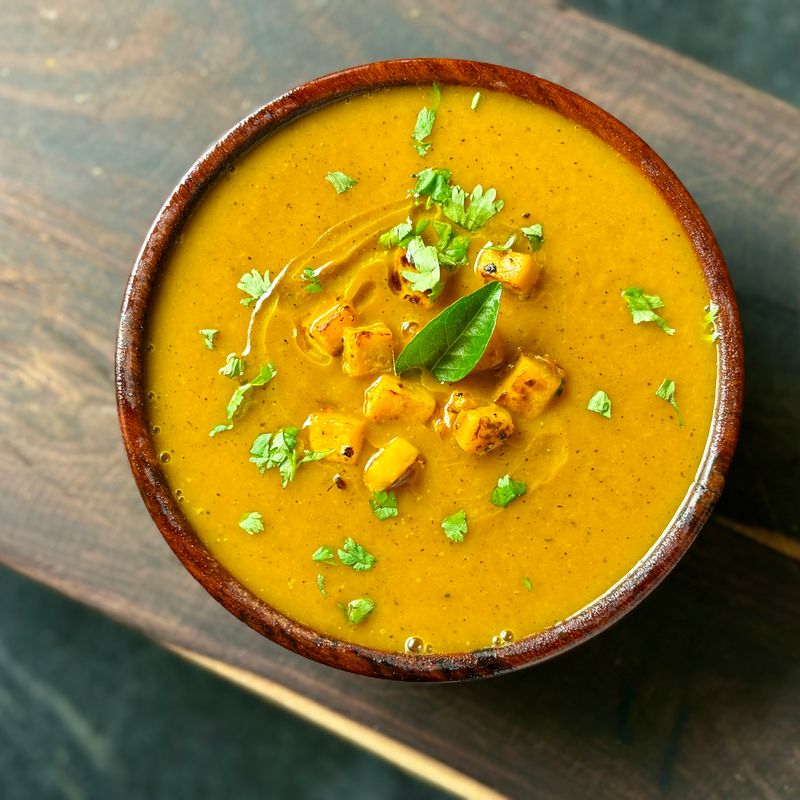
A fragrant, velvety soup that brings together roasted pumpkin, earthy curry spices, and rich coconut milk. The aromatics—caramelized onion, garlic, and fresh ginger—are bloomed with curry powder to deepen their flavors, then simmered with tender pumpkin until silky. A squeeze of lime brightens the richness. Indian-inspired, entirely vegetarian, and deeply comforting.
- Prep
- 15 min
- Cook
- 24 min
- Wait
- 31 min
- Total
- 1 hr 10 min
- Makes
- About 5 cups (1.2 liters), serves 4 as a main course or 6 as a starter
Steps
Before you start
- Gather and prep all ingredients before you start cooking—especially the pumpkin, which takes time to cut into cubes.
- Make sure you have a large (4–5 quart) pot to accommodate the soup and room for blending.
- Have vegetable or chicken broth available; store-bought low-sodium broth works well.
- A sturdy vegetable peeler or sharp knife makes quick work of peeling pumpkin.
Prep pumpkin and aromatics
- Peel the pumpkin with a sturdy vegetable peeler or sharp knife.
- Cut it in half, scoop out the seeds, and cut the flesh into 1-inch (2.5 cm) cubes—you should have about 4 cups (600 g).
- Dice the onion into ½-inch (1.25 cm) pieces.
- Mince the garlic cloves into small pieces.
- Peel the ginger and mince it finely (roughly ⅛ inch / 3 mm).
- Have all ingredients measured and ready.
+ Show details− Hide details
Tip: Cutting pumpkin is easier if you use a sturdy Y-shaped vegetable peeler; a sharp chef's knife also works well. Cut pumpkin into equal-sized cubes so all pieces cook evenly.
Sauté onions until soft
- Heat 2 tablespoons (30 ml) of oil in a large 4–5 quart (3.8–4.7 liter) pot over medium heat.
- Once the oil is shimmering, add the diced onion.
- Cook, stirring occasionally, for 5–6 minutes until the onion is softened, translucent, and just beginning to caramelize at the edges.
- The onion should smell sweet and sweet-savory, not raw.
+ Show details− Hide details
Ready when: Onion is fully translucent, soft, and beginning to turn golden at the edges.
Cook garlic and ginger
- Add the minced garlic and ginger to the pot.
- Stir constantly for 1–2 minutes until the mixture is very fragrant and the raw edge is gone.
- You should smell warm, pungent garlic and spice.
- Do not let the garlic brown; if it starts to, reduce heat slightly.
+ Show details− Hide details
Ready when: Aromatics are very fragrant; garlic looks pale and soft, ginger is translucent.
Tip: Stir constantly to prevent browning, which creates a bitter flavor and overpowers the subtle spice.
Bloom curry powder
- Add 2 teaspoons (10 g) of curry powder to the pot.
- Stir constantly for about 1 minute, allowing the spices to toast slightly in the oil and release their aromatic oils.
- The mixture should smell warm, rounded, and much more fragrant than raw curry powder.
- This blooming step is crucial for developing depth of flavor.
+ Show details− Hide details
Ready when: Spices smell warm and fragrant, no longer smell raw or dusty.
Tip: Don't skip this step. This 1-minute bloom transforms the spice flavor from raw and flat to warm and rounded. The oil carries the flavors and makes them sing.
Add pumpkin and broth
- Pour in 4 cups (950 ml) of vegetable or chicken broth.
- Add all the pumpkin cubes to the pot and stir well to combine and submerge the pumpkin as much as possible.
- Increase the heat to medium-high and bring the mixture to a boil.
- This should take 2–3 minutes.
+ Show details− Hide details
Ready when: Mixture reaches a rolling boil with steam rising steadily.
Simmer pumpkin 30 minutes
- Once boiling, reduce the heat to medium-low so the soup simmers gently.
- Partially cover the pot (leave the lid slightly ajar to allow steam to escape).
- Simmer for 25–30 minutes, stirring occasionally (every 8–10 minutes), until the pumpkin is very soft and easily breaks apart with the back of a spoon.
- The broth will absorb the pumpkin's sweetness and become slightly thicker and more golden.
+ Show details− Hide details
Ready when: Pumpkin pieces break apart easily when pressed with a spoon; broth is slightly thickened and golden.
Tip: If you notice the soup is reducing too much (evaporating rapidly), cover it fully. If it seems too thin at the end, simmer uncovered a few minutes longer to reduce.
Blend to desired texture
- Remove the pot from heat and let it cool for 1–2 minutes.
- You now have three texture options: (A) for smooth, silky soup, use an immersion blender and blend thoroughly until no chunks remain, about 3–5 minutes; (B) for a chunkier, more rustic texture, blend partially, leaving some whole pumpkin pieces, about 2 minutes; (C) for fully chunky soup, skip blending and go directly to step 8.
- If using a regular blender instead of an immersion blender, carefully transfer the soup in batches (fill only halfway to avoid steam pressure), blend, and return to the pot.
+ Show details− Hide details
Ready when: Soup reaches your desired texture (smooth, chunky, or somewhere in between).
Tip: If using a regular blender, fill it only halfway with hot liquid to avoid the lid blowing off from steam pressure. Always blend away from your face.
Stir in coconut milk
- Open the can of coconut milk and pour it entirely into the pot, including both the thick cream on top and the thinner liquid below.
- Stir well with a wooden spoon or spatula, breaking up any clumps of coconut cream until it's fully incorporated and the soup is an even color and consistency.
- Do not heat yet.
+ Show details− Hide details
Ready when: Coconut milk is fully incorporated; soup is uniform in color (no streaks of white cream visible).
Tip: Full-fat coconut milk gives the best richness and velvety texture. Don't use lite coconut milk, which will produce a thin, watery soup.
Season and add brightness
- Taste the soup.
- Add salt, starting with ½ teaspoon (3 g), then tasting and adding more if needed—remember, you can always add more salt, but you cannot remove it.
- Grind in fresh black pepper to taste (a few good grinds, roughly ¼ teaspoon).
- Now squeeze the juice of 1 lime (about 2 tablespoons / 30 ml juice) into the pot.
- The lime juice adds brightness and cuts through the richness of the coconut, balancing all the flavors.
- Stir well and taste again, adjusting any seasoning.
+ Show details− Hide details
Ready when: Soup is well-seasoned, with bright citrus notes balancing the creamy, spiced flavors.
Tip: Lime juice is essential—it prevents the soup from tasting heavy and one-dimensional. Add it gradually; you can always add more, but you can't remove citrus acidity.
Warm through and serve
- Return the pot to medium heat and simmer gently for 2–3 minutes, stirring occasionally, to ensure all the flavors meld together and the soup is heated through.
- If the soup is too thick (it should be pourable but creamy), stir in more broth ¼ cup at a time until you reach the desired consistency.
- If it's too thin, simmer uncovered for 5 more minutes to reduce slightly.
- Ladle into bowls and serve hot, optionally garnished with fresh cilantro, a drizzle of oil, or a lime wedge.
+ Show details− Hide details
Ready when: Soup is heated through and steaming; flavors are well-balanced and rounded.
Tip: If the soup has thickened in storage or sitting, just add more broth to loosen it to your preferred consistency. This soup thickens slightly as it cools.
Good to know
Tips
- Cut the pumpkin into equal-sized 1-inch cubes so all pieces cook at the same rate and become tender at the same time.
- Don't skip the blooming step. This 1-minute toasting of curry powder in hot oil transforms the flavor from raw and dusty to warm, complex, and deeply fragrant. It's one of the most important steps in the recipe.
- Use full-fat canned coconut milk for the best texture and richness. Lite coconut milk will produce a thin, watery soup lacking the creamy mouthfeel that makes this dish special.
- Lime juice is essential for balance. It prevents the soup from tasting heavy and one-dimensional, brightening the rich coconut and spices. Add it just before serving for maximum impact.
Make ahead
This soup is excellent for advance preparation. Make it through step 9 (seasoning), then cool completely and refrigerate for up to 3 days or freeze for up to 3 months. To reheat: Thaw overnight in the refrigerator (if frozen), then warm on the stovetop over medium heat, stirring occasionally, until heated through. The soup may thicken slightly upon storage; thin it with additional broth as needed. The flavors deepen slightly after a day or two.
Storage & reheating
Room temperature: Up to 2 hours (refrigerate within 1 hour for food safety). | Refrigerator: Up to 3 days in an airtight container. | Freezer: Up to 3 months in a freezer-safe container (leave about 1 inch / 2.5 cm headspace to allow for expansion). | To reheat: Thaw overnight in the fridge. Warm on the stovetop over medium heat, stirring occasionally, until steaming throughout. Add extra broth if the soup has thickened. Alternatively, reheat in the microwave in a microwave-safe bowl, stirring every 2 minutes.
Substitutions
- curry powder → Spice blend: 1 teaspoon ground cumin, ½ teaspoon ground coriander, ¼ teaspoon ground turmeric, and a pinch of cayenne pepper. This mimics the flavor profile of curry powder if you prefer to use individual spices or want to adjust heat level.
- pumpkin or winter squash (such as butternut), peeled, seeded → Butternut squash, kabocha squash, acorn squash, or delicata squash. Any orange winter squash works well; the flavor will be slightly different but equally delicious. Butternut squash is most similar.
- full-fat canned coconut milk → Heavy cream, sour cream, or cashew cream (made by blending soaked cashews with water). Heavy cream will make a richer, less coconut-forward soup. Cashew cream gives similar richness with a more neutral flavor. Use the same volume.
- fresh ginger root → Ground ginger (use 1 teaspoon dried instead of 1 tablespoon fresh). Ground ginger is more potent, so use less. The fresh version has a brighter, more vibrant flavor, but ground ginger works in a pinch.