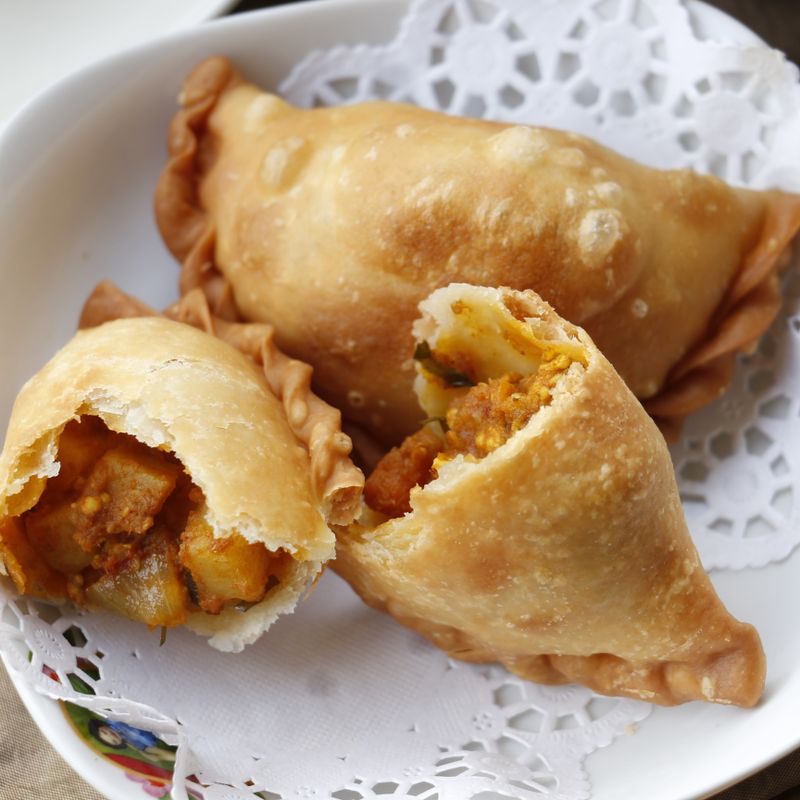
Crispy Taro Puffs with Pork and Shallot Filling (Wu Gok)
Fluffy, lacy-crisp shells of mashed taro and wheat starch hide a savory filling of pork, shallots and shiitake. These are the classic dim sum teahouse puffs, made at home with a thermometer, a pot and a little patience.
- Prep
- 59 min
- Cook
- 57 min
- Wait
- 38 min
- Total
- 2 hr 34 min
- Makes
- 12 puffs (about 2 per serving)
Steps
Before you start
- Buy about 550 g (1¼ lb) of unpeeled large taro to get 450 g (1 lb) peeled. Raw taro can irritate skin, so wear disposable gloves or rub a little oil on your hands when peeling.
- Wheat starch (also called Tang flour) is not wheat flour and cannot be replaced one-for-one with it. Look for it in Asian grocery stores.
- Read the whole recipe first. The dough is soft and sticky, so keep a small bowl of wheat starch and a clean tray nearby for shaping.
- You need a deep-fry or candy thermometer for the oil and an instant-read thermometer to confirm the pork filling reaches 160°F (71°C). Oil that is too cool makes greasy puffs, and oil that is too hot browns the shell before the center heats through.
Soak mushrooms, prep taro
- Put the dried shiitake in a heatproof bowl, cover with 1 cup (240 ml) hot tap water and a small plate to keep them submerged, and soak 20 minutes.
- Meanwhile, wearing gloves, peel the taro with a knife or sturdy peeler, rinse, pat dry, and cut into ½-inch (1.25 cm) slices.
- Cut any very wide slices in half so the pieces cook evenly.
+ Show details− Hide details
Ready when: Mushroom caps are pliable all the way through with no hard, pale center
Tip: Peeled taro can feel slimy. Pat it dry so it steams and mashes cleanly.
Steam the taro
- Arrange the taro slices in a single layer, slightly overlapping if needed, on a heatproof plate.
- Bring about 2 inches (5 cm) of water to a boil in the steamer, set the plate on the rack, cover, and steam over medium-high heat for 25 minutes.
- Top up with boiling water if the pot runs low.
+ Show details− Hide details
Ready when: A chopstick slides into the thickest slice with no resistance, and the edges crumble slightly
Tip: Under-steamed taro leaves lumps in the dough that can tear the shells while frying.
Cook the filling
- Squeeze the mushrooms dry, discard the stems, and mince the caps.
- Stir the cornstarch into 3 tablespoons (45 ml) of the strained soaking liquid.
- Heat the cooking oil in a large nonstick skillet over medium-high heat until shimmering.
- Add the shallots and stir for 1 to 2 minutes until soft and fragrant but not browned.
- Add the pork and mushrooms, breaking the meat into small crumbs, and cook 3 to 4 minutes until no pink remains.
- Add the Shaoxing wine, oyster sauce, soy sauce, sugar and white pepper and stir 30 seconds.
- Stir the cornstarch mixture again, pour it in, and cook 30 to 60 seconds until the sauce turns glossy and clings to the meat.
- Check with an instant-read thermometer that the ground pork reads at least 160°F (71°C) in several spots.
- Off the heat, stir in the sesame oil.
+ Show details− Hide details
Ready when: Ground pork reads at least 160°F (71°C) on an instant-read thermometer, the sauce is thick and glossy, and there is no liquid pooling in the pan
Tip: Keep the filling fairly dry. Wet filling steams inside the puff and can burst the shell in the fryer.
Cool filling and taro
- Spread the filling on a plate in a thin layer and refrigerate 15 minutes until cool and firm enough to scoop.
- Leave the steamed taro on its plate, uncovered, to cool a little and release steam.
- It should be hot but comfortable to touch for the next step.
+ Show details− Hide details
Ready when: Filling is cool to the touch and holds together when pressed
Tip: Do not skip the cooling. Hot filling softens the dough and makes sealing difficult.
Make the taro dough
- Put the wheat starch in a large heatproof bowl.
- Pour in the boiling water and stir hard with chopsticks or a spatula for about 30 seconds until it forms a thick, translucent paste with no dry white patches.
- Add the warm taro and mash with a potato masher until almost smooth, then add the lard, sugar, salt and five-spice.
- Knead in the bowl with lightly starch-dusted hands for 2 to 3 minutes until it forms a smooth, soft, slightly sticky dough that holds a shape.
- You should have about 600 g.
+ Show details− Hide details
Ready when: Dough is smooth, with no visible taro lumps, and pulls cleanly off the bowl as one mass
Tip: Work while the taro is still warm. Cold taro makes a stiff, crumbly dough. If it sticks to your hands, dust them with a pinch of wheat starch.
Shape the puffs
- Divide the dough into 12 pieces of about 50 g each and roll into balls.
- Dust a tray with wheat starch.
- Working with one ball at a time, press it into a 3-inch (7.5 cm) disc in your palm, thinner at the edges than the center.
- Place 1 heaping tablespoon (about 16 g) of filling in the middle, bring the edges up around it, and pinch the seam closed.
- Roll gently between your palms and taper the ends into an egg or football shape about 3 inches (7.5 cm) long.
- Set seam-side down on the lined tray.
+ Show details− Hide details
Ready when: Each puff is smooth, fully sealed, with no filling visible and no cracks
Tip: If a crack forms, patch it with a pinch of dough and smooth with a damp fingertip. Cover finished puffs with a barely damp towel so they don't dry out.
Heat the frying oil
- Pour the frying oil into a heavy 4-quart (3.8 L) pot so it is about 2 inches (5 cm) deep.
- Clip on the thermometer and heat over medium heat to 350°F (175°C), about 8 minutes.
- Adjust the heat to hold the temperature steady.
+ Show details− Hide details
Ready when: Thermometer reads 350°F (175°C)
Tip: Never leave hot oil unattended, and keep the oil at least 3 inches (7.5 cm) below the rim of the pot to prevent overflow.
Fry in batches
- Lower 4 puffs into the oil with a spider strainer, one at a time, and do not touch them for the first 30 seconds so the shells set.
- Fry 4 to 5 minutes, turning gently once or twice, until deep golden and the surface looks lacy and crisp.
- Lift out with the spider, drain a few seconds over the pot, and move to the rack.
- Return the oil to 350°F (175°C) between batches and repeat with the remaining 8 puffs.
+ Show details− Hide details
Ready when: Puffs are deep golden brown, the lacy surface is crisp, and they float and feel light when lifted
Tip: Overcrowding drops the oil temperature and makes oily, fragile puffs. Fry only 4 at a time.
Drain and serve
- Let the puffs rest on the rack over paper towels for 3 minutes so the shells firm up and the filling cools slightly.
- Serve hot, with hot tea and, if you like, chili sauce or Chinese mustard on the side.
+ Show details− Hide details
Ready when: Shells are crisp to the touch and the filling is hot but not scalding
Tip: Break one open to check: the taro should be soft and fluffy and the filling steaming hot.
Good to know
Tips
- Weigh the dough pieces. Evenly sized puffs fry in the same time and look professional.
- Taro varies in moisture. If the dough feels too wet to shape, knead in 1 to 2 teaspoons of wheat starch. If it cracks, knead in 1 teaspoon of softened lard.
- Make sure the seam is fully sealed. An open seam lets oil in and can cause the puff to burst.
- Skim fried bits from the oil between batches so they don't burn and darken later puffs.
Make ahead
Cook and chill the filling up to 2 days ahead. Shape the puffs, arrange them on a parchment-lined tray without touching, wrap, and refrigerate up to 8 hours or freeze solid then bag for up to 1 month. Fry frozen puffs without thawing at 340°F (170°C) for 6 to 7 minutes.
Storage & reheating
Best eaten within 1 hour of frying. Leave at room temperature no more than 2 hours. Refrigerate cooled leftovers in an airtight container up to 3 days. Freeze fried puffs up to 1 month. Reheat refrigerated or frozen puffs on a rack in a 375°F (190°C) oven for 10 to 15 minutes until hot and crisp. Do not microwave, which makes the shells soggy.
Substitutions
- taro → Peeled Japanese sweet potato or purple yam. Gives a sweeter, slightly denser puff. Steam the same way and reduce the sugar to 1 teaspoon.
- lard or vegetable shortening → Vegetable shortening. Equal weight. Gives similar tenderness without the pork flavor.
- ground pork → Ground chicken thigh or finely chopped raw shrimp. Chicken needs to reach 165°F (74°C). Shrimp should be cooked until pink and opaque.
- Shaoxing wine → Dry sherry. Use equal volume. Skip if you avoid alcohol and add 1 extra tablespoon of mushroom soaking liquid.
- shallots → Yellow onion. Mince finely and cook 1 minute longer to soften.