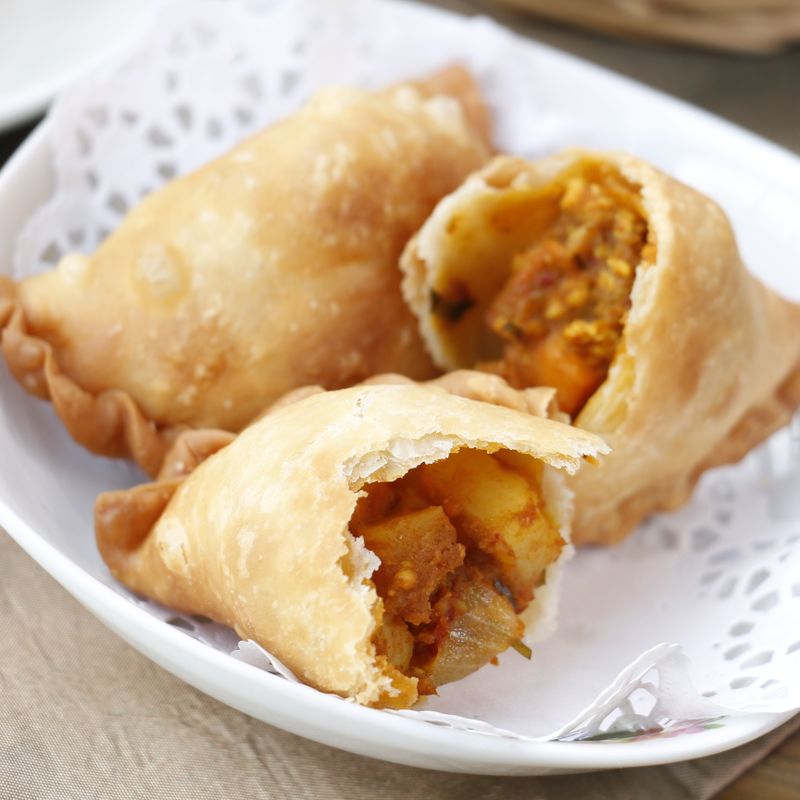
Crisp Samosas with Spiced Potato and Pea Filling
Flaky, blistered homemade samosa pastry wrapped around a fragrant filling of potatoes, sweet peas, cumin, ginger and garam masala. Fried low and slow so the crust turns shatteringly crisp, not greasy.
- Prep
- 45 min
- Cook
- 1 hr 15 min
- Wait
- 40 min
- Total
- 2 hr 40 min
- Makes
- 16 samosas (2 per serving)
Steps
Before you start
- Read the timing: the dough rests 30 minutes, so start the potatoes while it rests to save time.
- The filling must be cool (not warm) before you shape the samosas, or steam will soften the dough and cause tears.
- Fry in 4 batches over low-medium heat. A thermometer makes this much easier; the oil should stay at 320–330°F (160–165°C).
- Set a wire rack over a baking sheet for draining. Paper towels trap steam and make the crust soft.
Mix the dough
- In a large bowl, stir together 250 g (2 cups) flour, 1 tsp salt and the ajwain if using.
- Pour in 60 ml (4 tbsp) oil and rub it into the flour with your fingertips for about 2 minutes, until the mixture looks like damp sand and clumps when squeezed in your fist.
- Add about 100 ml (7 tbsp) cold water, then add more a little at a time until the dough just comes together.
- Knead on the counter for 5 minutes until stiff, smooth and no longer sticky.
+ Show details− Hide details
Ready when: Dough is stiff but smooth, firmer than bread dough, and springs back slowly when poked.
Tip: A firm dough is correct. Soft dough absorbs oil and fries up bubbly and greasy instead of crisp.
Rest the dough
- Cover the dough with an overturned bowl or wrap it in plastic.
- Let it rest at room temperature for 30 minutes.
- Start the potatoes in the next step while it rests.
+ Show details− Hide details
Ready when: Dough feels softer and stretches slightly when pressed.
Boil the potatoes
- Put the potato chunks in a medium pot, cover with cold water by 1 inch (2.5 cm) and add 1 tbsp salt to the water.
- Bring to a boil over medium-high heat, then reduce to medium and simmer for 12–15 minutes.
- Drain well and let the potatoes sit in the colander for 5 minutes so surface steam evaporates.
+ Show details− Hide details
Ready when: A knife slides into the center of a chunk with no resistance, but the chunks still hold their shape.
Tip: Do not overcook. Mushy potatoes make a wet filling that tears the pastry.
Spice the filling
- Heat 30 ml (2 tbsp) oil in a 12-inch skillet over medium heat.
- Add the cumin seeds and cook 30 seconds until they sizzle and darken slightly.
- Stir in the ginger and green chiles and cook 1 minute.
- Add the coriander, turmeric and peas and cook 2 minutes, stirring.
- Add the potatoes and 1 tsp salt, and crush them roughly with a spatula or potato masher, leaving some pea-sized and thumbnail-sized lumps.
- Stir in the garam masala, lemon juice and cilantro and cook 1 minute more.
- Taste and add salt if needed.
+ Show details− Hide details
Ready when: Filling is dry, fragrant and holds together when pressed with a spoon, with no visible liquid in the pan.
Tip: Season boldly. Once wrapped in dough, the filling tastes milder.
Cool the filling
- Spread the filling on a plate or small tray in an even layer and let it cool to room temperature, about 10 minutes.
+ Show details− Hide details
Ready when: Filling feels cool, not warm, when touched.
Roll the dough
- Divide the rested dough into 8 equal pieces (about 48 g each) and keep them covered.
- On a lightly floured counter, roll one piece into a 6-inch (15 cm) circle about 1/16 inch (2 mm) thick.
- Cut the circle in half with a sharp knife to make 2 half-moons.
- Repeat with the remaining pieces.
- Stir 1 tbsp flour and 1 tbsp water together in a small bowl to make a smooth sealing paste.
+ Show details− Hide details
Ready when: Dough is thin enough to see your fingers faintly through it, but not tearing.
Tip: Keep unrolled dough covered; it dries and cracks quickly.
Fill and shape
- Take one half-moon.
- Dab sealing paste along the straight edge.
- Bring the two corners together, overlapping the pasted edge by about 1/4 inch (6 mm), and press to form a cone.
- Hold the cone in your palm and spoon in about 2 tbsp (35 g) filling, packing it gently to the top without overfilling.
- Brush a little paste on the open rim, then pinch the rim firmly shut, pressing out any air.
- Set the samosa upright or on its side on a tray.
- Repeat to make 16.
+ Show details− Hide details
Ready when: Each samosa is fully sealed with no gaps and the seams are pinched tight.
Tip: Skip the paste on the filled rim if it gets wet; too much paste prevents a good seal.
Heat the frying oilOven 325°F / 165°C
- Pour 950 ml (4 cups) oil into a deep, heavy 3-quart pot or wok so it is 2–2½ inches (5–6 cm) deep.
- Heat over medium heat until a thermometer reads 325°F (163°C).
- This takes about 7 minutes.
- Adjust the heat to hold this temperature.
+ Show details− Hide details
Ready when: Thermometer reads 325°F (163°C), and a small dough scrap sinks briefly then rises with slow, steady bubbles.
Tip: Never leave hot oil unattended, and keep the pot no more than half full.
Fry in batchesOven 325°F / 165°C
- Carefully slide 4 samosas into the oil, with room around each.
- Fry over medium-low heat, turning occasionally, for 12–14 minutes, keeping the oil at 300–325°F (150–163°C).
- They should rise slowly and start to blister within 3–4 minutes.
- Lift out with a slotted spoon, letting excess oil drain back into the pot, and move to a wire rack.
- Let the oil return to 325°F (163°C) before frying each of the other 3 batches.
+ Show details− Hide details
Ready when: Deep golden-brown all over, with a blistered surface, and the crust feels hard when tapped with the spoon.
Tip: If they brown in under 8 minutes the oil is too hot; the crust will be pale and soft inside. Lower the heat.
Drain and serve
- Let the samosas drain on the wire rack for 5 minutes so the crust sets and crisps.
- Serve warm with mint-cilantro chutney or tamarind chutney.
+ Show details− Hide details
Ready when: Surface is dry, matte and very crisp.
Tip: Take care with the first bite; the potato filling stays very hot inside.
Good to know
Tips
- Pinch the seams firmly and press out air; trapped air and weak seams cause bursting in the oil.
- Keep the oil at 300–325°F (150–163°C). Too hot gives a pale, doughy inside, and too cool gives a greasy crust.
- Rolling the dough thin (about 2 mm) gives crisp, flaky results, while thick dough fries dense.
- Mash the potatoes coarsely for more texture and flavor, and keep the filling dry.
Make ahead
Make the dough up to 1 day ahead and refrigerate, wrapped well; bring to room temperature for 30 minutes before rolling. The filling keeps 2 days in the fridge. Shaped, unfried samosas can be refrigerated on a tray, covered, for up to 8 hours, or frozen solid on a tray and then bagged for up to 2 months. Fry frozen samosas without thawing, at 300°F (150°C) for 15–18 minutes.
Storage & reheating
Room temperature: up to 4 hours, uncovered, for best crispness. Fridge: up to 3 days in an airtight container. Freezer: up to 2 months. Reheat refrigerated or frozen cooked samosas on a baking sheet in a 375°F (190°C) oven for 10–15 minutes, until hot through and crisp. Avoid the microwave, which makes the crust soft.
Substitutions
- waxy or all-purpose potatoes (such as Yukon Gold) → Russet potatoes. Fluffier and drier; mash very roughly so the filling doesn't turn pasty.
- ajwain (carom seeds) → Omit, or use 1/4 tsp cumin seeds in the dough. Ajwain adds a thyme-like flavor, but the samosas are still good without it.
- fresh lemon juice → 1 tsp amchur (dried mango powder). Traditional tang; add it with the garam masala.
- neutral vegetable oil for deep frying → Bake instead: brush with oil and bake at 400°F (200°C) for 25–30 minutes. Less crisp and more cracker-like, but still good; turn once halfway.