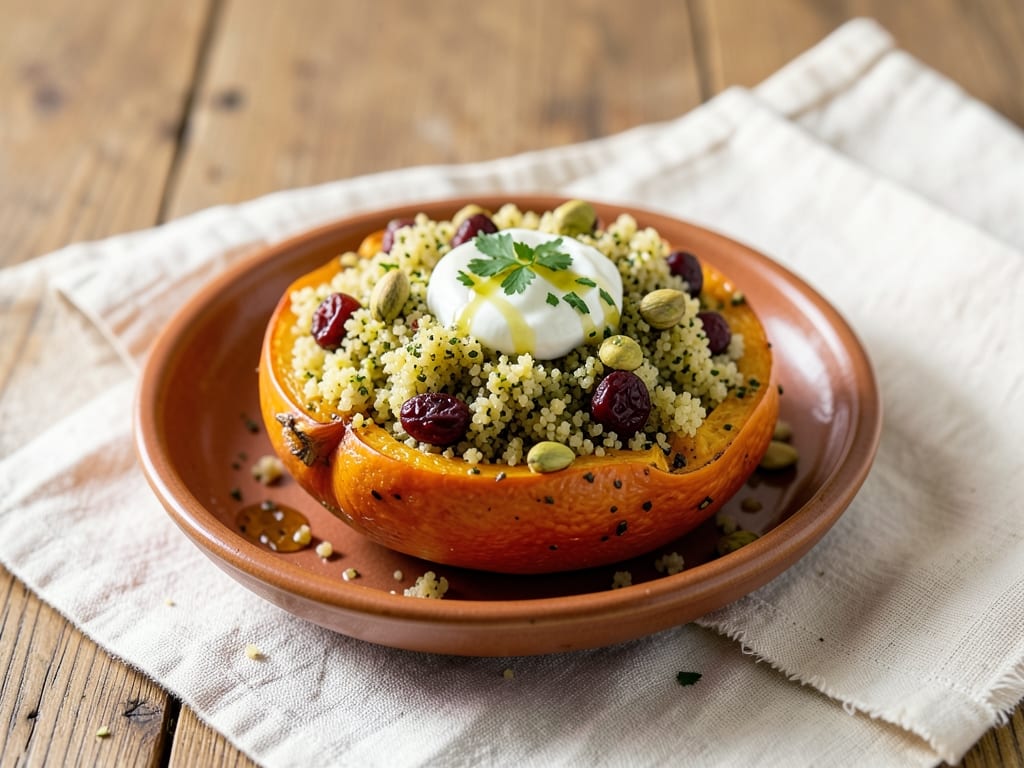
Couscous Stuffed Acorn Squash with Za'atar
Roasted acorn squash halves are piled with fluffy couscous tossed with za'atar, toasted pistachios, sweet dried cranberries, lemon and parsley. It is a cozy, colorful vegetarian main that looks impressive but uses one skillet and one baking sheet.
- Prep
- 25 min
- Cook
- 47 min
- Wait
- 10 min
- Total
- 1 hr 22 min
- Makes
- 4 stuffed squash halves (serves 4 as a main)
Steps
Before you start
- Preheat the oven to 400°F (200°C) with a rack in the center before you cut the squash.
- Use plain small-grain (Moroccan) couscous, not pearl/Israeli couscous or whole wheat, since the steeping time and liquid ratio below are for the plain kind.
- Read the timing: the filling is made on the stovetop while the squash roasts, so have everything chopped and measured before you start.
- Za'atar blends vary in saltiness. The recipe is seasoned for a lightly salted blend; if yours is very salty, reduce the filling salt to ½ teaspoon.
Preheat and cut squashOven 400°F / 205°C
- Position a rack in the center of the oven and preheat to 400°F (200°C).
- Line a large rimmed baking sheet with parchment.
- If the squash feels rock-hard, microwave the whole squash on a plate for 2 minutes to soften the skin.
- Set each squash on its side on a stable cutting board and cut from stem to tip through the ridges into 2 halves.
- Scoop out the seeds and stringy pulp with a spoon.
- Trim a thin slice off any rounded bottom so the halves sit level later.
+ Show details− Hide details
Ready when: Squash halves are cleanly hollowed with smooth, seedless cavities.
Tip: Keep your fingers clear of the blade and cut on a damp towel or non-slip board so the squash can't slide.
Season and roast squashOven 400°F / 205°C
- Mix the squash olive oil and maple syrup in a small bowl.
- Brush it over the cut surfaces and inside the cavities of all 4 halves.
- Sprinkle with 1 tablespoon za'atar, ½ teaspoon salt and the black pepper.
- Place the halves cut side down on the lined baking sheet.
- Roast at 400°F (200°C) for 25 minutes.
- Start the filling while this roasts.
+ Show details− Hide details
Ready when: Cut edges are golden brown and a knife pierces the flesh with little resistance.
Toast the pistachios
- Place a 10-inch (25 cm) skillet over medium-low heat.
- Add the chopped pistachios and toast, stirring often, for 3 to 4 minutes until they smell nutty and look a shade deeper in color.
- Tip them into a small bowl right away to stop the cooking.
+ Show details− Hide details
Ready when: Nuts smell nutty and are lightly toasted, with no dark spots.
Tip: Pistachios go from toasted to bitter fast; don't walk away from the pan.
Cook onion and garlic
- Return the same skillet to medium heat and add the 2 tablespoons olive oil for the filling.
- Add the diced onion and cook, stirring occasionally, for 5 to 6 minutes until soft and translucent with just a few golden edges.
- Stir in the garlic and 2 tablespoons za'atar and cook for 30 seconds, until fragrant.
+ Show details− Hide details
Ready when: Onion is soft and translucent; garlic smells fragrant but is not browned.
Tip: If the garlic starts to brown, lower the heat; burnt garlic turns the whole filling bitter.
Steep the couscous
- Pour the vegetable broth into the skillet, increase the heat to high, and bring to a boil.
- Stir in the couscous, cover with the lid, and remove the pan from the heat.
- Let it stand for 5 minutes.
- Uncover and fluff thoroughly with a fork, breaking up any clumps.
+ Show details− Hide details
Ready when: All the liquid is absorbed and the grains are tender and separate when fluffed.
Tip: Don't stir during the steep; stirring makes couscous gummy.
Finish the filling
- Fold the toasted pistachios, dried cranberries, parsley, lemon zest, 2 tablespoons lemon juice and ¾ teaspoon salt into the couscous.
- Taste and add a little more lemon juice or salt if it tastes flat.
- Fold in the crumbled feta, if using.
- Cover the skillet to keep the filling warm.
+ Show details− Hide details
Ready when: Filling is evenly flecked with herbs and nuts and tastes bright, lightly salty and slightly sweet.
Flip the squashOven 400°F / 205°C
- When the 25 minutes are up, remove the baking sheet from the oven.
- Carefully turn each squash half cut side up using tongs.
- Return to the oven and roast for 10 more minutes, until the flesh is fully tender and lightly caramelized.
+ Show details− Hide details
Ready when: A paring knife slides into the thickest part of the flesh with no resistance.
Tip: Hot steam escapes when you flip the halves; use oven mitts and turn them away from your face.
Stuff and bakeOven 400°F / 205°C
- Spoon the couscous filling into the squash cavities, mounding it generously (about 1 cup per half) and pressing gently so it holds.
- Any extra filling can be served on the side.
- Return to the oven and bake at 400°F (200°C) for 12 minutes, until the couscous tops look dry and slightly crisp and everything is piping hot.
+ Show details− Hide details
Ready when: Couscous tips are lightly golden and the filling is hot throughout.
Tip: If the squash wobbles, nestle it into crumpled foil on the baking sheet to keep it level.
Rest and serve
- Let the squash rest on the pan for 5 minutes so it's cool enough to handle.
- Drizzle each half with the finishing olive oil, add a spoonful of Greek yogurt if using, and sprinkle with extra chopped parsley.
- Serve warm, with a spoon to scoop the squash flesh along with the filling.
+ Show details− Hide details
Ready when: No more steam billows when you scoop in; the squash is hot but comfortable to eat.
Good to know
Tips
- Roasting cut side down first traps steam so the squash becomes creamy-tender; flipping at the end lets the cut edges brown.
- Fluff the couscous with a fork, never a spoon, to keep the grains light and separate.
- Add the lemon juice and herbs to the couscous after it steeps so their flavor stays fresh and bright.
- For a vegan version, skip the feta and yogurt and finish with a drizzle of tahini thinned with lemon juice.
Make ahead
"Roast the squash halves up to 2 days ahead (through the cut side up step), cool, and refrigerate covered. Make the couscous filling up to 2 days ahead and refrigerate separately. To finish, stuff the squash, cover loosely with foil, and bake at 400°F (200°C) for 18 to 20 minutes, uncovering for the last 5."
Storage & reheating
"Room temperature: up to 2 hours. Refrigerator: store leftover stuffed squash in an airtight container for up to 4 days. Freezer: freeze unstuffed roasted squash for up to 2 months; couscous filling freezes for up to 1 month, but texture is best fresh. Reheat in a 350°F (175°C) oven, covered with foil, for 15 to 20 minutes, or microwave a single half for 2 to 3 minutes."
Substitutions
- acorn squash → delicata squash or small honeynut squash. Honeynut halves are smaller and roast in about the same time; delicata can be roasted in boats and needs 5 to 10 fewer minutes.
- plain couscous (small-grain, quick-cooking) → quinoa (cooked) or pearl couscous. Use 3 cups cooked quinoa and skip the broth steep; for pearl couscous, simmer in the broth for 8 to 10 minutes until tender.
- shelled unsalted pistachios → toasted slivered almonds or pine nuts. Use the same weight and toast the same way.
- dried cranberries → chopped dried apricots or golden raisins. Same amount; apricots add a more tart, jammy note.