Classic Lemon Cookies
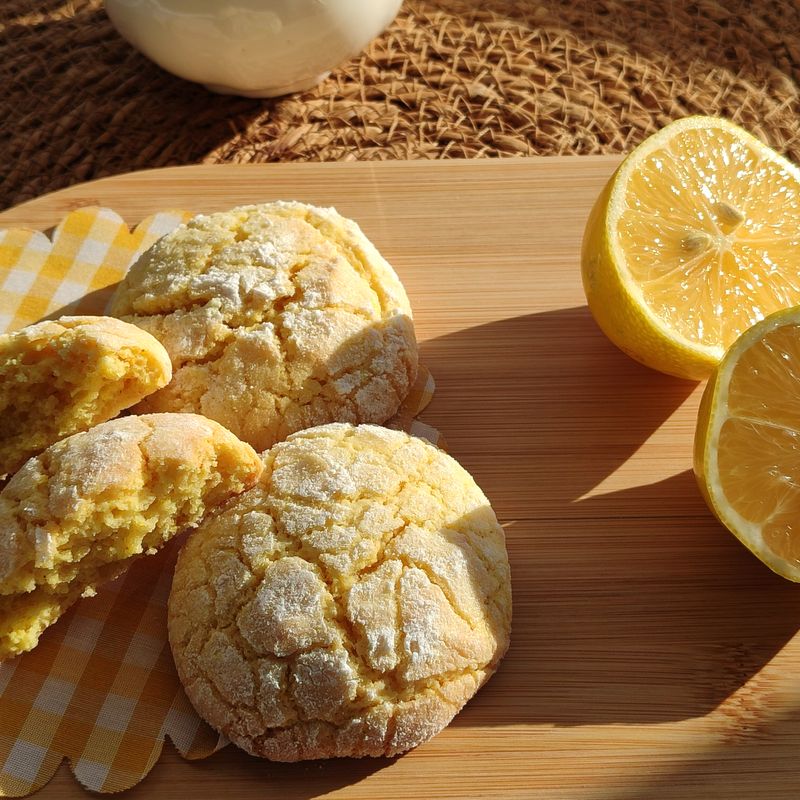
Soft, tender drop cookies with a buttery crumb, bright lemon flavor from zest rubbed into the sugar, and a thin, tangy lemon glaze that sets with a gentle crackle.
- Prep
- 25 min
- Cook
- 24 min
- Wait
- 1 hr 5 min
- Total
- 1 hr 54 min
- Makes
- 24 cookies, about 2½ inches (6 cm) wide
Steps
Before you start
- Set the butter and egg out about 1 hour ahead. The butter should dent easily under a finger but not look greasy (about 65°F / 18°C).
- The dough needs to chill for 30 minutes, and the baked cookies need 15 minutes to cool before glazing. Plan about 2 hours in all.
- Zest the lemons before juicing them. A whole lemon is far easier to zest than a squeezed one.
- Use two rimmed baking sheets. You will bake one sheet at a time.
Zest and juice lemons
- Finely grate the zest from 2 large lemons, yellow part only, to get 1 Tbsp (6 g) for the dough.
- Grate an extra 1 tsp (2 g) into a small separate pile if you want to garnish.
- Halve the lemons and squeeze them.
- Strain out the seeds and pulp, then measure 2 Tbsp (30 ml) for the dough and 2 Tbsp (30 ml) for the glaze.
+ Show details− Hide details
Ready when: You have 1 Tbsp zest, 4 Tbsp (60 ml) strained juice, and the optional extra zest.
Tip: Avoid the white pith under the zest. It tastes bitter.
Rub zest into sugar
- Put the granulated sugar and 1 Tbsp lemon zest in the mixer bowl.
- Rub them together with your fingertips for about 1 minute.
+ Show details− Hide details
Ready when: The sugar looks damp and pale yellow, and it smells strongly of lemon.
Tip: This releases the lemon oils into the sugar and gives much more flavor than stirring the zest in.
Cream the butter
- Add the softened butter to the lemon sugar.
- Beat on medium speed with the paddle or hand mixer for 2 to 3 minutes.
- Scrape the bowl once halfway through.
+ Show details− Hide details
Ready when: The mixture is pale, fluffy, and noticeably lighter in color, with no gritty butter streaks.
Tip: If the butter is too warm and shiny, the cookies will spread thin. Chill the bowl for 10 minutes and try again.
Add egg and lemon
- Add the whole egg, the egg yolk, 2 Tbsp lemon juice, and the vanilla.
- Beat on medium-low speed for about 1 minute, scraping the bowl once.
+ Show details− Hide details
Ready when: The mixture is smooth and uniform. It may look slightly curdled from the lemon juice, which is fine.
Tip: Don't overbeat at this stage. Extra air makes the cookies puff, then collapse.
Whisk the dry ingredients
- In a medium bowl, whisk the flour, baking powder, and salt for 20 seconds until evenly combined.
+ Show details− Hide details
Ready when: There are no clumps of baking powder, and the mixture looks uniform.
Mix the dough
- Add the dry mixture to the butter mixture in 2 additions.
- Mix on low speed just until the flour disappears, 20 to 30 seconds after each addition.
- Finish by folding once or twice with a spatula, scraping the bottom of the bowl.
+ Show details− Hide details
Ready when: The dough is soft and thick, like a scoopable paste, with no dry flour pockets.
Tip: Overmixing develops gluten and makes the cookies tough.
Chill the dough
- Cover the bowl and refrigerate for 30 minutes.
- Meanwhile, line two baking sheets with parchment.
+ Show details− Hide details
Ready when: The dough is firm enough to scoop and hold its shape.
Tip: Chilling longer than 1 hour makes the dough hard to scoop. If it gets too firm, let it sit at room temperature for 10 minutes.
Preheat and scoopOven 350°F / 175°C
- Position a rack in the center of the oven and preheat to 350°F (175°C).
- Scoop the dough into rounded balls, about 1 heaping Tbsp (32 g) each.
- Place 12 balls on each lined sheet, spaced about 2 inches (5 cm) apart.
- Keep the second sheet in the refrigerator while the first bakes.
+ Show details− Hide details
Ready when: You have 24 evenly sized dough balls, 12 per sheet.
Tip: Don't flatten the balls. They will spread on their own.
Bake first batchOven 350°F / 175°C
- Bake the first sheet at 350°F (175°C) for 11 to 13 minutes.
- Rotate the sheet front to back at the 6-minute mark.
- Cool on the sheet for 5 minutes, then move the cookies to a wire rack.
+ Show details− Hide details
Ready when: The edges are set and barely golden, and the tops look matte and pale with a few fine cracks. The centers will still feel soft.
Tip: Pull them when the centers still look slightly underdone. They firm up as they cool, and overbaked lemon cookies turn dry.
Bake second batchOven 350°F / 175°C
- Bake the second sheet the same way, 11 to 13 minutes.
- Use a cooled sheet, or let the first sheet cool and re-line it with fresh parchment.
- Transfer the cookies to the rack and let all cookies cool completely, about 15 minutes.
+ Show details− Hide details
Ready when: The cookies feel cool to the touch on the bottom and hold together when lifted.
Tip: Never put dough on a hot sheet. It will begin melting and spread too much.
Make the glaze
- In a small bowl, stir the powdered sugar and 2 Tbsp lemon juice together until smooth.
- The glaze should fall from the spoon in a thick ribbon that disappears back into itself after about 5 seconds.
- If it is too thick, add more lemon juice a few drops at a time, up to 1 tsp.
+ Show details− Hide details
Ready when: The glaze is smooth, glossy, and thick enough to coat a spoon.
Tip: Add liquid sparingly. Thin glaze runs off and turns see-through.
Glaze and set
- Dip the top of each cooled cookie into the glaze, or spoon about 1 tsp onto each and spread to the edges.
- Let excess drip off, then set the cookies on the rack.
- Sprinkle with the extra lemon zest, if using.
- Let stand for about 20 minutes.
+ Show details− Hide details
Ready when: The glaze is opaque and dry to a light touch, with no smudging.
Tip: Place parchment under the rack to catch drips.
Good to know
Tips
- Weigh the flour if you can. Too much flour is the most common reason lemon cookies turn out dry.
- Use fresh lemons. Bottled juice tastes flat, and the zest provides most of the aroma.
- Bake a single test cookie first. If it spreads too much, chill the dough 15 more minutes. If it stays too tall, flatten the remaining balls slightly.
- For a stronger tang, glaze the cookies twice. Let the first coat dry for 10 minutes, then add a second.
Make ahead
Make the dough up to 2 days ahead and keep it covered in the fridge. Let it sit at room temperature for 10 to 15 minutes before scooping. You can also scoop the dough balls, freeze them on a tray until solid, then store them in a freezer bag for up to 3 months. Bake from frozen at 350°F (175°C) and add 1 to 2 minutes.
Storage & reheating
Store glazed cookies in an airtight container at room temperature for up to 4 days, with parchment between layers. Refrigerate for up to 1 week. Freeze unglazed baked cookies for up to 3 months, thaw at room temperature for 30 minutes, then glaze. To refresh, warm unglazed cookies at 300°F (150°C) for 3 to 4 minutes.
Substitutions
- unsalted butter → salted butter. Use salted butter and omit the ½ tsp salt.
- fresh lemon juice → fresh orange or lime juice. Use the same amount for a different citrus flavor. Keep the lemon zest for the strongest lemon taste.
- large egg yolk → 1 extra tablespoon (15 ml) milk. The cookies will be slightly less rich and a little more cakey.
- all-purpose flour → gluten-free 1:1 baking flour blend. Use the same weight (280 g) and chill the dough for 45 minutes. Cookies may be slightly more crumbly.